
Explore the SAP S/4HANA Procure-to-Pay process and its key stages, from supplier selection and purchase orders to goods receipts, invoice checks and payments.

Purchasing of materials and services is one of the activities that is very important to every business entity. There should be a process put in place that enables the business to purchase through identification of purchasing needs, selection of vendors, making purchase orders, receiving of materials, verification of invoices and making of payments. In case the above activities are handled manually or by disconnected systems, then the business will face many challenges such as delay in purchasing, wrong orders and payment problems.
In SAP S/4HANA, the procurement of goods is done via the Procure-to-Pay process.
The Procure-to-Pay process is the whole purchasing process that begins from the identification of a need by the organization for certain materials and services and ends when the supplier is paid for his/her delivery.
The Procure-to-Pay process in SAP S/4HANA integrates procurement processes with inventory and financial processes. It facilitates the work of purchasers with regard to maintaining data about suppliers, preparing purchases, recording receipt of materials/services and checking invoices.
The key idea behind the P2P process is to ensure that companies buy the right products and pay suppliers properly.
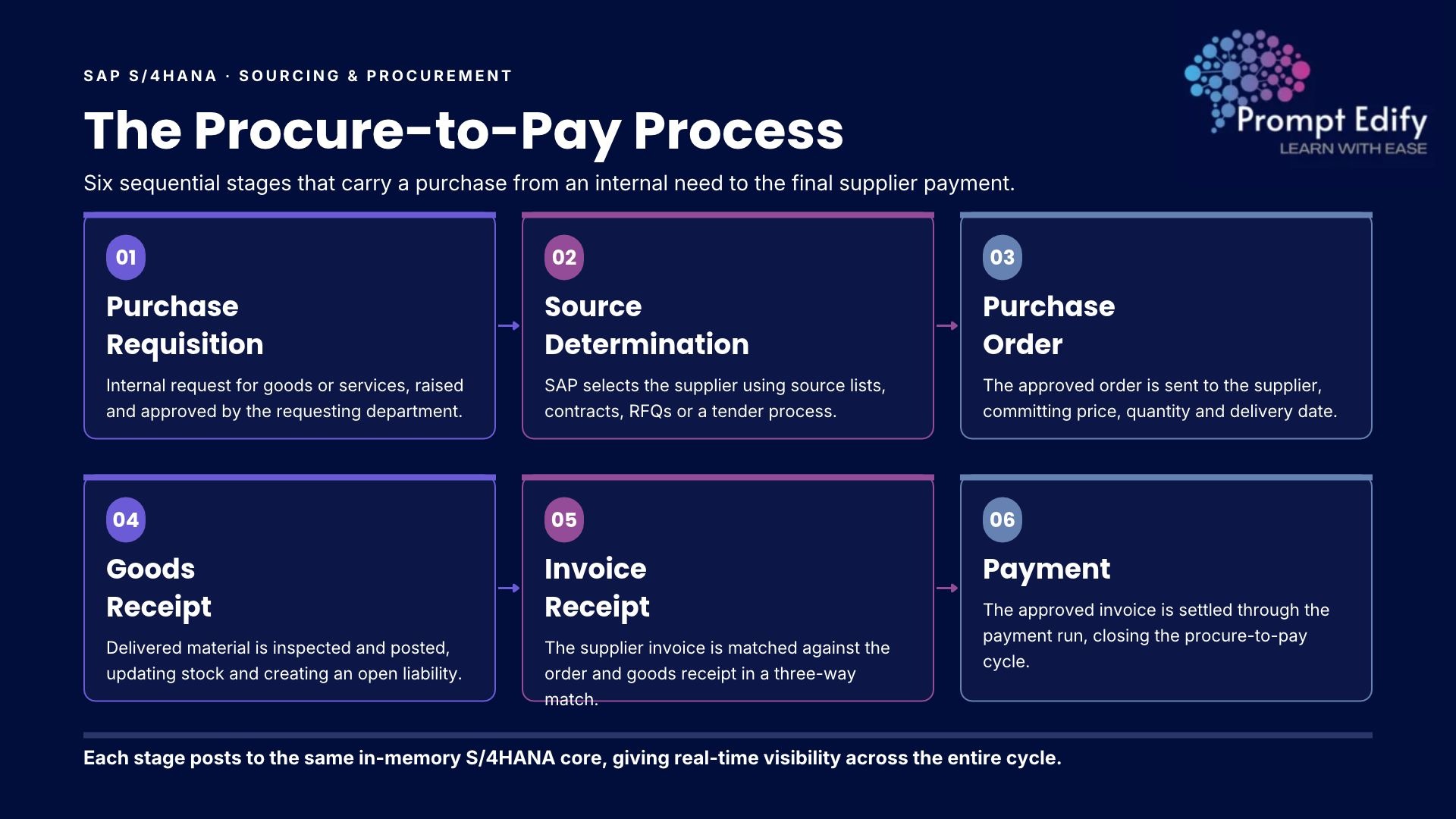
This will enable a person to have an idea of how the procurement process occurs in SAP S/4HANA system.
In this stage, there is the identification of what needs to be procured.
The procurement needs may vary from one department to another based on the individual needs.
For instance, a company manufacturing products will need more raw materials than the IT department which may need more computers.
Procurement need involves:
Once a requirement is found, then the respective department or the individual who needs the material or service creates a purchase requisition (PR).
A purchase requisition is an internal document that conveys the requirement of material or service to the procurement department. It is not an order placed by a supplier.
In SAP S/4HANA, purchase requisitions can be created manually as well as by automatic generation during planning procedures like Material Requirement Planning (MRP).
When the purchase requirement has been approved by the procurement team, the process of selecting a supplier begins.
If the process of selecting the competitive supplier is necessary, then the organization may use a Request for Quotation (RFQ).
In response, the suppliers provide their quotes with prices, delivery times, product description, and business terms.
The criteria on which the quotes are evaluated by the purchasing team are as follows:
Following the vendor selection process, the next thing that should be done is generating the purchase order (PO).
This is because PO is a document used in purchasing, where the supplier receives an order from the company confirming that the organization intends to purchase certain materials or services from the vendor under some conditions.
PO normally has some details such as vendor details, description of the material, quantity, price, scheduling delivery and payment terms.
Purchase order in SAP S/4HANA can be generated using purchase requisition, quotation, and purchasing agreement.
Goods receipt is a process whereby the supplier delivers the purchased material to the business entity.
In this instance, the receiving department checks the material received in terms of quantity through the purchase order.
After this verification process, the goods receipt is then recorded in SAP S/4HANA.
Organizations will gain from this because it enables them to:
For certain material and procurement methods, there can be accounting postings associated with goods receipt.
After the delivery of the goods or services, the supplier sends an invoice for payment.
The AP (Accounts Payable) department checks the supplier’s invoice against the PO (purchase order) and GR (goods receipt) details.
This activity is generally referred to as three-way matching.
The comparison involves:
In case all details match as per the allowed tolerance, then the invoice can be posted, otherwise it is usually blocked until the differences are sorted out.
The last activity involves the payment of the supplier.
Once the invoice is approved and posted, the payment process is completed by paying the total amount according to the payment terms.
The payment process is performed via SAP S/4HANA, which is equipped with features for financial accounting. According to the setting of the organization, payments can be done by creating payment runs, which will determine invoices to be paid, select suitable items, and perform the payments.
The completion of the payment cycle leads to the settlement of the liability to the supplier.
This concludes the Procure to Pay process.
A complete Procure-to-Pay process has certain advantages for organizations:
The procure-to-pay process in SAP S/4HANA includes all major activities related to the entire purchasing cycle from requirement creation to purchasing requisitions to material delivery and payments to the vendor.
Awareness of such activities is helpful for the individuals involved in procurement, purchasing, stock control, accounts payable, and supply chain.
SAP Procurement Course by Prompt Edify
Prompt Edify provides learning programs on SAP that assist professionals and students in understanding the ERP processes and gaining practical knowledge. Enroll in the SAP Procurement Course to learn about procurement documents, vendors, procurement process, material delivery, and invoices.
By Team Prompt Edify
Have any enquiry? Call us
+(27) 740294414
(+91) 99932-86938
wecare@promptedify.com


Prompt Edify Africa (PTY) Limited
2nd Floor, Rivonia VillageCnr Mutual Road and Rivonia Boulevard Rivonia Village, 2191
Johannesburg , South Africa
Contact : +27740294414
Prompt Edify East Africa Limited
KN 78 ST, Kagarama, Kigali, Kigali, Nyarugenge, Umujyi wa Kigali, Rwanda
Contact : +250 727 845 771
Prompt Edify Private Limited
4th Floor #15, City Vista Tower, Fountain Road,
Kharadi, Pune(MH), India.
PIN- 411014
Contact : (+91) 99932 86938



Contact Us Today!
+27740294414 | (+91) 99932 86938 | +250 727 845 771
contact@promptedify.com | wecare@promptedify.com
🌐 https://promptedify.co.za/