
Learn how SAP Ariba Buying simplifies procurement through catalog purchasing, purchase requisitions, approval workflows, purchase orders and spend visibility.

Procurement is one of the key functions which ensures the continuity of the business process. Employees require goods, materials and services for their work whereas the purchasing department is responsible for fulfilling these needs in accordance with the company policy and budget. The problem may arise when purchasing processes are organised with the use of emails and spreadsheets.
In order to address the mentioned problem, SAP Ariba Buying solution can be used. This solution allows employees to buy approved goods and services in a convenient manner while the purchasing process is controlled by the purchasing team. Knowing what SAP Ariba Buying is, how it works and why businesses use it can assist procurement specialists in identifying the significance of this solution for purchasing processes.
SAP Ariba Buying is a procurement solution that facilitates the purchase of goods and services that are needed by an organization. It enables employees to identify approved products or services, place purchase orders, and comply with prescribed purchasing processes. For procurement professionals, it facilitates procurement activities and application of purchasing policies and increased insight into organizational spend.
This procurement solution aims to organize purchasing through the coordination of procurement processes. Based on the configuration of the SAP Ariba platform and the system connectivity within an organization, it can offer catalog-based purchasing, requisitioning, approval, ordering and management of suppliers.
SAP Ariba Buying is especially helpful for organizations that wish to build a standardized purchasing experience.
There are certain features offered by SAP Ariba Buying which could be helpful in supporting various stages of the procurement process. The feature available to an organisation would depend on the edition and configuration of the solution.
Users would have access to pre-approved catalogs where they would have to search for products or services which would help them in performing their job. Catalogs could include details like supplier's products, descriptions, prices, etc. Thus, users would choose products from pre-approved sources rather than trying to find suppliers themselves.
This would document an employee's need before placing an order. Users would be able to specify the product along with other information like quantity, delivery information, etc.
Approval process guidelines may be established depending on expenditure, department, purchasing category or responsibility within an organization. This would ensure appropriate approvals have been obtained prior to the purchasing process.
Following the approval of the requisition, the purchasing process would proceed to the creation and management of the purchase order. The purchase order would include all the purchasing details agreed between the buyer and the supplier. The integration of the system with others could assist in ensuring purchasing consistency.
Purchasing policies can be established within organizations which would encourage people to purchase from approved vendors and through approved purchasing catalogues and procedures. It would discourage any unauthorized purchasing.
Purchasing information can be analyzed by the procurement team to give them insights regarding purchasing practices. The analysis of purchasing information is dependent on reporting capabilities and information system integration.
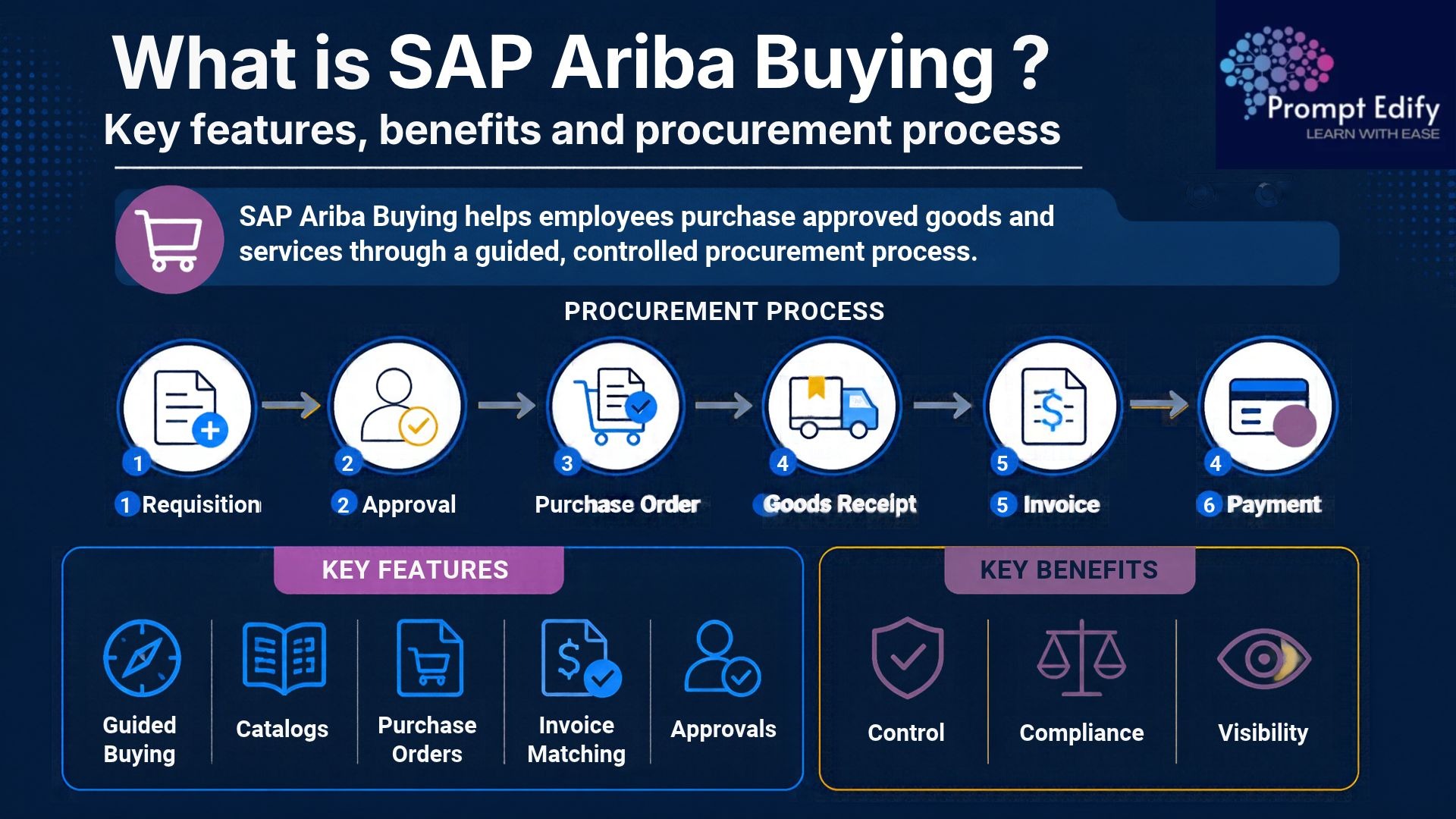
SAP Ariba Buying Workflow process usually involves a number of steps starting from requirement identification and ending with notification of suppliers about approved order.
An employee determines a need for certain products, material or services. The requirements might be related to office supplies, IT equipment, maintenance material or other types of requirements.
An employee selects products or services using available catalogs or purchasing options. He /She evaluates relevant product information, suppliers information and prices and selects the necessary products or services.
Selected products or services are then used to create purchase requisition, during which an employee enters all relevant details such as quantity, destination, costs assignment etc.
Requisition is put forth for evaluation. Depending on the workflow of approval, the right person approves the requisition. Any further evaluation is made in case the requisition has a limit that exceeds the limit.
Once approved, the purchase order is prepared based on the purchase process of the organization. The purchase order carries significant information like items, quantity, price and supplier information.
The supplier is notified about the purchase order through the appropriate communication or integration method and then fulfillment is done. Other steps can be carried out like receiving of goods, processing of invoices and payment.
A structured purchasing approach may bring several benefits to organizations:
The SAP Ariba Buying solution can cater to various organisations irrespective of their sectors and environment. Some common examples of where it can be used by an organisation include procuring office supplies, purchasing hardware and software for IT, maintenance items, and operational equipment as well.
Organisations with various departments and locations may find the process of structured buying beneficial in maintaining purchasing consistency. It is especially useful when an organisation wants its employees to procure items only via authorised sources.
SAP Ariba Buying will allow you to get knowledge on how digital purchasing connects with the needs of employees in terms of requisitions, approvals, and purchase orders. Knowledge gained in this area can also be useful for developing one’s career in the field of procurement and SAP.
Get SAP Ariba Buying Training with Prompt Edify and learn more about the purchasing workflow, features of the solution and procurement process.
By Team Prompt Edify
Have any enquiry? Call us
+(27) 740294414
(+91) 99932-86938
wecare@promptedify.com


Prompt Edify Africa (PTY) Limited
2nd Floor, Rivonia VillageCnr Mutual Road and Rivonia Boulevard Rivonia Village, 2191
Johannesburg , South Africa
Contact : +27740294414
Prompt Edify East Africa Limited
KN 78 ST, Kagarama, Kigali, Kigali, Nyarugenge, Umujyi wa Kigali, Rwanda
Contact : +250 727 845 771
Prompt Edify Private Limited
4th Floor #15, City Vista Tower, Fountain Road,
Kharadi, Pune(MH), India.
PIN- 411014
Contact : (+91) 99932 86938



Contact Us Today!
+27740294414 | (+91) 99932 86938 | +250 727 845 771
contact@promptedify.com | wecare@promptedify.com
🌐 https://promptedify.co.za/