
Explore SAP Ariba Supplier Management, including supplier onboarding, qualification, segmentation, performance, risk management and its benefits for businesses.

For every business to flourish, suppliers are indispensable. Without suppliers, no organization can obtain its required resources such as raw material, products, and many more without which an organization cannot function effectively on a daily basis. However, keeping track of suppliers at times can become difficult as their information is dispersed amongst different departments.
By having SAP Ariba Supplier Management in place, a business will have the ability to maintain relationships with the suppliers by ensuring that it has effective ways of evaluating, processing information, and building relationships with suppliers.
The SAP Ariba Supplier Management is a set of solutions that will assist organizations in managing supplier information, onboarding, qualifying, performance and risk management. The solutions assist organizations in managing suppliers in all phases of the supplier’s lifecycle starting from the selection process until the performance monitoring phase.
Through SAP Ariba Supplier Management solutions, organizations will be able to manage the supplier information without having to manage it via spreadsheets, emails, and documents.
The solutions will also help in the collaboration between the buyer and the supplier through digital means. Through the solutions, organizations will be able to gather information about suppliers and assess the risks.
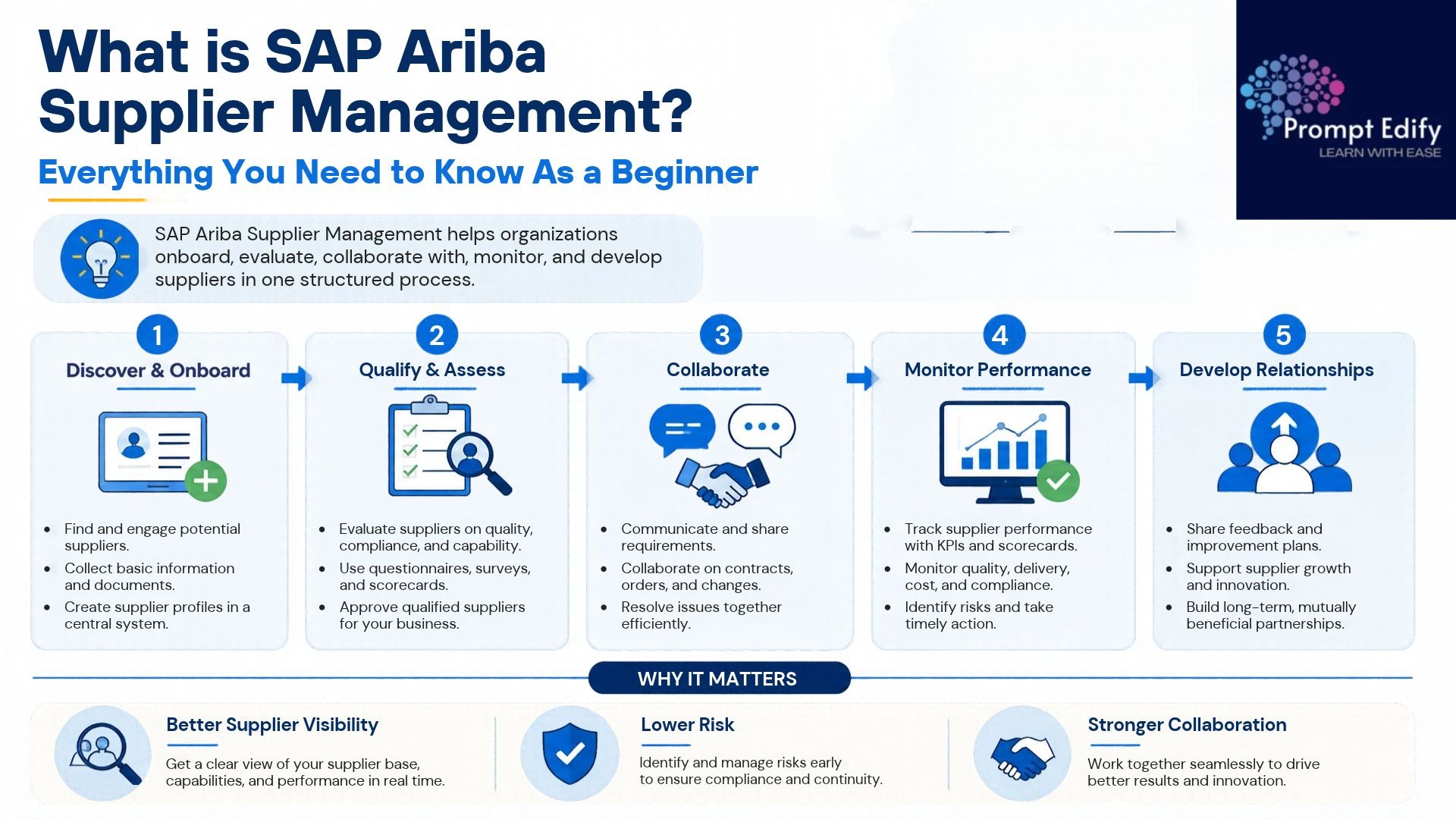
The various activities involved in the identification of appropriate suppliers and maintaining business relationship include:
The first stage includes identification of the supplier and onboarding process.
The organization can receive a request either internally from any of its departments or from the external supplier who wishes to do business with the organization.
Once the request is accepted after due review, the supplier is invited to submit their relevant business information in the form of registration questionnaires.
This information could include organization details, contact details, banking details, business categories, and other relevant documents required by the organization.
SAP Ariba is capable of supporting supplier requests, registration processes and information gathering to facilitate a better onboarding process.
Every supplier may not be the right fit for all business needs. Prior to selecting a supplier, there is a need to assess whether the supplier is meeting the expectations set by the company.
Supplier qualification requires the evaluation of information such as business capability, industry experience, financial stability, regulatory requirement, and quality of product/service.
The SAP Ariba Supplier Management solution provides the ability to qualify suppliers using surveys, assessments, and approvals. Business can qualify suppliers for various categories, geographic areas, and business units.
Supplier segmentation entails sorting the suppliers into groups based on their importance, abilities, categories of operation, geographical locations or organizational needs.
For instance, the organization can sort suppliers into strategic suppliers, preferred suppliers and service providers.
Such segmentation is important because it enables the procurement team to know how to treat various supplier relationships. Additionally, such segmentation makes it easier for the organization to find appropriate suppliers.
The selection of a supplier is only one step towards creating an alliance between both parties. It is essential for organizations to check whether the supplier fulfills its obligations.
Supplier performance management consists of evaluating elements like the delivery time of products, quality of goods, service offered by the supplier, and overall reliability.
The SAP Ariba tool will be able to facilitate evaluations, questionnaires, and ratings according to the availability of configurations.
Collaborating with suppliers is another activity that poses several different kinds of risks. The problems can be financial in nature, regulatory, operational, or non-compliance problems, and may impact the operations of the business.
Supplier risk management assists in recognizing, evaluating and managing potential risks.
The SAP Ariba Supplier Risk solution facilitates risk evaluation and monitoring of the related risks.
Carefully designed supplier management processes ensure several benefits for the organization.
SAP Ariba Supplier Management is used in conjunction with other SAP Ariba solutions for procurement activities.
Examples of such solutions areas are:
All these solutions can be used in combination to link supplier information with the sourcing and procurement activities.
SAP Ariba Supplier Management allows organizations to categorize supplier data, onboarding process, evaluation of their performance, and identifying any risks involved. The use of SAP Ariba will allow an organization to gather all aspects of supplier management into one place and hence increase visibility and make sound decisions.
It is important to understand these aspects by individuals working in the procurement area, sourcing, supply chain management, and SAP.
Expand your knowledge about SAP Ariba by joining Prompt Edify. Get yourself enrolled in professional training provided by Prompt Edify for gaining practical knowledge about SAP applications and business operations.
By Team Prompt Edify
Have any enquiry? Call us
+(27) 740294414
(+91) 99932-86938
wecare@promptedify.com


Prompt Edify Africa (PTY) Limited
2nd Floor, Rivonia VillageCnr Mutual Road and Rivonia Boulevard Rivonia Village, 2191
Johannesburg , South Africa
Contact : +27740294414
Prompt Edify East Africa Limited
KN 78 ST, Kagarama, Kigali, Kigali, Nyarugenge, Umujyi wa Kigali, Rwanda
Contact : +250 727 845 771
Prompt Edify Private Limited
4th Floor #15, City Vista Tower, Fountain Road,
Kharadi, Pune(MH), India.
PIN- 411014
Contact : (+91) 99932 86938



Contact Us Today!
+27740294414 | (+91) 99932 86938 | +250 727 845 771
contact@promptedify.com | wecare@promptedify.com
🌐 https://promptedify.co.za/