
Government sector training in Africa empowers public employees with digital skills, improving transparency, efficiency, and citizen-focused service delivery.

In Africa, the growing demand for transparent and efficient delivery of governmental services is being realized. Factors contributing to the current shift include the fast-rising population, enhanced citizen expectations, and technological change programs. As a result, government sector training and development have emerged as a core priority for ensuring the development of a competent public workforce for the future.
Training enables the government workforce to possess the necessary skills to effectively utilize public resources, increase service delivery, and realize national development objectives.
Various government agencies deal with intricate business activities in relation to finance, purchasing, the workforce, and government service delivery, among others. In some public sector entities, there are still concerns about manual processing, low technology adoption, outdated technology, and a lack of capacity among employees.
When governments implement and start using the ERP system and other technologies like the digital platforms and the e-governance tools, and the data-driven decisions, there arises the pressing need to train in a structured way.
The training provided within the government sector ensures that government employees understand the systems, processes, and policies within which they can work efficiently and responsibly.
Contemporary government operations involve the use of several digital systems aimed at preserving accountability and efficiency. These systems include:
In fact, effective training is important since it allows government officials to make good use of these technologies with fewer mistakes.
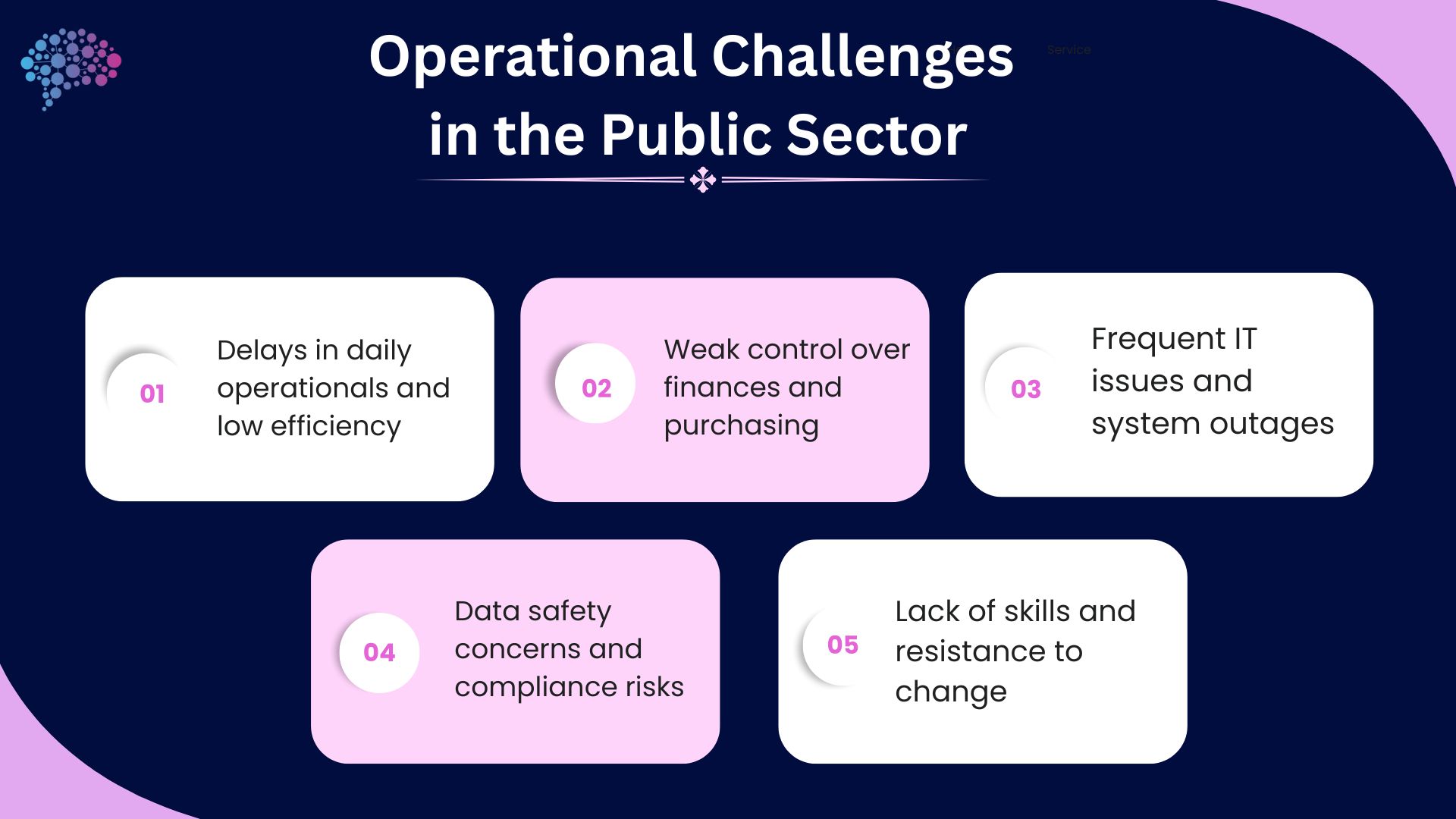
Many government departments are characterized by fragmented systems, poor processes, and a lack of integration among different departments. Such challenges cause delays and inaccuracies in reporting, as well as wastage of resources.
Effective management of public finances must have control, transparency, and readiness for auditing. Lack of training on ERP and procurement can result in difficulties in tracking finances, vendor administration, assets, and public finance administration.
The absence of standard processes for providing IT services causes various issues, including system downtime, slowness in resolving incidents, and unstable online services.
The government institutions deal with rather sensitive information, like that of citizens and national data. Lack of awareness regarding cybersecurity hampers safety against data breaches, cyber attacks, and non-compliance with regulations.
Not many public servants undergo system-specific training. This causes them to be reluctant towards digital initiatives and less productive.
The Prompt Edify is offering training programs specific to the governmental sector to handle specific operations within public institutions in Africa.
Other SAP role-specific trainings include SAP S/4HANA Public Sector Finance for financial reporting, Spend Visibility, SAP MM for purchasing and receiving goods & services, asset management, and report generation. These training programs will enhance financial visibility, efficiency in the purchasing process, and audit readiness.
ITIL Training can help the IT departments within the government to implement best practices for the management of services such as availability, issue resolution, and support for electronic government services.
Skills training in Microsoft Excel, Office, Teams, SharePoint, and Power BI allow government workers to make accurate reports and informed decisions based on data analysis.
Workers in the public sector acquire basic knowledge in cloud computing, cybersecurity best practices, protecting data, and safe system usage, which aids in protecting sensitive information in the government.
These courses include public sector compliance obligations, audit documentation processes, risk management fundamentals, and alignment of business processes with government regulations and standards.
There are government institutions that invest in structured training, and these institutions have seen the following benefits:
In the end, the well-trained public servant is key to having good public institutions.
Government sector training is no longer optional, but the a need for the foundation for sustainable governance and transformation. A trained and informed public sector is the key for governments to effectively deal with the economic challenges, changes in policies, and public needs. Prompt: The training programs offered by Edify to the government sector are aimed at enabling African public sector organizations to build a competent and compliant workforce that is digitally empowered to deliver efficient and transparent public services.
By Team Prompt Edify
Have any enquiry? Call us
+(27) 740294414
(+91) 99932-86938
wecare@promptedify.com

Prompt Edify Africa (PTY) Limited
2nd Floor, Rivonia VillageCnr Mutual Road and Rivonia Boulevard Rivonia Village, 2191
Johannesburg , South Africa
Contact : +27740294414
Prompt Edify East Africa Limited
KN 78 ST, Kagarama, Kigali, Kigali, Nyarugenge, Umujyi wa Kigali, Rwanda
Contact : +250 727 845 771
Prompt Edify Private Limited
4th Floor #15, City Vista Tower, Fountain Road,
Kharadi, Pune(MH), India.
PIN- 411014
Contact : (+91) 99932 86938



Contact Us Today!
+27740294414 | (+91) 99932 86938 | +250 727 845 771
contact@promptedify.com | wecare@promptedify.com
🌐 https://promptedify.co.za/