
Africa’s healthcare training equips professionals with digital, operational, and compliance skills to improve patient care, efficiency, and system reliability.
.png)
The drivers of the changing face of Africa's healthcare include population growth, increasing healthcare demand, adoption of digital health, regulatory imperatives, and operational efficiency needs. As a result, a leading number of hospitals, clinics, laboratories, pharmaceutical companies, public health institutions, and health insurance providers are adopting technology to deliver quality, compliant, and patient-centric services.
This transformation is supported by a growing demand for structured training in the healthcare sector, particularly in the technical, operational, and digital competencies of health professionals in modern health settings.
The modern healthcare institution has an ecosystem that brings together various areas of clinical services with deep IT systems, regulatory compliance, security of data, and financial accountability. Most healthcare organizations on the African continent have some of the major prevailing challenges as limited digital skills, inefficient processes, system downtime, data management issues, and risks of regulatory compliance.
The training in the healthcare sector bridges this gap by making the professional understand and operate healthcare systems efficiently, thus maintaining patient safety, data integrity, and service quality.
Some of the many digital systems modern healthcare organizations depend on to make daily operations effective include:
It is at this point that Hospital Information Systems and Electronic Medical Records begin to play their role.
It means that effective training enables care staff to feel confident in using these systems correctly, minimizing errors and enhancing operational efficiency.
Most healthcare facilities face challenges related to manual processes, fragmented systems, and poorly designed workflows, which hinder their efficiency. These inefficiencies, on the other hand, may cause delays in patient service delivery, inaccurate reporting, and poor coordination between finance, procurement, and IT departments.
Hospitals and other healthcare providers have to manage huge inventories of medical equipment, consumables, and pharmaceuticals. In the absence of adequate SAP or ERP training, an organisation faces challenges in procurement planning, inventory tracking, asset maintenance, and audit readiness.
Poor-performing IT teams commonly have no standardized processes for incident management, change control, and service desk. The aftermath of this negligence is system downtime, delayed issue resolution, and eroded trust in digital systems among healthcare professionals.
Healthcare data is highly sensitive. Poor cybersecurity awareness increases the risk of data breaches, ransomware attacks, and non-compliance with data protection regulations that can destroy patient trust and institutional credibility.
Many clinicians have minimal onboarding or system-specific training. This leads to underutilization of technology, low productivity, and resistance to digital transformation initiatives.
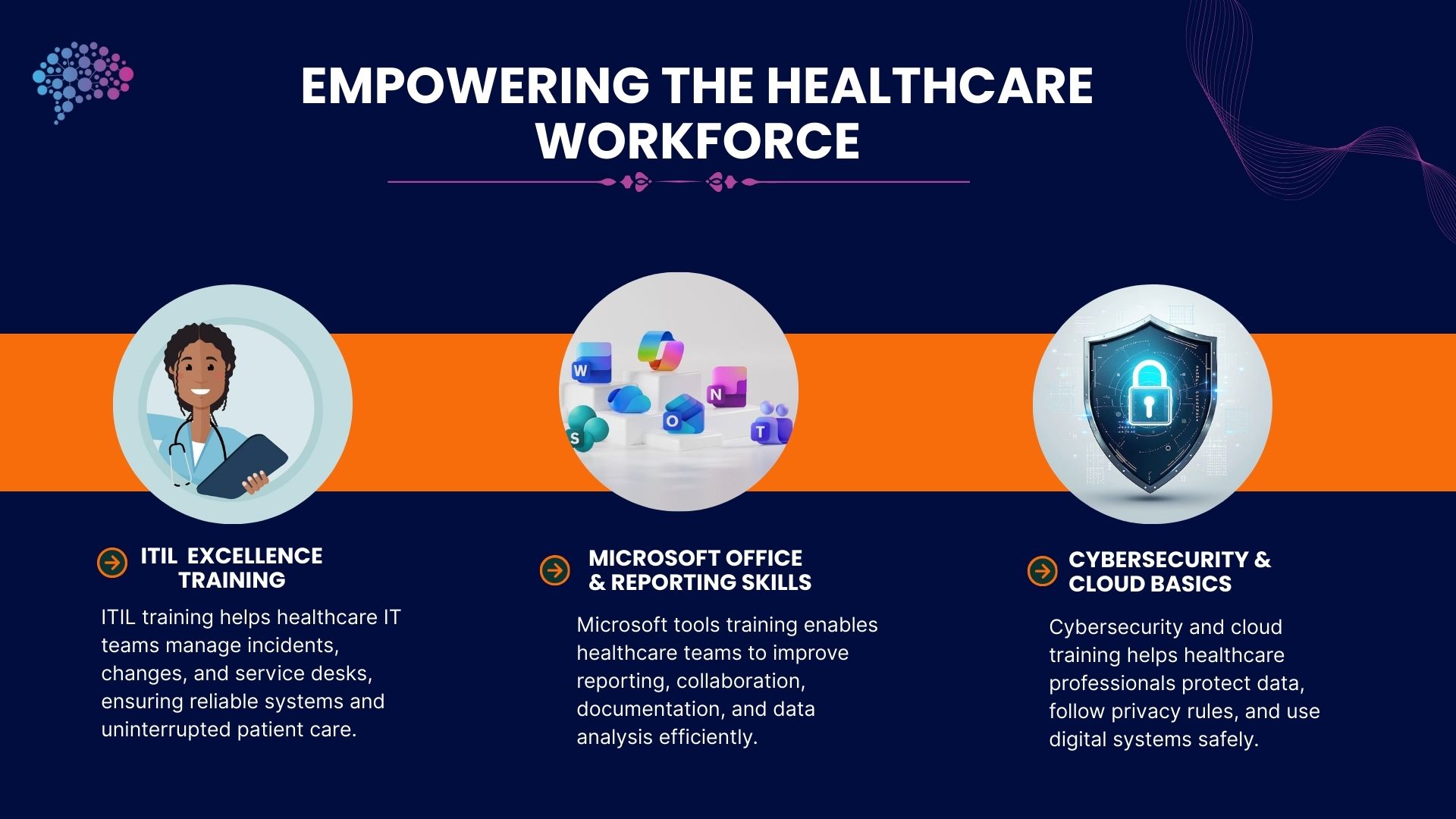
Prompt Edify provides health care sector-specific training programs designed to respond to the peculiar needs of health care institutions across Africa.
Role-based SAP training includes SAP S/4HANA End User, SAP Finance-FICO, SAP MM, Procurement, Inventory Management, and Asset Tracking. The programs will help healthcare organizations increase financial accuracy, control procurement processes more efficiently, and ultimately provide audit-ready records.
ITIL training provides a mechanism for healthcare IT groups to adopt service management practices for incident management, problem management, change control, and service desk operations that ensure systems are reliable and allow continuity of care.
Productivity Tools Training - Microsoft
Training in MS Excel, MS Office, Teams, SharePoint, and Power BI increases the ability of individuals to apply such software for effective reporting, collaboration, documentation, and analysis in health departments.
Introduction to Cloud and Cybersecurity Training
Cyber
Healthcare professionals are implementing the knowledge gained from training on cybersecurity awareness, the principles of data privacy, the basics of cloud computing, and safe system use.
Training programs also cover compliance requirements in healthcare, audit documentation, handling of patient data, risk management principles, and operational workflows in line with healthcare standards.
Healthcare institutions that have invested in structured training experience measurable improvements, including:
Training in the healthcare sector is no longer an option but an institutional strategy to accomplish the goal of safe, efficient, and technology-based health services. The right competence of the professionals enables operational resilience, improved outcomes, and successful digital transformation. Prompt Edify's training programs in the healthcare sector are designed to equip African healthcare institutions with competent, compliant, and digitally skilled teams to meet the current demands of modern-day healthcare services.
By Team Prompt Edify
Have any enquiry? Call us
+(27) 740294414
(+91) 99932-86938
wecare@promptedify.com

Prompt Edify Africa (PTY) Limited
2nd Floor, Rivonia VillageCnr Mutual Road and Rivonia Boulevard Rivonia Village, 2191
Johannesburg , South Africa
Contact : +27740294414
Prompt Edify East Africa Limited
KN 78 ST, Kagarama, Kigali, Kigali, Nyarugenge, Umujyi wa Kigali, Rwanda
Contact : +250 727 845 771
Prompt Edify Private Limited
4th Floor #15, City Vista Tower, Fountain Road,
Kharadi, Pune(MH), India.
PIN- 411014
Contact : (+91) 99932 86938



Contact Us Today!
+27740294414 | (+91) 99932 86938 | +250 727 845 771
contact@promptedify.com | wecare@promptedify.com
🌐 https://promptedify.co.za/