
Learn why ITIL 4 Foundation strengthens employability in Tunisia’s IT sector by building service management skills for global outsourcing and cloud operations.
.png)
Tunisia has become one of North Africa’s fastest-growing digital talent hubs. The country hosts software outsourcing companies, telecom operators, fintech startups, government digital programs, and European service delivery centers. Cities like Tunis, Sfax, and Sousse are now recognized for IT support, cloud operations, and application management services.
Yet despite strong technical education, many IT professionals face a career growth barrier.
They learn networking, programming, or system administration—but employers increasingly ask for something else: service management understanding.
This creates confusion in the market.
Many candidates believe certifications must always be technical (Cisco, Microsoft, AWS). At the same time, companies complain that teams cannot manage incidents, coordinate changes, or communicate service impact to customers. Technical skills exist, but operational maturity is missing.
This is exactly where the ITIL digital transformation framework becomes important in Tunisia’s job market.
ITIL does not replace technical expertise. It connects technical work to business value. Employers hiring support engineers, cloud administrators, and operations analysts now prefer professionals who understand services—not just systems.
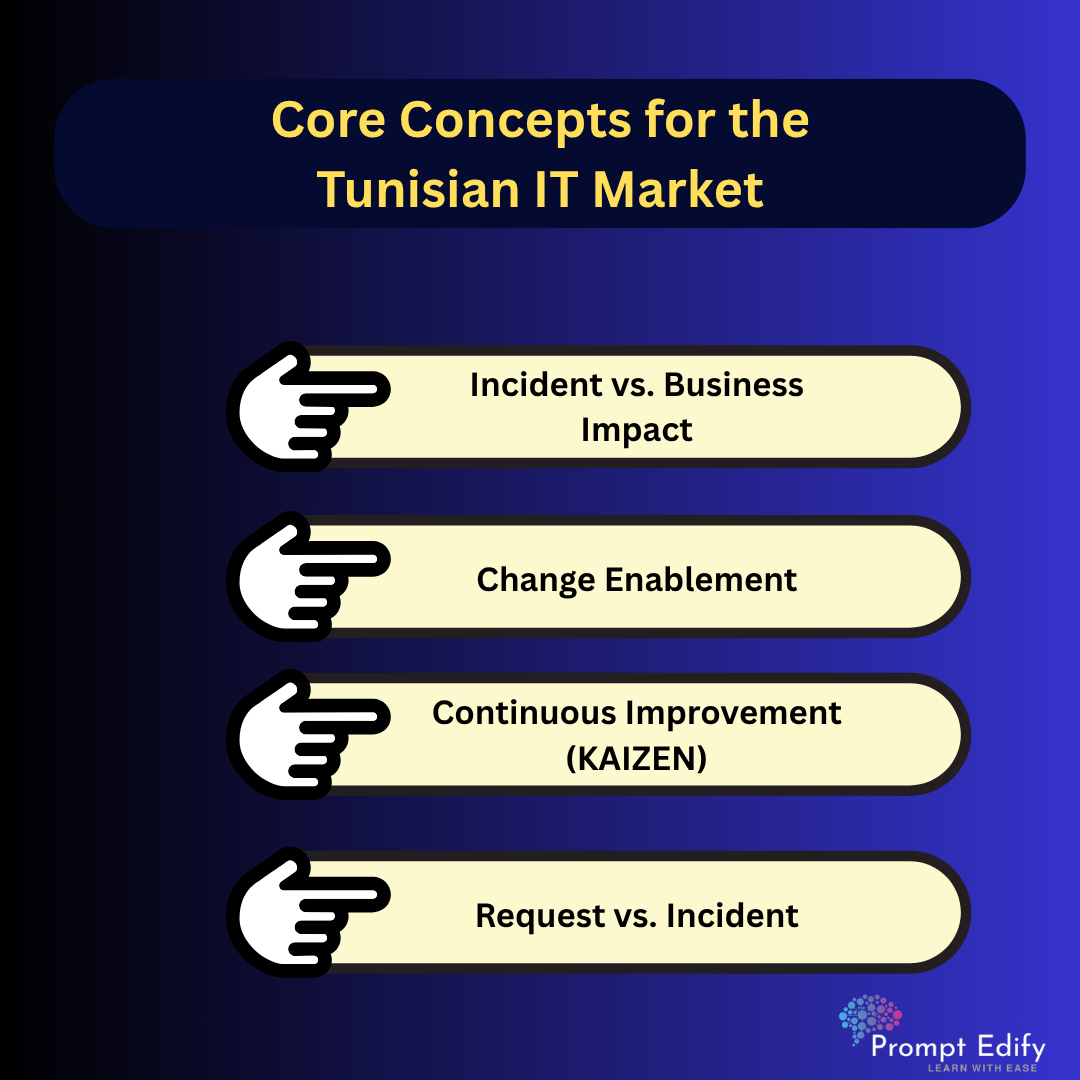
Tunisia’s digital economy is strongly linked to international outsourcing and managed services. Many organizations provide remote IT operations for European banks, telecom providers, and SaaS companies.
Because of this, companies must follow structured service standards.
Typical roles now require:
Without structured items based on ITIL 4, engineers struggle to adapt to real operational environments.
A graduate may know Linux or networking perfectly but fail interviews because they cannot explain priority levels, service impact, or escalation procedures. Employers increasingly evaluate operational thinking, not only technical knowledge.
This is why ITIL certification is becoming a baseline requirement for entry-level and mid-level IT roles in Tunisia.
The ITIL evolution from ITIL 4 changed how organizations hire talent.
Older IT environments separated support, infrastructure, and development. Today they operate integrated service teams.
Companies no longer want a technician who only fixes tickets.
They want a professional who understands service continuity.
With ITIL 4 Foundation, candidates learn:
This knowledge dramatically improves employability because outsourcing providers need staff who can interact with international clients professionally.
For many Tunisian professionals, ITIL training certification becomes the first step from technical operator to service professional.
Tunisia is expanding into cloud support, DevOps operations, and SaaS platform management. These roles require coordination across multiple teams and time zones.
The ITIL framework for digital IT provides a shared language.
When a customer in Europe reports downtime, teams in Tunisia, France, and Germany must interpret severity the same way. Without a common framework, responses become chaotic.
ITIL provides structure to daily work:
Because outsourcing contracts depend on reliability, companies increasingly shortlist candidates who already understand itil practices.
Many Tunisian companies now manage hybrid cloud environments and AI-supported monitoring platforms. Alerts are generated automatically, but humans must interpret service impact.
ITIL cloud and AI governance ensure professionals can translate technical events into service decisions.
For example, a server alert does not always mean a service outage.
A professional trained in ITIL training evaluates business impact before escalating.
This ability is highly valued because companies want fewer false escalations and better communication with international clients.
In recruitment interviews today, employers often test scenario thinking rather than command knowledge.
That shift explains the rising demand for ITIL 4 Foundation certification.
Even with automation and AI tools, core career principles remain constant:
Technology changes quickly, but service discipline does not.
This is why itil certification remains relevant across decades while specific tools evolve.
A professional trained in service management adapts easily to new platforms, while tool-dependent knowledge becomes outdated faster.
Over the next few years, Tunisia’s IT sector will shift toward higher-value services: cloud operations centers, cybersecurity monitoring, managed SaaS platforms, and digital government projects.
The ITIL future roadmap aligns with these roles by focusing on value streams and continuous improvement rather than rigid processes.
Professionals with itil training certification will be positioned for roles such as
Service Desk Analyst → Service Coordinator → Service Manager
Operations Engineer → Reliability Analyst → IT Operations Lead
This progression happens because ITIL knowledge demonstrates operational maturity, something international employers expect when outsourcing critical services.
Many candidates ask whether they should start with technical certification first.
In Tunisia’s outsourcing-driven market, combining both works best.
Technical skills help you perform tasks.
ITIL helps you understand why the task matters. I help you understand why the task matters.
Recruiters increasingly view ITIL certification as proof that a candidate can work in structured environments and communicate professionally with global customers.
For fresh graduates, ITIL 4 Foundation often opens doors to the first job.
For experienced engineers, it supports promotion into coordination and leadership roles.
Tunisia’s IT industry is evolving from technical support outsourcing to managed digital services. Employers are no longer hiring only problem solvers—they are hiring service managers at every level.
The ITIL digital transformation framework provides the bridge between technical knowledge and business value. It helps professionals understand service impact, improve communication, and operate within global service standards.
For individuals, earning an itil certification strengthens career opportunities across cloud, telecom, SaaS, and enterprise support roles.
For organizations, adopting items based on itil 4 improves reliability and client trust.
In the 2026 outlook, Tunisian IT careers will grow not just through coding or networking expertise but through service understanding. And that understanding begins with itil 4 foundation and structured ITIL training certification.
By Team Prompt Edify
Have any enquiry? Call us
+(27) 740294414
(+91) 99932-86938
wecare@promptedify.com


Prompt Edify Africa (PTY) Limited
2nd Floor, Rivonia VillageCnr Mutual Road and Rivonia Boulevard Rivonia Village, 2191
Johannesburg , South Africa
Contact : +27740294414
Prompt Edify East Africa Limited
KN 78 ST, Kagarama, Kigali, Kigali, Nyarugenge, Umujyi wa Kigali, Rwanda
Contact : +250 727 845 771
Prompt Edify Private Limited
4th Floor #15, City Vista Tower, Fountain Road,
Kharadi, Pune(MH), India.
PIN- 411014
Contact : (+91) 99932 86938



Contact Us Today!
+27740294414 | (+91) 99932 86938 | +250 727 845 771
contact@promptedify.com | wecare@promptedify.com
🌐 https://promptedify.co.za/