
Learn how ITIL 4 enables Angolan banking teams to stabilize transactions, govern AI and cloud platforms, and build trusted, always-available fintech services.
.png)
Banking and financial technology in Angola are being driven by the growth of digital technologies. Payment options like mobile wallets, online banking, real-time payments, and app-based services are becoming commonplace throughout Luanda and other expanding urban communities. Customers want to be able to pay for things with or without a branch in the evenings and on weekends, as well as on holidays if applicable.
However, there are still some concerns raised at several of the financial institutions in Angola regarding the necessity of having ITIL (Information Technology Infrastructure Library) in place for those institutions using a cloud-based, automated core banking software system.
Many IT departments believe that most of the operational processes in their banking system have been embedded into the modern core banking software solution; therefore, the relevance of ITIL-4 Foundation falls solely on the technical support desks of the bank (not on the digital product teams). This misinterpretation is what results in recurring outages whenever an update occurs, failed integrations of the banking APIs, and slow incident coordination between vendors (i.e., service providers).
Trust is essential in any form of digital banking/finance, as even a brief disruption of a payment system can negatively impact thousands of end-users or damage an institution's reputation. The ITIL digital transformation framework is designed to aid institutions in avoiding such occurrences by providing digital financial services that are reliable, auditable, and continually improving.
The financial landscape in Angola is progressing past normal banking practices. FinTech companies, mobile payments, and companies that provide access to capital are all providing higher access to financial services. As banks connect to telecom and payment networks to provide customers a better means of doing business, there is an increase in operational complexities across multiple platforms that rely on a single API or authentication service to perform transactions. While technical teams perform due diligence, trying to restore operations quickly, the same issue reoccurs because root causes are not being tracked systematically.
Implementation of ITSM disciplines is paramount in this situation. The ITIL framework for digital IT lends itself to a lifecycle approach to managing services by designing services properly, changing services in a controlled manner, monitoring service operational performance, and continually improving processes. Rather than reacting to incidents in the services provided, companies are minimizing the risk of being reactive.
Financial services firms that have implemented ITIL certification training realize that they can develop a single service model that captures all vendors, developers, infrastructure, and compliance departments working in conjunction with each other.
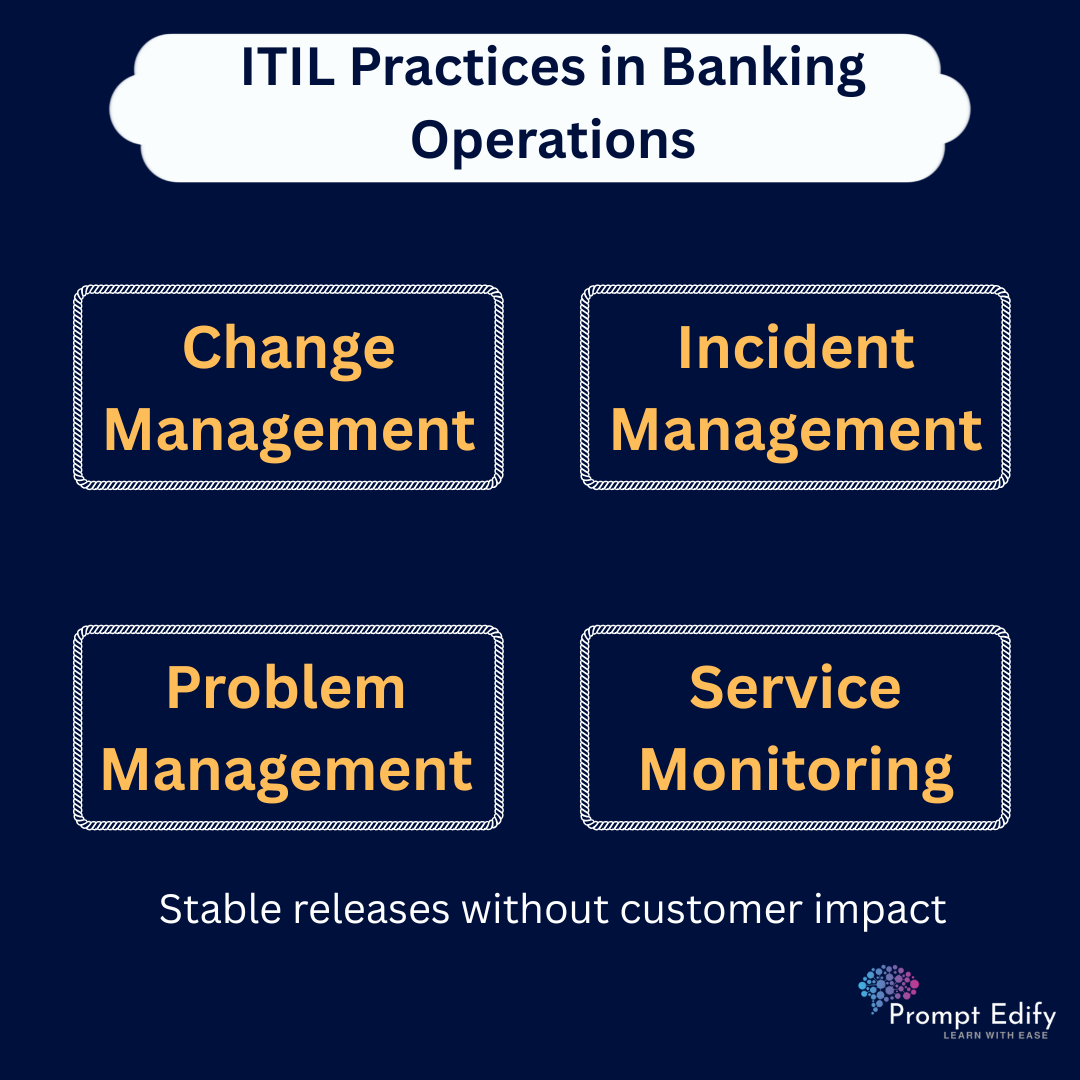
Digital banking has progressed beyond simply implementing software to now delivering services continuously. Customers measure reliability as the number of successful transactions and speed of responses, with no formalized process to follow. Using "rapid development cycles" could cause instability.
The purpose of ITIL training is to help professionals create synergy between technology operations and their customers’ experience and regulatory compliance. The ITIL evolution from ITIL 4 provides assistance for Agile and DevOps workflows, facilitating accelerated release cycles while still controlling change.
With ITIL providing controlled change management, for example, when mobile applications are released, payment methods are integrated, or database modifications are made, all can occur without adversely affecting customers. Using project management and ITIL-certified teams enables teams to anticipate risks and resolve issues before they happen, rather than reacting to them once they've occurred.
Increasingly, Angolan banks utilize cloud hosting, fraud detection algorithms, and AI-based analytics for their operations. While there are benefits to these technologies in terms of improving performance, there are also challenges around accountability due to the lack of traceability for automated decisions and compliance with financial regulatory requirements.
The approach to IT governance via ITIL for cloud and AI (artificial intelligence) is designed to help ensure that all financial services can operate transparently and securely. All organizations must establish the appropriate approval workflows, monitoring checkpoints, fallback procedures, etc. before the use of automation in making real-time decisions that affect actual transactions.
By utilizing ITIL 4 practices, financial institutions can manage:
Automated fraud detection transactions
Real-time transaction processing systems
Vendor-managed payment platforms
By implementing this governance structure, customer data is protected, and service availability is continuous. This is critical in the financial services environment because downtime equates to loss of revenue and loss of trust.
The number of roles available for individuals with skills in service management will increase exponentially as demand increases within the banking and fintech communities of Angola. This includes banks and digital payment companies and service-oriented roles at all levels, from entry-level through upper-level management.
Today’s organizations want to hire employees who are knowledgeable about technology and its impact on operations. As a result, ITIL 4 Foundation Certification is serving as an entry-level certification for many roles, such as digital banking operations analysts, service reliability coordinators, and IT governance officers. With ITIL training, individuals can begin gradually transitioning from technical roles to decision-making positions—that is, positions that drive the quality of services delivered through the organization.
In many cases, it is possible to progress from technical support and/or infrastructure management through service delivery management. As collaboration continues among financial services companies worldwide, the use of standardized frameworks (e.g., ITIL) allows for greater employability and career mobility within organizations.
The ITIL Roadmap will align with future developments in open banking, API ecosystems, and cross-platform technology solutions within Angola's financial services sector. Much like many other developing nations, Angola is expected to see a rise in digital payment solutions and, as such, create regional networks of financial institutions that are capable of operating together in a compliant, always-available system.
ITIL provides all departments within an organization and all stakeholders with a consistent, usable operational language. Consequently, organizations that implement ITIL will be able to operate as coordinated service organizations rather than independent service units. This will ultimately provide a more rapid response time to customer requests and incidents, reduce the organization's exposure to operational risks, and enhance the organization's ability to meet customer confidence expectations.
Using ITIL to enhance outcomes and support the innovation process, organizations will have the ability to safely manage change and communication, rather than stifling or hindering innovation.
Banks and fintech in Angola are moving into an era where reliable services are just as important as innovative services. Cloud infrastructure and automation are great ways to increase operational speed; however, without proper governance models structured within the cloud service and automated processes, these services may become unstable.
Using the ITIL Digital Transformation Framework helps ensure financial institutions continue to deliver their digital services consistently, securely, and with a strong emphasis on the customer experience. By implementing ITIL, IT Service Management, and ITIL 4 Foundation best practices in their organization, they can offer a broader range of digital services while continuing to build trust with customers.
By Team Prompt Edify
Have any enquiry? Call us
+(27) 740294414
(+91) 99932-86938
wecare@promptedify.com


Prompt Edify Africa (PTY) Limited
2nd Floor, Rivonia VillageCnr Mutual Road and Rivonia Boulevard Rivonia Village, 2191
Johannesburg , South Africa
Contact : +27740294414
Prompt Edify East Africa Limited
KN 78 ST, Kagarama, Kigali, Kigali, Nyarugenge, Umujyi wa Kigali, Rwanda
Contact : +250 727 845 771
Prompt Edify Private Limited
4th Floor #15, City Vista Tower, Fountain Road,
Kharadi, Pune(MH), India.
PIN- 411014
Contact : (+91) 99932 86938



Contact Us Today!
+27740294414 | (+91) 99932 86938 | +250 727 845 771
contact@promptedify.com | wecare@promptedify.com
🌐 https://promptedify.co.za/