
Discover why Tanzanian public agencies adopt ITIL 4 to stabilize digital portals, manage cloud platforms, improve citizen trust, and build modern service management careers.
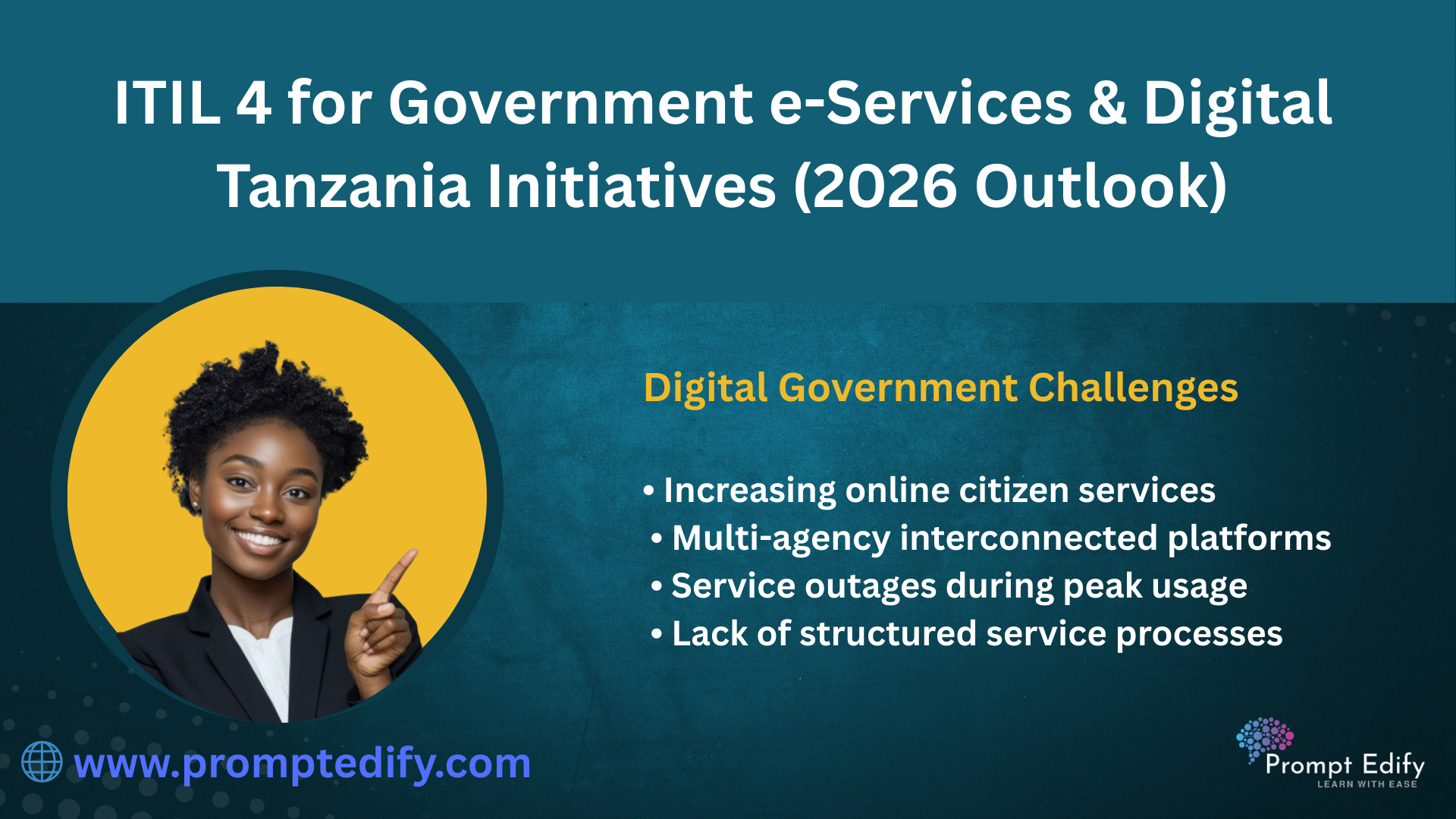
Government agencies throughout Tanzania are implementing digital transformation at an increasing rate. Citizens are now looking for ways to access services online, such as filing taxes, registering businesses, viewing healthcare records, obtaining licenses, and accessing educational resources, rather than going into an office. Several ministries and agencies continue to be confused about whether a current digital platform requires an ITIL framework or whether their use of cloud hosting and SaaS products will be able to accomplish service management independently.
Some IT teams see the transition to cloud and automation resulting in the elimination of structured processes; others see the ITIL 4 Foundation, at best, as applicable only to the private sector or help desk environments and not to public digital services. The misunderstanding of the application of the framework has resulted in unstable services being delivered to the citizenry and significant delays in delivering updates; this has also caused frustration among citizens when portals go down due to high usage.
The Digital Tanzania initiative aims to provide access to government services via the internet for citizens and businesses throughout Tanzania by using cloud platforms and centralized databases, as well as integrated payment methods. While this helps with access to government services, it also creates additional complexity for government operations.
Government agencies need to use multiple vendors, interconnected databases, or shared infrastructure to deliver services electronically. If one component fails, it could cause one or more government services to terminate at the same time. Technical teams will often be able to fix the problem; however, due to no existing service management process, there is currently no means to prevent the reoccurrence of these types of issues.
Using IT Service Management (ITSM) processes will help facilitate the delivery of digital government services. The ITIL (IT Infrastructure Library) framework helps introduce lifecycle management for companies that use digital services. This includes management of service design, change management, service monitoring, and continual service improvement processes as they occur during upgrades and peak usage times.
If a structured approach is not taken with digital government services, the loss of trust by citizens could result in far greater loss than any technical failure.
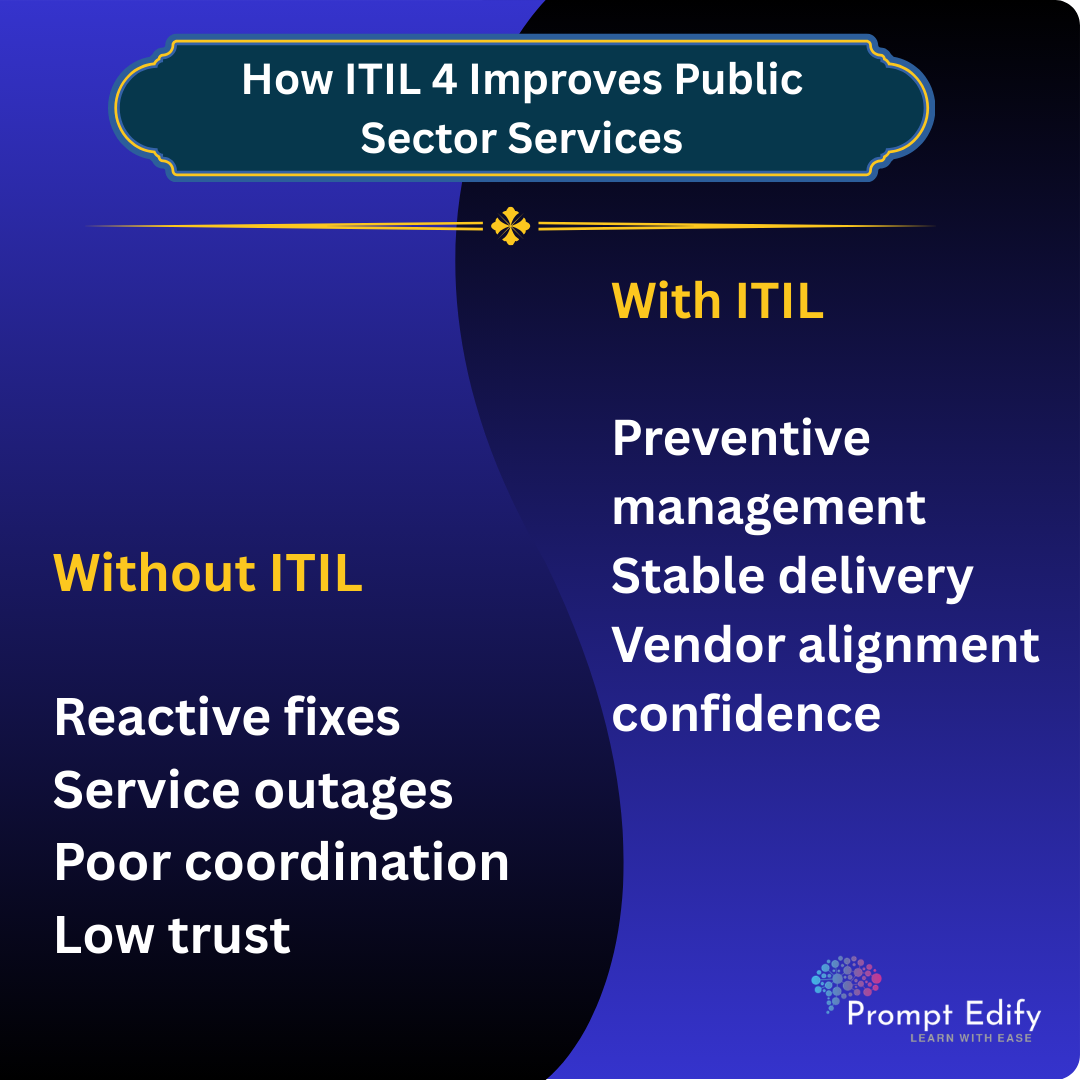
Due to government agencies’ requirement of balancing transparency, compliance, and access, government agencies’ IT environments are quite different from their private-sector counterparts. Outages in the government sector will affect not only its customers but also how the government will administer services to its citizens at the national level.
Due to these differences in environment, government IT professionals are trained through ITIL certification to be service managers instead of just service maintainers. ITIL teaches government professionals how to work with customers (service recipients) to understand what the value of a service to them is, how stakeholders may be affected by the service, and how business risk can affect the delivery of that service (or how risk can be reduced).
From the transition between ITIL V3 to ITIL V4, ITIL has continued the evolution towards a service value-based delivery model, which fits into our public administration from a procedural perspective (currently transitioning to an Agile development process) and a technical infrastructure perspective (transitioning to cloud-based services and infrastructure). Providing practical solutions for our governments to provide new citizen services on time while continuing to provide governance and accountability.
Professionals with ITIL certification can coordinate vendors, developers, and infrastructure teams to ensure that all services are delivered in a continuous manner, regardless of whether the activities are due to system updates, system integrations, or both.
Tanzania’s digital services increasingly utilize cloud hosting, centralized identity systems, and automated processes; some agencies have also started creating analytics and AI-enabled decision-making support systems. These technologies can lead to increased efficiencies within Tanzania’s public sector, but they can pose risks to agencies if there are no protocols to govern their use.
The ITIL cloud and AI governance framework (governance) facilitates agency control over public systems by providing for auditability of public systems. Rather than having disparate automated functions that can show out-of-control or unaccountable activities, agencies employ approval processes, risk assessment processes, and rollback procedures.
With appropriate ITIL 4 practices in place, agencies will have better mechanisms to manage citizen privacy, service continuity, and vendor accountability. This is particularly important as citizen data will flow across multiple platforms. Properly implemented, structured governance fosters both creativity and protection for users and institutions.
The growth of technology-related service delivery to the public sector in Tanzania has resulted in new IT roles that are different from traditional systems administrator roles; therefore, agencies will need professionals who understand service delivery as well as the underlying infrastructure.
To support this transition, professionals entering roles such as service desk analysts, IT coordinators/digital operations officers, or service delivery managers will need certification in the ITIL 4 Foundation. Rather than just providing technical troubleshooting, certified professionals will assist in helping to design and implement stable service workflows.
With an ITIL certification, employees will be able to advance from an operational support role to service management and policy coordination positions, which is very valuable within government environments where interdepartmental communication is important.
Candidates who have completed ITIL certification will have more appeal to both international organizations and regional technology initiatives, thereby enhancing long-term career opportunities.
The development of ITIL's future roadmap supports the growth of integrated digital ecosystems that utilize shared infrastructure and data by multiple agencies in Tanzania. The success of the digital initiatives developed by Tanzania will depend on the ability of the ministries, financial institutions, and telecommunications providers to work collaboratively.
Through the establishment of a common language for service delivery and an operational standard for service delivery processes, ITIL facilitates this cooperation. By providing a unified framework for all agencies to work within, duplication of effort is reduced, response times are improved, and stability is increased across all national-level infrastructure.
The implementation of the ITIL methodology in Tanzania is accelerating the rate of innovation and further supporting the deployment of technology because all changes that are made will go through a structured process to assess risks before implementation and facilitate the communication of changes before their implementation.
Digital initiatives created by government agencies in Tanzania will change the way in which citizens connect with government services. However, technology in and of itself cannot create reliability in the provision of e-service delivery to citizens. Therefore, as a result of the growing interconnectedness of e-government systems, implementing structured service management will be critical to the continued success of e-government systems.
The ITIL digital transformation framework will allow an agency’s e-government system to be continually reliable, secure, and improved. Therefore, in implementing ITIL, ITSM, and ITIL 4 Foundation best practices, agencies will be able to provide stable service delivery while simultaneously increasing the population's access to digital services throughout Tanzania.
By Team Prompt Edify
Have any enquiry? Call us
+(27) 740294414
(+91) 99932-86938
wecare@promptedify.com

Prompt Edify Africa (PTY) Limited
2nd Floor, Rivonia VillageCnr Mutual Road and Rivonia Boulevard Rivonia Village, 2191
Johannesburg , South Africa
Contact : +27740294414
Prompt Edify East Africa Limited
KN 78 ST, Kagarama, Kigali, Kigali, Nyarugenge, Umujyi wa Kigali, Rwanda
Contact : +250 727 845 771
Prompt Edify Private Limited
4th Floor #15, City Vista Tower, Fountain Road,
Kharadi, Pune(MH), India.
PIN- 411014
Contact : (+91) 99932 86938



Contact Us Today!
+27740294414 | (+91) 99932 86938 | +250 727 845 771
contact@promptedify.com | wecare@promptedify.com
🌐 https://promptedify.co.za/