
Explore how ITIL 4 improves government service reliability, governance, and digital transformation in Mali while creating strong public sector IT career opportunities.
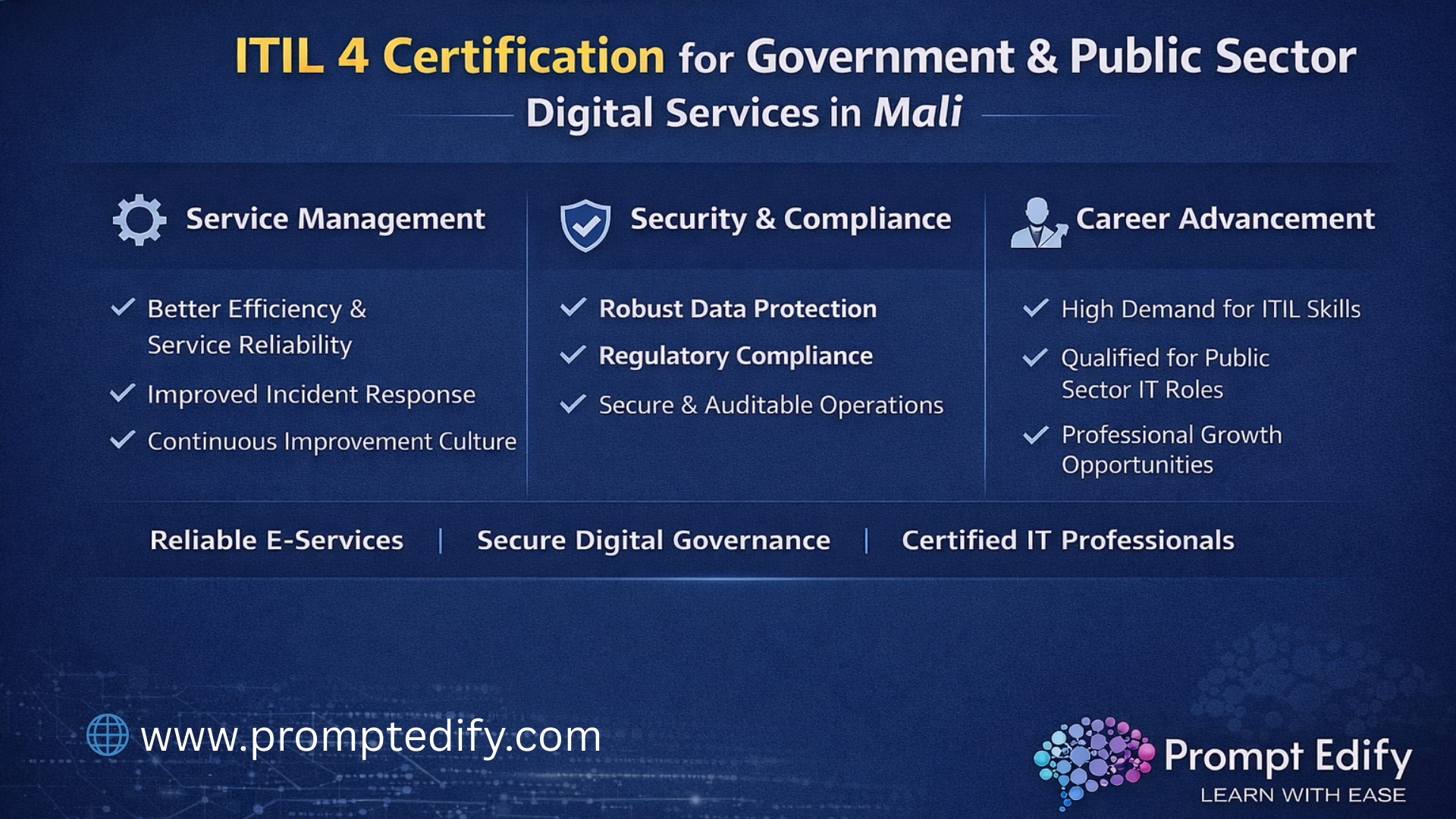
Over the last decade, public sector organizations in Mali have increased. Public sector organizations in Mali are experiencing an increased demand to transform how they deliver services. Digital identity systems, e-government technologies, and a move to cloud-based services continue to place substantial expectations upon public institutions to provide reliable, secure, and transparent digital services. However, this drive for modernization has created confusion surrounding the relevance of ITIL in the digital-first public sector.
Historically, ITIL was thought to refer solely to central IT areas that support internal functional areas or divisions and therefore does not support modern public sector (or 'digital') government initiatives. With a focus on rigid adherence to processes, much of what ITIL 4 seeks to do is shift the focus from rigid adherence to process to providing value, enabling service integration, and providing continuous improvement.
Through the use of the ITIL framework for digital IT, public sector organizations in Mali can manage digital services for use across multiple ministries, agencies, and external providers using digital technology, whether the digital services are being produced on cloud platforms, in shared data centers, or in a combination of both (hybrid).
The ITIL 4 framework provides public sector institutions and agencies in Mali with a shared 'common governance language,' which aligns the delivery of technology with public value.
Because public sector agencies provide digital services under a range of different constraints (budget accountability, regulatory oversight, data protection, and service continuity), there is a greater risk that failure of these digital services and the impact on citizens will result in a loss of trust in the government.
ITIL 4 helps the public sector develop its service management and IT service management (ITSM) capabilities by ensuring the design, delivery, and ongoing improvement of the organization's services are managed in a controlled and transparent way across all areas of the organization. In addition to focusing on IT operations or technology delivery, ITIL 4 allows for collaboration and partnerships between policy teams, IT organizations, third-party vendors, and end-users.
The adoption of ITIL by public sector agencies in Mali will help establish greater consistency in the delivery of digital services across multiple delivery channels (digital service) while also reducing the need for public sector agencies to establish and/or have multiple suppliers (vendors) who each deliver services based on their respective solution sets (applicable technology).
Increased use of cloud platforms or AI-based systems by the public sector for digital initiatives is helping public institutions become more efficient and scalable. However, if these technologies are not governed properly, they can pose a threat to the security of data, service reliability, and accountability.
Governance of ITIL, cloud, and AI provides a level of assurance that will enable digital services to be managed and audited. ITIL does not specifically define how cloud-based platforms or AI-based tools should be constructed; rather, ITIL defines how they will be managed as a service. This is a key differentiator for public institutions in Mali, where compliance, risk management, and continuity of services are essential.
ITIL provides much-needed clarity with respect to service ownership, change control, and incident management—even in automated or AI-based situations.
The evolution of ITIL does not change its core principles. ITIL remains focused on the delivery of service value, engaging and understanding stakeholder needs, and continual improvement. ITIL 4's framework provides structured knowledge that will enable personnel to understand how their services create value for both their organization and society.
While the evolution of ITIL continues, the importance of ITIL in service-based environments continues to be present, where service reliability, governance, and accountability are of utmost importance to organizations. Public sector organizations continue to require structured IT service delivery methods to ensure digital services are provided reliably and align with the priorities of the nation.

Mali’s digital government initiative is growing, and there is an increase in the demand for digital service leaders who can manage digital services correctly. Over the past several years, just having technical skills has not been enough. Organizations are looking for professionals who will also understand the fundamental aspects of governance, service quality, and risk management.
Having an ITIL certification provides you with the validated skill set to manage digital services (public sector) in a structured and internationally recognized manner. The ITIL 4 Foundation certification should be a great asset to anyone working in the following:
- Governmental IT departments
- eGovernment and digital public service projects
- Regulatory agencies and agencies in the public sector
- System integrators and service providers in the public sector
Employers are increasingly recognizing the value of an individual who has received ITIL training and certification. ITIL training and certification ensure that an individual has been exposed to a consistent level of service delivery with an emphasis on sustainment.
The knowledge that you gain from a certification will demonstrate your knowledge, but the professional ITIL training will help you to apply that knowledge practically to real public sector issues. As a trained professional, you are prepared to assist with the design, transition, operation, and continual improvement of service delivery, which are the major components of a successful digital public service.
Prompt Edify provides ITIL training programs that align with ITIL principles while reflecting the challenges of the real world that governments and public sector entities face. All training of ITIL 4 principles will relate to the application of digital governance and cloud services, as well as interdepartmental collaboration, thus making it particularly relevant to Mali's public sectors.
The ITIL Future Roadmap remains in step with the ever-developing trends of platform-based service delivery, data-driven decision-making, and AI-supported operations. The ITIL Reference Framework, as a result, is a viable governance framework that will provide every emerging trend in the public sector with an innovative and robust infrastructure as the public sector in Mali continues to migrate toward a fully integrated digital public sector.
Overall, as technology continues to transform many of the traditional ways of delivering public sector services, the ITIL framework is only going to become more critical as the number of interconnected technologies (or digital ecosystems) continues to rapidly grow and evolve.
Conclusion
ITIL 4 has a long and healthy future in providing governance for the government (public sector) organizations of Mali in the context of providing digital services and applications. The ITIL 4 framework has developed into a flexible governance framework capable of supporting modern digital transformation while still maintaining the values of accountability, reliability, and public trust. Government employees will be able to create meaningful, sustainable digital change for their employees, customers, and communities by adopting the ITIL digital transformation framework, investing in ITIL training, and obtaining internationally recognized ITIL certification.
In conclusion, ITIL 4 is not a legacy framework for Mali’s government organizations but rather a key enabler of effective delivery of digital public services.
By Team Prompt Edify
Have any enquiry? Call us
+(27) 740294414
(+91) 99932-86938
wecare@promptedify.com

Prompt Edify Africa (PTY) Limited
2nd Floor, Rivonia VillageCnr Mutual Road and Rivonia Boulevard Rivonia Village, 2191
Johannesburg , South Africa
Contact : +27740294414
Prompt Edify East Africa Limited
KN 78 ST, Kagarama, Kigali, Kigali, Nyarugenge, Umujyi wa Kigali, Rwanda
Contact : +250 727 845 771
Prompt Edify Private Limited
4th Floor #15, City Vista Tower, Fountain Road,
Kharadi, Pune(MH), India.
PIN- 411014
Contact : (+91) 99932 86938



Contact Us Today!
+27740294414 | (+91) 99932 86938 | +250 727 845 771
contact@promptedify.com | wecare@promptedify.com
🌐 https://promptedify.co.za/