
Learn how AI-Powered Enterprise Service Management automates enquiries, categorizes requests, routes cases and streamlines workflows to improve delivery.
Modern enterprises face the challenge of managing increasing numbers of requests for services both internally and externally from various departments such as IT, Human Resources, accounting, purchasing, and customer service. Managing these requests manually may result in inefficiencies in time and work that could otherwise be done by machines.
Thanks to the combination of artificial intelligence (AI), automation of workflows and intelligent data processing, enterprises have the ability to increase efficiency in their handling of incoming service requests, the process of their classification and assignment to responsible employees, as well as resolution of such requests.
AI-Powered Enterprise Service Management is defined as the application of artificial intelligence in the enterprise services process in order to facilitate the handling of requests, case management, knowledge discovery, and workflow execution.
Conventionally, ESM solutions employ predefined processes for managing the service requests. Through AI in ESM, there are abilities such as natural language processing, intelligent recommendations and automatic classification.
For instance, in a situation where an employee makes a request for a laptop, AI will enable the identification of the request, recommend knowledge articles and recommend the right support team.
This will vary from one SAP solution to another depending on the licensing and deployment.
AI-Enabled Workflow is the amalgamation of intelligent analytics and business process automation to improve the efficiency of services operations.
Below are some ways through which AI can be used in enterprise services processes:
For Example – User requesting for HR services concerning his/her salary.
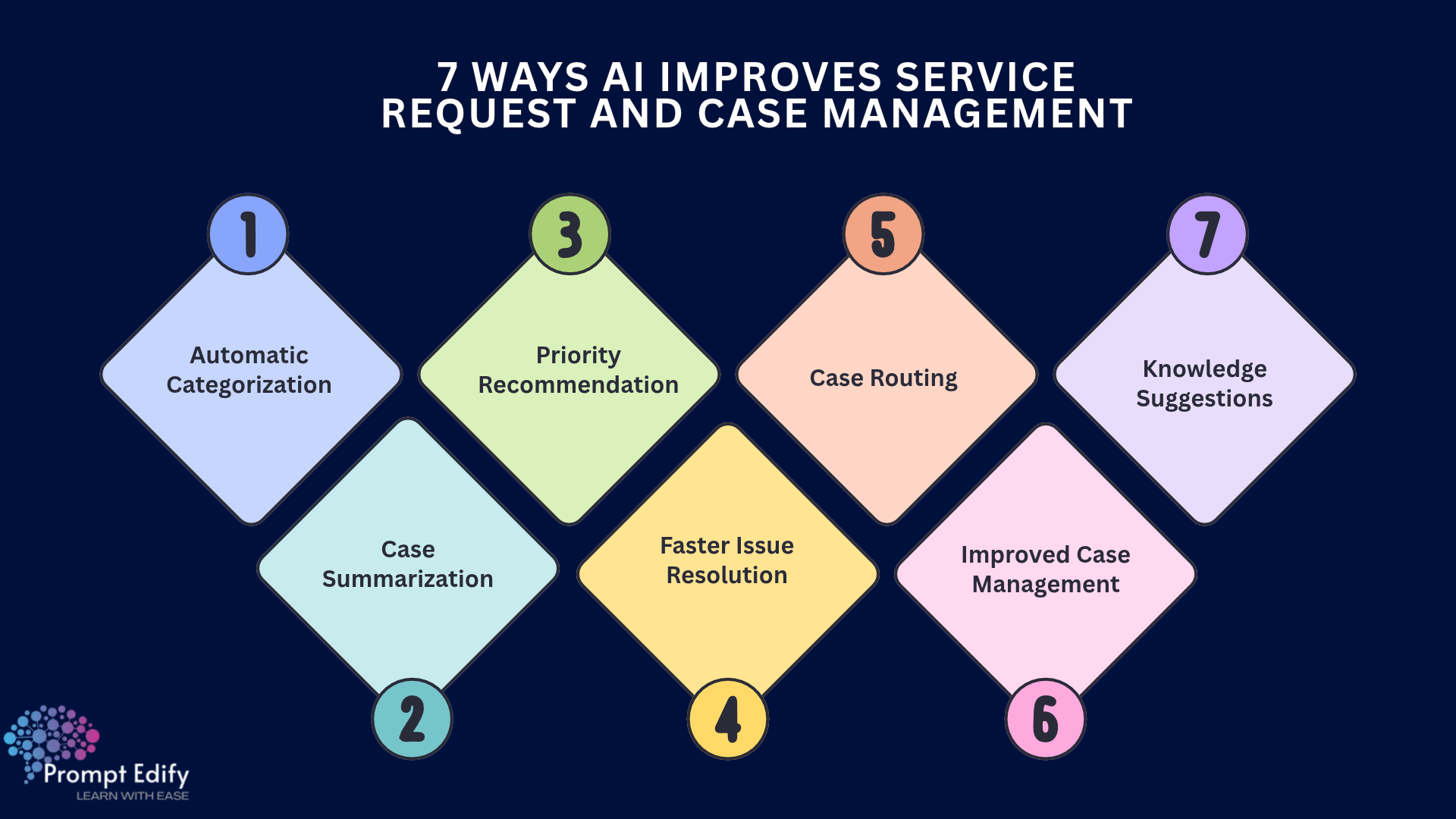
Handling of multiple cases and inquiries might bring about some challenges to service departments in enterprises. With case management using artificial intelligence, the process will become very easy through request categorization, prioritization, and routing.
Some real-life examples may be:
If any employee faces issues related to the availability of business applications, then the AI will help to find out the issue, provide useful information and route the case to the right support team.
Service requests by organizations come from various sources such as emails, portals, and services. Manual handling of such service requests takes a lot of time.
Using the power of AI to manage service requests entails the ability to understand the meaning of the service request and provide an appropriate response.
For instance, in the case of an employee asking the question "How do I reset my company password?", the AI will determine that the question pertains to passwords and will recommend a knowledge article to the user.
Other uses of AI in managing service requests include:
While both the traditional rule-based automation and AI-assisted automation are aimed at enhancing business process management practices, there are some differences between the two. The former relies on the set of rules and structured conditions for executing certain tasks and is highly dependent on configured workflows. It is more suitable for repetitive tasks that require similar actions to be performed. For instance, this type of automation allows assigning password-related requests to the corresponding IT support team according to the predefined categories.
On the other hand, AI-assisted automation implies the usage of artificial intelligence for the interpretation of information and providing recommendations in response to natural language inputs. This approach allows handling the tasks based on the contextual decisions and dealing with various descriptions of requests. For example, AI will be able to recognize the password-related enquiries regardless of the language used by employees for their description.
The two methods can complement each other to enhance the efficiency of enterprise services management.
There are several advantages of using AI systems in Enterprise Service Management that can be attained through proper application of business processes. These include:
However, there are some disadvantages that arise from the usage of AI. Incorrect calculation, incomplete knowledge base, and wrong suggestions can impact on the quality of services offered. Moreover, there will be a need for configuration, preparation, integration, and training of staff members for use of AI in business processes.
AI-based systems need proper governance in order to ensure that these are reliable and secure and meet the requirements of the business.
These points should be considered:
AI-based systems will support the services teams but not make the human decision process obsolete. Human supervision is necessary in case of sensitive information.
AI-driven enterprise solutions are revolutionizing how organizations conduct internal service management, staff queries, and business processes. Through the integration of AI-driven workflow processes with the enterprise workflow automation process, organizations can ensure better request management, streamlined service management, and easy access to information.
Organizations looking at SAP solutions for service management need to look at the level of AI supported by the selected SAP solutions.
To learn about how you can leverage AI-driven enterprise solutions in your organization, connect with Prompt Edify.
By Team Prompt Edify
Have any enquiry? Call us
+(27) 740294414
(+91) 99932-86938
wecare@promptedify.com


Prompt Edify Africa (PTY) Limited
2nd Floor, Rivonia VillageCnr Mutual Road and Rivonia Boulevard Rivonia Village, 2191
Johannesburg , South Africa
Contact : +27740294414
Prompt Edify East Africa Limited
KN 78 ST, Kagarama, Kigali, Kigali, Nyarugenge, Umujyi wa Kigali, Rwanda
Contact : +250 727 845 771
Prompt Edify Private Limited
4th Floor #15, City Vista Tower, Fountain Road,
Kharadi, Pune(MH), India.
PIN- 411014
Contact : (+91) 99932 86938



Contact Us Today!
+27740294414 | (+91) 99932 86938 | +250 727 845 771
contact@promptedify.com | wecare@promptedify.com
🌐 https://promptedify.co.za/