
Explore how SAP Customer Data Platform and Customer Data Cloud differ in data unification, identity management, consent, preferences and customer experiences.
Customers generate data via websites, apps, e-commerce portals, social media, and many other digital touchpoints. The management of such data plays an essential role in providing personalized interactions and nurturing customer relationships in the long term. However, data collection and the management of customers' identities, permissions, and privacy are two different needs in business operations.
Here comes the need to compare the Customer Data Platform vs Customer Data Cloud to understand how they work differently and help solve separate challenges for organizations' customer experience strategy implementation.
A Customer Data Platform (CDP) is software designed for gathering and combining the data concerning customers which is collected by different sources into one place and creating complete profiles of them. It means that such software helps companies to better understand their customers.
SAP Customer Data Platform is a platform which unifies and activates customer data. It gathers data from many business systems, digital channels, and applications and creates comprehensive customer profiles.
The features of the CDP are:
For instance, an online store may gather data about customers using its website, mobile application, and customer service platform. CDP will unite all the information and help the company to get the whole picture of the buying process of the customer.
The SAP Customer Data Cloud is related to customer identity management, access, consent, and preferences. The SAP Customer Data Cloud lets companies establish trusted digital relationships with customers via registration, authentication, profile management, and control of personal data usage.
SAP Customer Data Cloud Capabilities consist of Customer Identity, Customer Consent, and CIAM for B2B.
Key capabilities of SAP Customer Data Cloud are as follows:
As an illustration, while creating an account on an e-commerce website, the SAP Customer Data Cloud makes it possible to register, sign in securely, and obtain consents from customers. They also can manage their communication preferences.
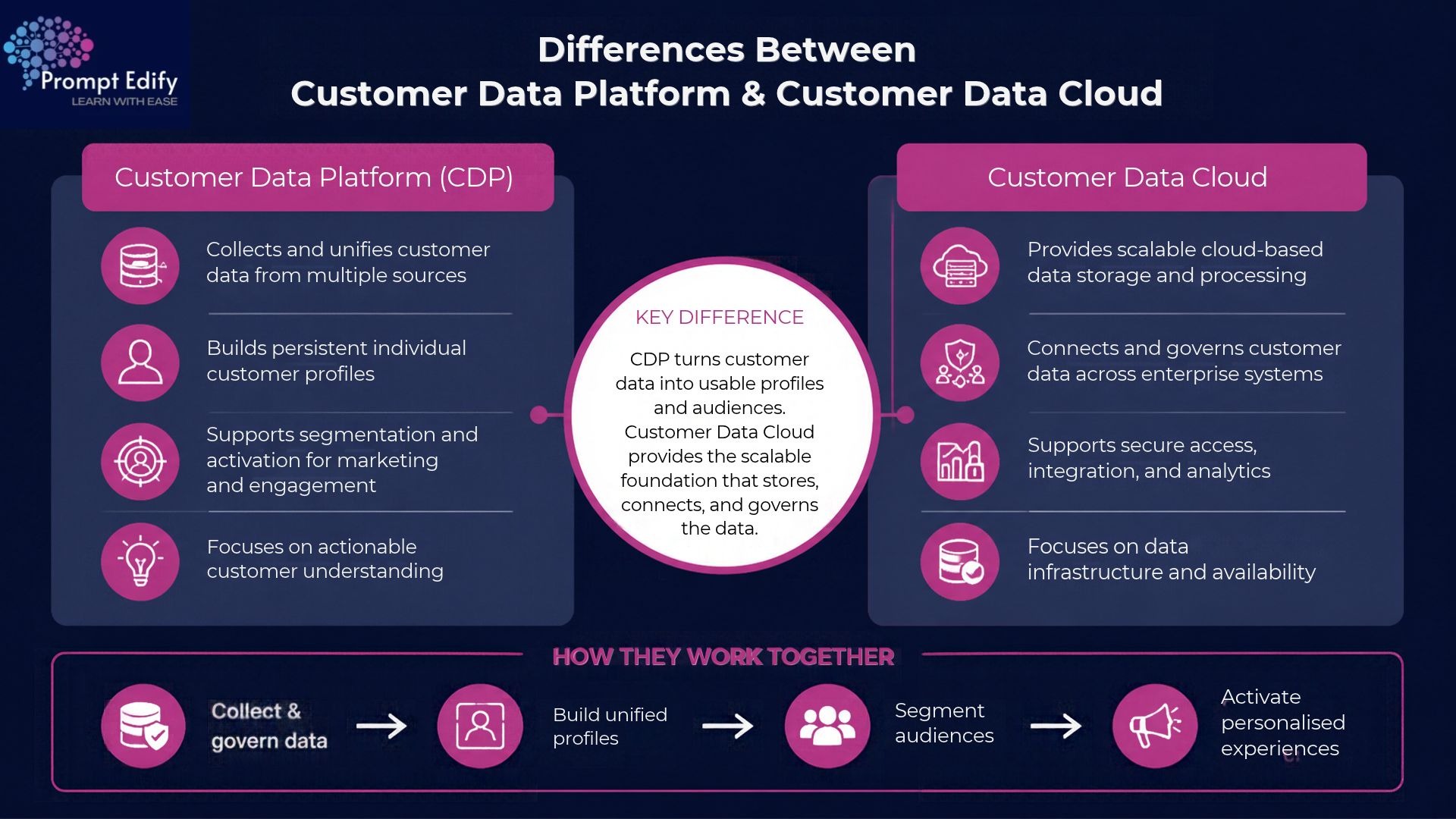
There are two types of platforms which are meant to help in managing the customer data. The main difference between the two is that while the first one is meant for customer data integration, the second one is meant for customer identity, access, consent, and preference management.
The main differences between CDP and CDC include the following:
It should be noted that comparing SAP CDP vs SAP CDC does not imply that companies need to choose one of the two solutions exclusively. Both SAP CDP and SAP CDC can supplement each other in a connected customer experience ecosystem.
Imagine a company that is running an online shop. There, people sign up using the company’s website, buy goods using a mobile application, and contact customer service.
SAP Customer Data Cloud will handle customer sign-up, identity management, consent management, etc. At the same time, SAP Customer Data Platform will gather purchasing activities, web interactions, and other customer data to create a consolidated profile.
Combining such capabilities, companies will be able to get a bigger insight into customers’ characteristics and honor customers’ privacy choices at the same time.
For instance, marketers will be able to create target audiences based on unified customer data. Consent data will make sure that customer interactions take place according to the permission granted by individuals.
The solution to this query would be dependent on the objectives of the company and its current technology environment.
One should go for Customer Data Platform if:
Customer Data Platform vs Customer Data Cloud enables the organisation to understand the distinction between customer data unification and customer identity management. While the former entails integration of customer data and creation of profile of the customers, the latter revolves around identity, access, consent, and preference of the customers.
Together, these areas can aid the organisation in crafting personalised and secure customer experiences.
Those who wish to learn more about these technologies are encouraged to consider SAP Customer Data Capabilities Training from Prompt Edify. This learning course is designed to enable learners to gain an understanding of customer data solutions, their applications, and significance in today’s SAP Customer Experience environments.
Discover Prompt Edify to advance your SAP skills and expertise.
Note: Currently, SAP presents SAP Customer Data Platform and SAP Customer Data Cloud as two separate offerings within SAP Customer Data Solutions. SAP Customer Data Cloud comprises Customer Identity, Customer Consent, and CIAM for B2B.
By Team Prompt Edify
Have any enquiry? Call us
+(27) 740294414
(+91) 99932-86938
wecare@promptedify.com


Prompt Edify Africa (PTY) Limited
2nd Floor, Rivonia VillageCnr Mutual Road and Rivonia Boulevard Rivonia Village, 2191
Johannesburg , South Africa
Contact : +27740294414
Prompt Edify East Africa Limited
KN 78 ST, Kagarama, Kigali, Kigali, Nyarugenge, Umujyi wa Kigali, Rwanda
Contact : +250 727 845 771
Prompt Edify Private Limited
4th Floor #15, City Vista Tower, Fountain Road,
Kharadi, Pune(MH), India.
PIN- 411014
Contact : (+91) 99932 86938



Contact Us Today!
+27740294414 | (+91) 99932 86938 | +250 727 845 771
contact@promptedify.com | wecare@promptedify.com
🌐 https://promptedify.co.za/