
Explore how ITIL 4 enables Malawi’s public sector to achieve reliable digital services, stronger governance, and greater citizen trust in 2026.

Malawi's government is progressively digitizing the country as a whole. Examples include e-services provided by various stakeholders within the government, digital tax systems, e-licenses, health information systems, educational portals, etc. There are clear expectations that these will enhance transparency, efficiency, and access for citizens.
Despite the investment in infrastructure and software, most initiatives are experiencing problems related to reliability, timeliness, and interruptions after the initial implementation has occurred successfully, but after that, an operationally stable environment proves difficult.
This is confusing within the marketplace.
Some stakeholders have an impression of what digital transformation looks like and believe that digital transformation is simply having new technology or a cloud-based system. Other stakeholders think that a cybersecurity solution by itself will ensure that the solution will work. In reality, the failure of digital transformation has less to do with the technology and more to do with poor service management.
ITIL provides a valuable service to public organizations in Malawi undergoing digital transformation.
While ITIL is not a replacement for the technical solution, it provides a framework to deliver, support, and enhance those solutions in a way that preserves the public's trust in the processes of government.
Millions of citizens are impacted by Malawi’s public agencies and ministries, so when digital systems fail, they do so immediately through disrupted health records, delayed payments, and restricted access to services. Students must be taught how TVM-based structured IT service management (ITSM) practices governed by ITIL 4 can help with service availability. Instead of traditional one-off technology project implementations, projects are viewed as ongoing services that require ongoing reliable operations.
Today, government IT departments are not just about maintaining hardware (servers); they also play an integral part in providing a continuous, lived digital experience for citizens. To make this change, the governing bodies will need to build up process discipline and service governance in line with ITIL 4 Foundation.
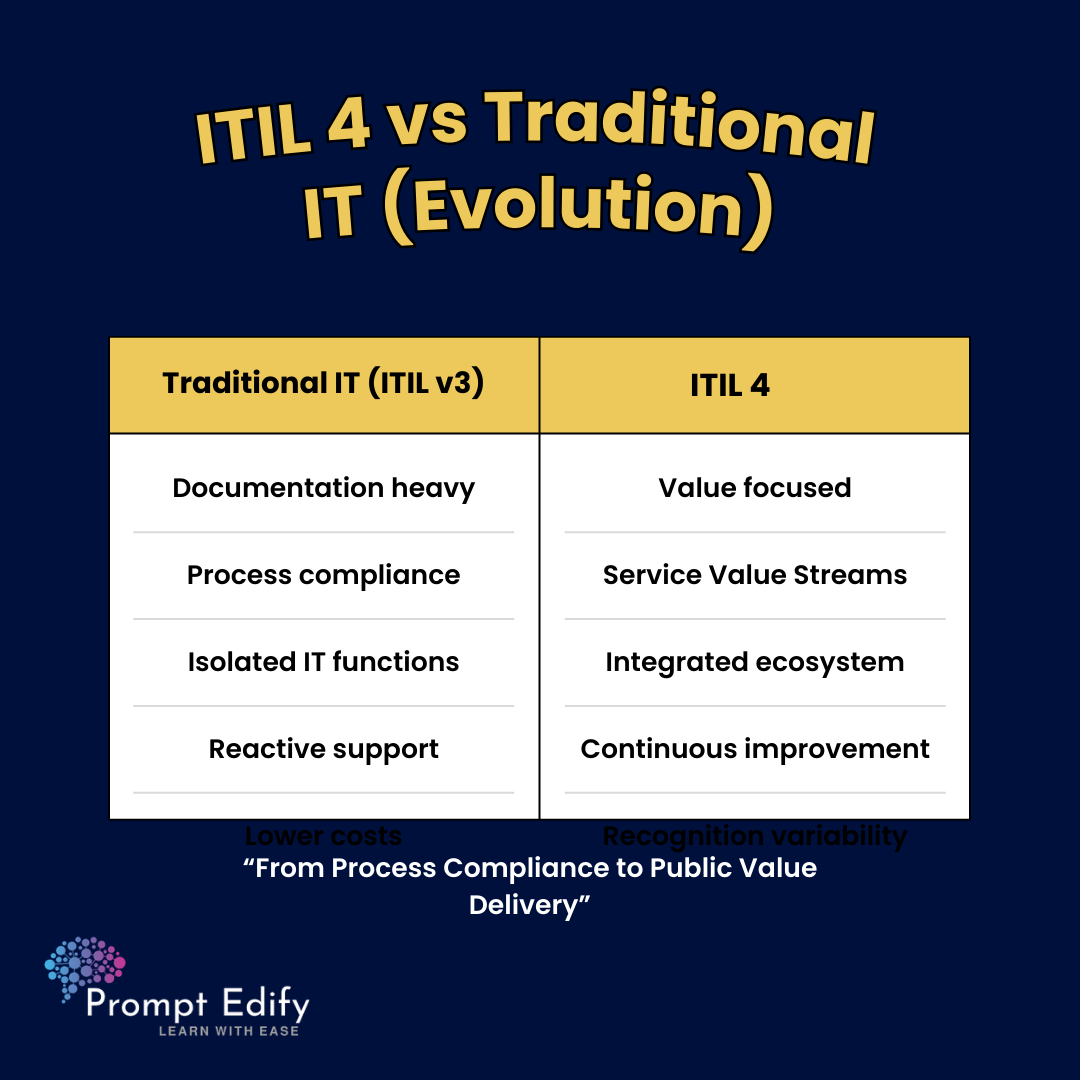
The transformation from traditional (i.e., ITIL v3) to ITIL 4 will be significant to the public sector; it is primarily one of moving from enforced documentation/compliance to value-based service management. Whereas older frameworks emphasized compliance with documented and implemented IT processes, ITIL 4 places emphasis on achieving value and improving services through continuous improvement.
In Malawi’s public institutions, moving to a focus on a service value stream (s) that connects planning/development/delivery/support into a unified model will provide an opportunity to deliver better outcomes (i.e., improved time-to-market).
Public sector professionals can also obtain ITIL training certification, which builds the professionals' knowledge of effective incident management, prioritizing service based on the customer’s impact, and reducing the occurrence of system failures through continuous improvement.
Malawi's digital government is reliant on collaboration among different ministries, vendors, telecommunications providers, and cloud providers. Without working together, service delivery will be fragmented.
Using an established framework for ITIL's Digital IT, an organization has a common operational structure. Therefore, if a citizen-facing portal is down, consistent escalation and resolution processes would be followed by each agency involved in providing the service.
ITIL is useful to accelerate digitization by strengthening Processes such as
Incident management in line with public service impact, change enablement to limit disruption during change, and problem management to eliminate recurring outages.
While bullet processes are important, it is the consistency of those processes that provides the real benefit. By having each ministry follow the same process framework, it provides for more reliable services across the public sector.
With the shift towards cloud-based solutions and the digitization of data within Malawi, there is an increasing need for governance. Cloud, data analytics, and AI-based monitoring tools are all efficient in their own right; however, they also create new levels of complexity.
The technology decisions made using ITIL Cloud and AI governance must align with performance related to service goals.
For example, if a cloud-based health platform experiences degraded performance, ITIL governance will ensure that the evaluation of the incident is based on how that incident impacts the citizen, as well as on normal technical parameters. Also, automated alerts must convert into structured workflows and communication protocols.
Despite modernization and automation, there are still fundamental principles in public administration in the country of Malawi that have not changed:
Citizens expect that service will be delivered in a reliable and easily accessible manner
If there were a disruption to services, then the ability to communicate clearly about the disruption would create trust with those citizens
It is better to be proactive in preventing a disruption than to wait until after an incident occurs before repairing the incident or providing service
Some skilled people provide services to citizens, and that workforce is critical in the successful delivery of services
The technology used to provide services can change, but the amount of discipline that is required while providing service remains constant.
Thus, ITIL certification is still relevant, even as the way the technology is used (i.e., the method of using digital tools) continues to develop.
The fundamental concepts of structured ITSM are timeless: define the services being provided, properly manage risk, and improve performance through continual improvement.
As we look forward to 2026 and beyond, the strategy for Malawi’s digital transformation is likely to include a greater number of integrated government platforms, enhanced utilization of smart data, and increased levels of collaboration between government agencies.
The ITIL future roadmap correlates to these goals through an emphasis on being flexible, creating value streams, continuous improvement, and not just strict adherence to processes.
Public sector organizations that invest in ITIL 4 Foundation and other ITIL training/certification programs will be more prepared to accommodate the increased complexity of services provided to their citizens.
As digital programs are implemented more, IT leaders who have achieved their ITIL certification will be accountable for coordinating transformation projects and ensuring sustainable service delivery for the organization.
ITIL training is more than just a certification for IT specialists in the Malawi government; it is equally about operational confidence.
ITIL training allows teams to develop an understanding of how their technical activities impact citizen services each day. It increases communication between departments as well as accountability in times of critical incidents.
As more organizations seek to hire professionals who possess ITIL certification, recruitment activity will increasingly depend on this indication of structured thought and service maturity after they hire individuals with ITIL certification. Whether in ministry entities, local governance entities, or national governmental agencies, those who possess ITIL 4 knowledge have the greater potential for success in leadership roles during digital transformation initiatives.
The steadily growing digital service offering being available to the public from the Malawi public sector will only succeed with the successful digital transformation, which occurs through the adoption of new technologies. However, successful transformation also relies upon the best service management of those technologies.
The ITIL digital transformation framework provides a framework of ongoing reliability, accountability, and continual improvement shared by all public sector entities that support the Malawi government.
By implementing ITIL and IT service management (ITSM) practices based on the ITIL 4 foundation, the Malawi public sector will be able to better build both digital resilience and public trust.
In the 2026 outlook, the successful implementation of digital transformation in Malawi will require both the implementation of modern systems and the effective management of the service offerings provided to the public through those systems.
By Team Prompt Edify
Have any enquiry? Call us
+(27) 740294414
(+91) 99932-86938
wecare@promptedify.com


Prompt Edify Africa (PTY) Limited
2nd Floor, Rivonia VillageCnr Mutual Road and Rivonia Boulevard Rivonia Village, 2191
Johannesburg , South Africa
Contact : +27740294414
Prompt Edify East Africa Limited
KN 78 ST, Kagarama, Kigali, Kigali, Nyarugenge, Umujyi wa Kigali, Rwanda
Contact : +250 727 845 771
Prompt Edify Private Limited
4th Floor #15, City Vista Tower, Fountain Road,
Kharadi, Pune(MH), India.
PIN- 411014
Contact : (+91) 99932 86938



Contact Us Today!
+27740294414 | (+91) 99932 86938 | +250 727 845 771
contact@promptedify.com | wecare@promptedify.com
🌐 https://promptedify.co.za/