
Explore SAP collaborative asset data handover, including OEM data sharing, standardisation, commissioning and SAP Asset Management integration for asset users.
Accurate, comprehensive information about industrial assets is crucial for owners when equipment transitions from manufacturing or construction sites to commercial operation. Without relevant specifications, maintenance information, spare parts, and documents, equipment owners cannot manage their industrial assets effectively. Unfortunately, such information is kept by different companies in dissimilar systems.
The asset data transfer may be challenging because of incomplete information such as missing documents, inconsistent descriptions of equipment, and lack of technical data.
SAP collaborative asset data handover helps resolve these issues by creating a unified digital space, where Original Equipment Manufacturers (OEMs), construction and engineering companies, and operators can share all required information about the asset.
With the help of SAP Business Network for Asset, the companies may create a unified data base on the asset, support the commissioning process, and link the information about the asset with the other processes in SAP Asset Management.
SAP collaborative asset data handover is the process of the distribution of the standard asset information by the business partners participating in the life cycle of the asset.
It is designated by SAP Business Network Asset Collaboration that links the producers, suppliers of the parts, constructors, operators, and service providers via a unified means of communication.
This software permits manufacturers and constructors to share equipment information with the operators of the asset via a common communication channel amongst the parties. Instead of having to depend on separate documents and manual data transfer, the companies in the group communicate with each other by utilizing unified asset definitions and digital representations of the equipment assets.
The information which is exchanged in this case might involve equipment specifications, technical descriptions, construction of the asset, spare parts data, and documentation.
SAP calls this functionality collaborative data handover, enabling to deliver data from OEMs and constructors to the operators and getting better results both for the commissioning of assets and for future use of the asset.
Many different companies may have different names for the same type of equipment or may classify it or describe its technical features using different document formats. And if the equipment information passes without any standardisation, the users will have to examine, alter, or even recreate their asset records.
Standardisation of asset information reduces these discrepancies.
SAP Business Network Asset Collaboration enables standard definitions of assets and standardisation of asset information taxonomy between the partners of a business. So companies can use the same templates while exchanging information.
The important information available about the asset may include:
Thus, the use of standard asset data enhances the understanding of the equipment by the users.
Multiple companies cooperate to create, share, and utilize information on assets. The process involves several key stages:
The process starts with the creation of asset data by manufacturers of equipment and engineering and construction companies. OEMs may provide their equipment technical specifications, manufacturer experience, models, spare parts and maintenance rules. Constructors may share information about the equipment that has already been installed, technical details and project documentation.
This information has formed the basis for the digital twin of the asset.
At this point in time it is essential to make sure that this information is correct as the future operator will rely on it when preparing the equipment for operation and maintenance.
Before it can be shared, asset data must possess a standard structure.
SAP Business Network Asset Collaboration provides standardized definitions, classifications, and attributes for asset description, enabling the parties to define assets in similar ways.
For instance, the same pump may be called differently by a manufacturer and an operator, and this is where standard technical characteristics and classifications will assist them in recognizing what is being referred to in case the parties use different descriptions of the same equipment.
Such an approach provides for better consistency of data and ease of communication among business partners.
Once the asset information is ready, manufacturers and constructors can share it with the relevant operators of the asset through SAP Business Network Asset Collaboration.
The solution employs a common digital representation- a shared digital twin-to foster the collaboration around the physical asset.
Information shared can include equipment definitions, technical specifications, documentation, and other asset particulars.
Business partners can get such information shared with them subject to the relevant sharing arrangements and permissions.
It creates a common foundation of information instead of supposing, essentially, that each organization has valid, completely separate versions of the same asset information.
Once the non-private information is received, the asset operator can use it to make conclusions about the equipment and to prepare for operation.
The operator can inspect technical specifications, structures of the equipment, and accompanying documents. This information assists in the identification of missing documents and other points that might need clarification before starting to use the equipment.
In cases of SAP ERP integration, the shared information about the asset might also be transferred to the connected systems.
The outcome is based on the way the data is integrated and processed.
Commissioning represents a phase in the life cycle of assets. Prior to recognition of asset operations, entities ought to ensure that appropriate technical information is accessible and that the apparatus is in serviceable form.
The process of handing over information about the assets helps operators acquire data passed on from manufacturers and builders.
To illustrate, an operator launching a new manufacturing plant is likely to get information about the technical specifications, operating manuals, spare parts prescribed in the project, and service information from the suppliers.
Thus, the operator is able to use these data to carry out identification of the asset, reporting of assets, and planning of maintenance activities.
Nonetheless, passing information does not substitute for technical inspections, tests, approvals, and other commissioning procedures set by organizations.
SAP Business Network Collaboration for Asset Management allows for external business partners' cooperation, while SAP Asset Management involves internal organizational asset and maintenance operations. The two businesses can function in tandem via integration with SAP S/4HANA Asset Management. As an illustration, equipment manufacturers can use SAP Business Network Collaboration for Asset Management to send necessary information and technical documents to operators so that they can use the required information in their asset management systems according to the integration parameters set.
This integration allows the company to avoid duplication of data entry and makes the equivalence of the environment possible in order to manage the equipment throughout its life cycle.
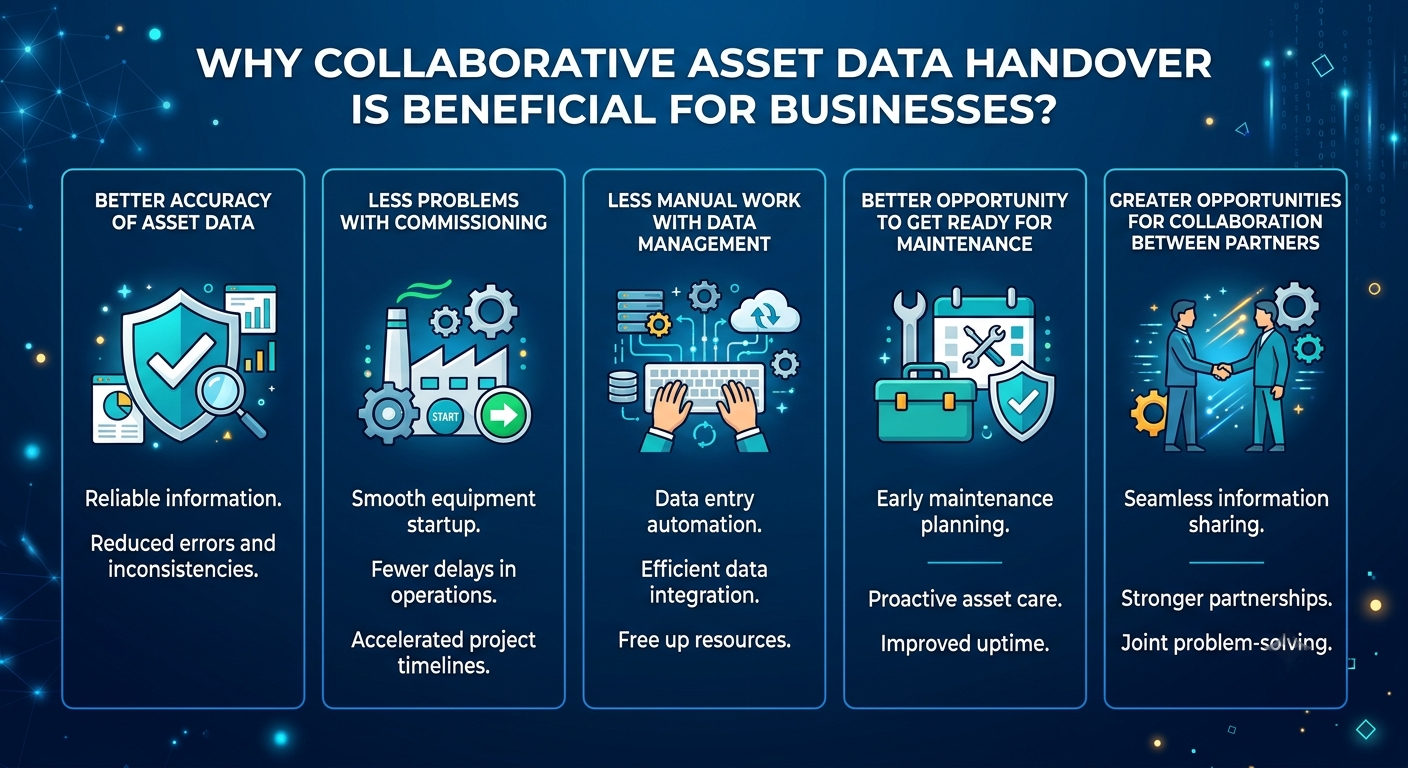
Collaborative asset data handover carries many advantages for businesses dealing with different manufacturers, builders and service providers.
With standard definitions of equipment, providers are able to acquire various types of relevant information and reduce differences between firms. Operators can use needed guidelines from producers instead of depending on untrusted documents prepared by humans.
Equipment specifications and technical information can help operators compile data about their assets successfully.
Having information passed through a single platform ensures lesser repetitions in data collection and less time spent on entering information.
Operators now have a chance to understand what maintenance instructions and spare parts information they need for maintenance.
Both manufacturers and providers work with one and the same source of asset information.
To conclude, SAP Asset Data Collaboration facilitates the seamless exchange of asset-related information among OEMs, contractors, and operators in a common virtual platform. SAP's Asset Collaboration Solution enhances communication by enabling standardised asset data usage, industry-wide asset descriptions and digital form representation.
The system also integrates asset data transmission with commissioning preparation and operation using SAP 4HANA Asset Management.
Collaborative asset data transfer serves as a robust solution for businesses dealing with various stakeholders and providing reliable information on their equipment.
By Team Prompt Edify
Have any enquiry? Call us
+(27) 740294414
(+91) 99932-86938
wecare@promptedify.com


Prompt Edify Africa (PTY) Limited
2nd Floor, Rivonia VillageCnr Mutual Road and Rivonia Boulevard Rivonia Village, 2191
Johannesburg , South Africa
Contact : +27740294414
Prompt Edify East Africa Limited
KN 78 ST, Kagarama, Kigali, Kigali, Nyarugenge, Umujyi wa Kigali, Rwanda
Contact : +250 727 845 771
Prompt Edify Private Limited
4th Floor #15, City Vista Tower, Fountain Road,
Kharadi, Pune(MH), India.
PIN- 411014
Contact : (+91) 99932 86938



Contact Us Today!
+27740294414 | (+91) 99932 86938 | +250 727 845 771
contact@promptedify.com | wecare@promptedify.com
🌐 https://promptedify.co.za/