
Explore how SAP Manufacturing Solutions help manufacturers streamline production, reduce material waste, identify bottlenecks, and improve quality and efficiency.

The manufacturing industry is under a lot of pressure to ensure that the quality of the products is maintained, operating costs are controlled, deliveries are done in time, and customer demands are managed. If the production planning, inventory management, machine scheduling, and quality control processes occur within isolated systems, small issues could lead to very costly delays. SAP Manufacturing Services provide the opportunity for businesses to integrate these processes.
Rather than depending entirely on spreadsheet management and manual updates, manufacturers could utilize SAP solutions to integrate production processes, from the planning stage all the way to finished products.
Effective production starts with being aware of what to produce, how many items must be produced and at what moment production should commence. Wrong planning may result in waiting for materials, overproduction, and order delays.
The manufacturing functionality of SAP provides businesses with the ability to synchronize their production process with customer demand, available material and production capacity. The access to necessary information enables more efficient decision-making before starting the process.
As a simple example, the business that receives increased demand from customers can assess the material availability and production capacity before changing its schedule. Such transparency will enable the planning team to identify potential problems, reassign priorities and control purchases without constant questioning.
Production cannot proceed effectively if the needed parts are not present. On the other hand, procuring too many materials results in higher storage expenses and the wastage of working capital.
SAP manufacturing systems can coexist with inventory management and material requirements planning tools to assist organizations in determining their existing material supply, production order needs, and replenishment material needs.
Manufacturers will enjoy the following benefits:
• Improved inventory visibility: Employees will have access to information about the inventory and determine which materials will impact future production.
• Informed procurement activities: The procurement team will plan for orders based on the requirements for production instead of guessing.
• Prevention of waste in material management: Increased coordination will prevent the purchase of excess materials.
• Fast detection of shortages: Planners will be able to analyze material shortages and prevent any disruptions.
A good example is an electronics manufacturer that assembles its product using hundreds of materials.Information connected to the materials will help the company detect shortages and look for substitutes in advance.
Although an organization’s production process may look full of activity, it might be wasting productive time through downtime in machines, rework, lengthy changeovers, or unequal loads. Lack of reliable production data may make it hard for management to pinpoint what the root cause is.
SAP’s manufacturing solutions may be used in production monitoring through linking orders, operations data, and performance reports. Depending on how the solution is configured and what kind of machines are involved, people can check the progress of production and analyze any anomalies in performance.
Let’s say a certain production line produces fewer units than anticipated.
Product quality influences customers' satisfaction, operational expenses, and company's reputation. If the defect is identified late, the manufacturer has to make changes to the product, change materials, or postpone the delivery while doing additional inspections.
Inclusion of quality management functions within the production process assists teams in registering inspections, defects, and researching problems that occur repeatedly. In cases where the corresponding SAP function is introduced, quality control can be synchronized with material movements and production process.
There are many activities that can be disrupted due to an unexpected machine breakdown. There is the delay of an order; there is also employees’ waiting and customer deliveries affected.
It is possible for manufacturers to plan their maintenance activities in line with the needs of their production. This is done depending on the SAP applications that the company uses. Maintenance planners can plan for their equipment, work orders, maintenance services and scheduling.
This will enable the production manager to take into consideration the machine’s availability while planning their manufacturing activities. In addition, maintenance planners can arrange proper time for maintenance services. For instance, a packing company can experience a problem with a certain machine within a certain manufacturing process.
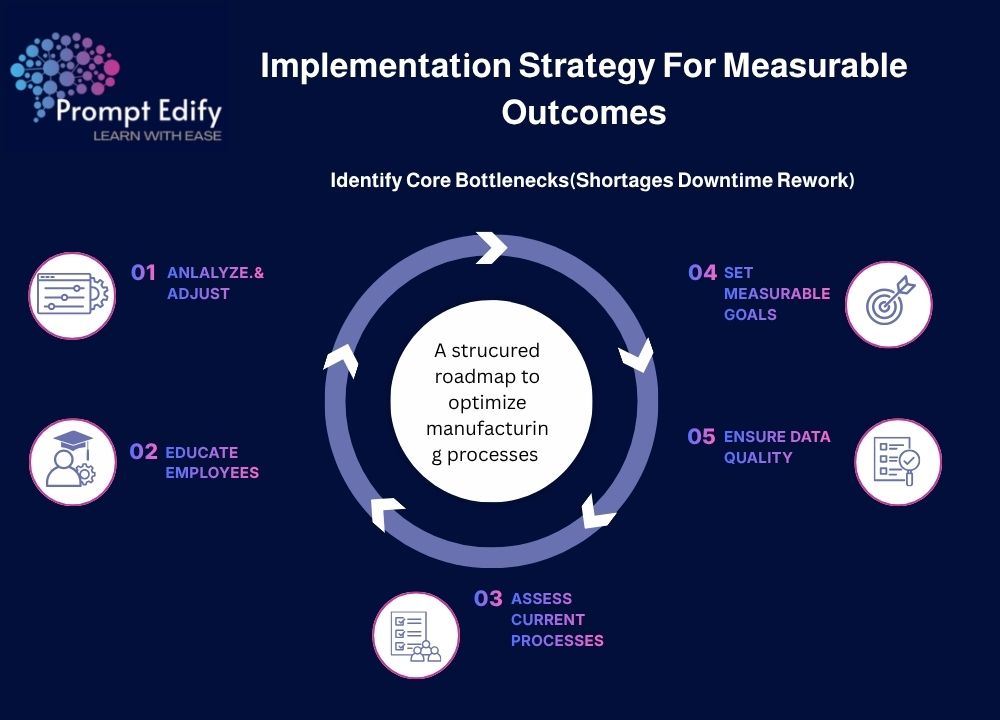
Technology alone is not a guarantor of improved manufacturing processes. The systems have to be configured based on actual production needs, and employees must be made aware of their proper use.
Prior to the implementation process, companies need to know which are their major problems related to production, such as material shortages, inaccurate scheduling, high number of reworks, and lack of visibility of performance.
A reasonable implementation strategy consists of the following steps:
1. Assess current processes to find delays, duplicate input and lack of reporting on production processes.
2. Set measurable goals that will include relevant indicators of schedule accuracy, defect percentage, machine downtime and inventory precision.
3. Provide good data by cleansing material records, production routings, bills of materials and other necessary data.
4. Educate employees to make them aware of their roles within the new process.
5. Analyze and adjust based on results comparison with previously set benchmarks.
In addition, companies have to pay attention to integration issues, data protection, reporting requirements and degree of automation.
Increasing the efficiency of manufacturing does not simply entail boosting machine speeds or having employees perform tasks at a quicker pace. It includes coordinating people, machines, materials, quality assurance and scheduling to ensure that one task complements another.
This is possible provided there is the right data, configuration, user adoption and process improvement in place.
If firms wish to update their manufacturing practices, they can learn how SAP manufacturing solutions address their specific production problems. Contact Prompt Edify for information about how to get more out of SAP manufacturing solutions.
Contact: +27 740 294 414 | +91 99932 86938
Email: contact@promptedify.com
Website: https://promptedify.co.za/
By Team Prompt Edify
Have any enquiry? Call us
+(27) 740294414
(+91) 99932-86938
wecare@promptedify.com


Prompt Edify Africa (PTY) Limited
2nd Floor, Rivonia VillageCnr Mutual Road and Rivonia Boulevard Rivonia Village, 2191
Johannesburg , South Africa
Contact : +27740294414
Prompt Edify East Africa Limited
KN 78 ST, Kagarama, Kigali, Kigali, Nyarugenge, Umujyi wa Kigali, Rwanda
Contact : +250 727 845 771
Prompt Edify Private Limited
4th Floor #15, City Vista Tower, Fountain Road,
Kharadi, Pune(MH), India.
PIN- 411014
Contact : (+91) 99932 86938



Contact Us Today!
+27740294414 | (+91) 99932 86938 | +250 727 845 771
contact@promptedify.com | wecare@promptedify.com
🌐 https://promptedify.co.za/