
Explore how SAP Marketing Cloud Services help businesses personalize campaigns, connect customer journeys, analyze insights, and build stronger customer relationships.
Customer engagement does not entail just sending out more emails and posting regularly on social media platforms. It involves understanding customer needs, acting at an appropriate time, and relevance in interactions. For companies that have to deal with information about customers in sales, service, and online, it may prove hard to achieve customer engagement without having the customer interaction in a consolidated manner. The SAP Marketing Cloud Services platform can assist organizations in achieving this.
The customer could visit a product page, watch a webinar, interact with a service team, and then contact a sales representative. With such interactions stored in disparate systems, teams could fail to see the entire story. They could end up sending duplicate messages, missing out on a relevant follow-up activity, or providing outdated information.
Integration of marketing solutions with customer information allows teams to create a coherent view of interactions. Based on different types of integration, marketers could rely on profile information, customer preferences, and interaction history to determine what information could be relevant. Data integrity and compliance are key issues here – incomplete information could lead to wrong decisions and customers' data must be processed in compliance with the rules.
Relevance can only be achieved when personalization is done in such a way as to influence decision-making, and not just when a message uses a person’s name. The software company could send introductory information to its prospect, implementation information to its comparison prospect and expert advice to the existing client.
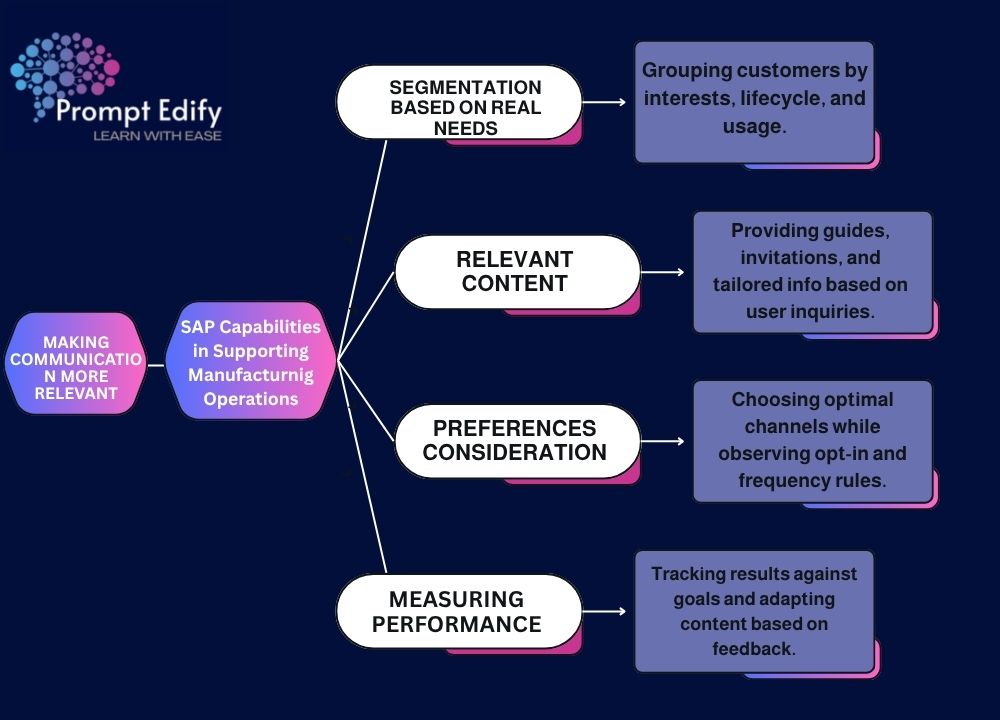
In SAP Marketing Cloud Services, campaigns may be run according to specific customer segments and behavior, depending on the configuration and data source connectivity used. These are some of the techniques one may apply:
• Segmentation based on real needs: Grouping customers based on interest, life cycle, product usage, or other relevant factors.
• Relevant content: Providing guide, invitation, information, or notification, which is related to what the customer would ask.
• Preferences consideration: Choosing appropriate communication channel and observing the opt-in and frequency rules.
• Measuring performance: Measuring the result against the campaign goals and changing the content based on feedback.
One does not need to increase the number of messages sent to customers, but rather improve their relevance and timeliness.
The customer does not think of departments when they are going through the purchasing process. Whether the interaction takes place through e-mail, websites, or a physical meeting with a sales representative, the customer expects consistency. If the marketing efforts are conducted separately from each other, the customer journey may be inconsistent since an individual attending a webinar could keep receiving invites, while the recently acquired customer could be offered introductory discounts.
With a well-coordinated approach, it will be possible to cut down such gaps as a result of aligning the rules of the campaign, audiences and follow-ups. For instance, after downloading the comparison chart, the organization could offer the interested customer a case study and provide consultations. This process should be limited in time and involve a relevant action, not endless automated messages.
Coordination involves collaboration as well. Marketing, sales, services, and data departments should agree upon lead definition, points of contact, customers' records ownership and signs which require follow-ups. While technology is used to carry out the process, it is the practices which make it possible.
Insights on engagement will reveal what kinds of messages gain traction, what channels aid conversions, and where potential clients get disinterested. Both open and click rates may be insightful measures; however, companies should look into their objectives related outcomes, such as qualified leads, event attendance, repurchase rate, and retention.
To begin with, a good measurement strategy requires having a clear question. In the case of product demos as a goal, for example, the team should know how many relevant prospects asked for a demo and moved to the next level. Subject lines or message format comparison may be helpful, although not if the test involves too many variables and not enough responses to draw a conclusion from.
Reports become important once they inspire action. Poor results may suggest wrong message, audience, timing, or a landing page that does not encourage moving forward. Investigation is necessary before boosting the volume of campaigns.
It would be wrong to believe that marketing technology will fix every engagement challenge automatically. The organisation needs to understand how its customers interact with it and where the necessary data is stored. It makes sense to start with one tangible journey like onboarding a new subscriber or following up after an event.
Data integration, duplicate record management, managing consents, access control, training for staff, and campaign ownership are among important things to consider. Organisations need to know what capabilities they have in the SAP system and whether some additional products and integration are required. There has to be somebody who maintains segments, reviews content, monitors performance, and manages rules changes.
Sales and service people can also contribute to making marketing's job more efficient by helping avoid meaningless contacts and making them more helpful.
Customer engagement is built on the factors of relevance, consistency, and trust, rather than the number of campaigns conducted. The solution offered by SAP Marketing Cloud Services will assist in organizing information about customers, coordinating communication with them, and evaluating the results if there is appropriate data, integration, and processes.
The success of the software is defined by the level of its usefulness for the customer.
Businesses that are able to set clear goals, take into account preferences of their clients, and use evidence in each transaction will succeed in building solid relationships with customers.
For more information about marketing approaches by SAP, contact Prompt Edify.
Contact: +27 740 294 414 | +91 99932 86938
Email: contact@promptedify.com
Website: https://promptedify.co.za/
By Team Prompt Edify
Have any enquiry? Call us
+(27) 740294414
(+91) 99932-86938
wecare@promptedify.com

Prompt Edify Africa (PTY) Limited
2nd Floor, Rivonia VillageCnr Mutual Road and Rivonia Boulevard Rivonia Village, 2191
Johannesburg , South Africa
Contact : +27740294414
Prompt Edify East Africa Limited
KN 78 ST, Kagarama, Kigali, Kigali, Nyarugenge, Umujyi wa Kigali, Rwanda
Contact : +250 727 845 771
Prompt Edify Private Limited
4th Floor #15, City Vista Tower, Fountain Road,
Kharadi, Pune(MH), India.
PIN- 411014
Contact : (+91) 99932 86938



Contact Us Today!
+27740294414 | (+91) 99932 86938 | +250 727 845 771
contact@promptedify.com | wecare@promptedify.com
🌐 https://promptedify.co.za/