
Discover how SAP Supply Chain Training develops skills in procurement, inventory, logistics, and production planning to prepare for supply chain career opportunities.

Supply chain management is an essential factor in the effective delivery of products by the companies, cost efficiency, and the maintenance of high levels of customer satisfaction. Everything from procurement of raw materials through inventory management, production, logistics and distribution requires appropriate coordination. With the introduction of digitization in order to make the processes efficient, there will be a need for professionals having knowledge in SAP.
SAP Supply Chain Training gives ideas on the ways technology can assist in the process of business and on its usage in various supply chain activities. This training can offer a basis for career development in supply chain management for recent graduates, employed people and those seeking career transition.
SAP Supply Chain Management is a process which involves the use of SAP technology to manage the process of the supply chain. The process can include functions such as procurement, inventory management, demand planning, production, warehousing, logistics, and order fulfillment among others.
SAP provides tools to organizations that will help in keeping uniformity of information, monitoring of business transactions and improving the visibility of the processes. Based on the needs of the organization, various SAP technologies facilitate these processes.
Understanding the processes involved helps in understanding the interaction between purchase, production, inventory and delivery to customers.
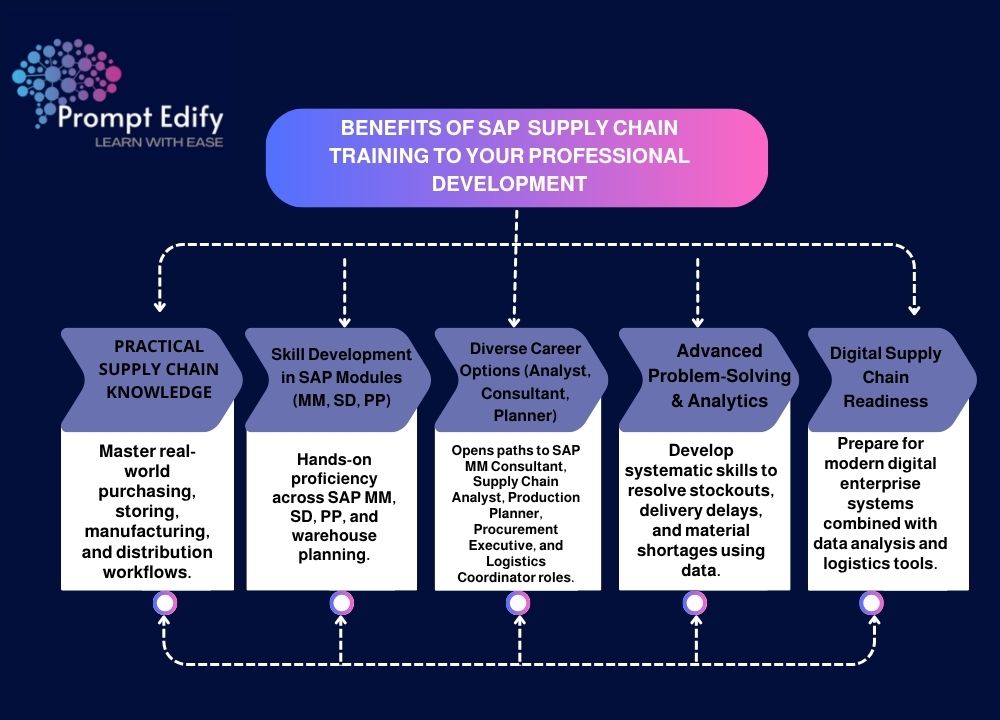
Traditionally, in the supply chain, firms usually face many departments, a lot of data, and urgent decisions. However, without integrated processes, the company may have such issues as stock outs, late deliveries, incorrect data, and unnecessary costs.
SAP course will provide students with information about the digital processes and the way how the company uses enterprise software to cope with these challenges.
Below there are only a few reasons why such training may be useful when it comes to developing your career:
To have a successful career in the field, it is not sufficient to know much information.The professional should be aware of how the materials are handled during the processes of purchasing, storing, manufacturing, and distribution.
Through SAP Supply Chain Training, learners will be able to learn about these processes using theoretical and practical aspects of the training.
There are many applications provided by SAP that can be applied in supply chain activities. This is based on the course that the students will take to study topics such as SAP material management (MM), sales & distribution (SD), production planning (PP), warehouse and supply chain planning.
They each have varied business requirements where, for example, SAP MM is about purchasing and inventory whereas SAP PP relates to production planning.
It allows the individual to get to understand his/her own interests and career objectives.
A knowledge of SAP can also be beneficial in complementing the skills in business, logistics, engineering, and operations of the learner. Upon obtaining the relevant training and experience, some of the career options include:
Logistics Coordinator: Assists in the process of transport and delivery.
In many cases, supply chain managers and specialists need to work with changing demand, delivery delays, differences in stock, material shortages, and other challenges. For dealing with those issues, it is important to have relevant information and to understand how processes interact with each other.
During SAP training, students will become familiar with business information registration, transactions impact on other departments, and the influence of system information on decision-making.
Using practical tasks, students will have a chance to learn how to analyze problems systematically, to evaluate information and possible ways to solve them.
Due to the growing tendency of digitalization of organizations' activities, nowadays supply chain management becomes more and more related to enterprise systems. Thus, there is a need for specialists in supply chain management who are capable of working with enterprise systems and of adapting to new processes.
Knowledge about SAP along with other skills, such as Excel, data analysis, communication, and problem-solving will surely make candidates' resumes look better.
It will also prepare those involved in procurement, logistics, or inventory management to deal with enterprise systems.
SAP supply chain training might be appropriate for new graduates, supply chain students, procurement officers, warehousing workers, logistics coordinators, production planners, and those individuals looking to upgrade their SAP expertise.
A beginner should begin with supply chain basics and advance to SAP modules. Professional experts can select a specific SAP training that suits their jobs.
Among the issues one must think about when deciding on an SAP training program include curriculum, experience of the trainer, system availability, mode of delivery, and suitability to your chosen career path.
The career of supply chain management involves an understanding of business processes, materials, inventory, purchasing, and logistics. SAP Supply Chain Training can help the learner gain an understanding of the above-mentioned subjects as well as systems used in businesses today.
While training does not ensure employment or promotion, training combined with experience and continuous learning can enable professionals to prepare themselves for supply chain opportunities.
Prompt Edify provides SAP training options for people and organizations willing to develop knowledge of SAP solutions and business processes. Look through appropriate learning opportunities to gain knowledge and practical skills as well as prepare yourself for the future in supply chain management.
Learn more about SAP training programmes at Prompt Edify or join the Prompt Edify Community.
Contact: +27 740 294 414 | +91 99932 86938
Email: contact@promptedify.com
Website: https://promptedify.co.za/
By Team Prompt Edify
Have any enquiry? Call us
+(27) 740294414
(+91) 99932-86938
wecare@promptedify.com


Prompt Edify Africa (PTY) Limited
2nd Floor, Rivonia VillageCnr Mutual Road and Rivonia Boulevard Rivonia Village, 2191
Johannesburg , South Africa
Contact : +27740294414
Prompt Edify East Africa Limited
KN 78 ST, Kagarama, Kigali, Kigali, Nyarugenge, Umujyi wa Kigali, Rwanda
Contact : +250 727 845 771
Prompt Edify Private Limited
4th Floor #15, City Vista Tower, Fountain Road,
Kharadi, Pune(MH), India.
PIN- 411014
Contact : (+91) 99932 86938



Contact Us Today!
+27740294414 | (+91) 99932 86938 | +250 727 845 771
contact@promptedify.com | wecare@promptedify.com
🌐 https://promptedify.co.za/