
Explore SAP Sustainability Control Tower for ESG reporting, data, metrics, dashboards, workflows, AI-assisted reports, target tracking, and business insights.
Given that sustainability reporting is becoming more important in corporate strategy, companies require more than simple spreadsheets to manage ESG information effectively.
ESG data management can be challenging because information needs to be collected from multiple departments, plants, and business sources. Data may be inconsistent, and reporting responsibilities may not always be clearly defined, making sustainability reporting more complex.
SAP Sustainability Control Tower supports ESG reporting by helping businesses centralise sustainability information, manage metrics, monitor performance, and prepare sustainability reports. It enables organisations to improve data visibility, streamline reporting processes, and make informed decisions based on sustainability performance.
SAP Sustainability Control Tower serves as a platform for managing sustainability performance and reporting data. The software allows organizations to gather ESG data from SAP as well as third-party sources, track performance, and generate reports in accordance with the organization’s reporting needs.
The software is capable of working with sustainability reporting frameworks such as ESRS (European Sustainability Reporting Standards) and IFRS Sustainability Disclosure Requirements. Organizations may either utilize metrics provided by SAP or develop custom metrics in accordance with the organization’s materiality assessment and reporting needs.
Quality reporting is based on quality data. ESG data could come from finance, human resources, production, purchasing, facilities, energy management, and other business departments.
Sustainability Control Tower of SAP is capable of supporting data sourcing from both SAP and non-SAP systems through integration options like open APIs. Companies are able to collect information from various sources and implement a data collecting procedure.
Companies may also determine the scope of reporting, delegate tasks to contributors, schedule data collecting sessions, and control submissions. Guided processes enable us to perform data entering, reviewing, validating, and approval activities.
This will help companies avoid fragmentation in data collecting and implement a more uniform reporting process.
Metric management is critical in ESG reporting due to the requirement for definitions and calculations to enable assessment of the sustainability performance.
The SAP Sustainability Control Tower helps to define and calculate SAP-provided quantitative and qualitative metrics, as well as custom metrics. In the case of quantitative metrics, companies can use measures, dimensions, and formulas to perform calculations. Qualitative metrics, on the other hand, provide an opportunity to report the information of relevance in textual format.
Metrics can be selected based on reporting needs and materiality considerations by the company. The company can manage actual and target values for relevant metrics.
Examples of such metrics could be related to greenhouse gases emissions, energy consumption, water consumption, workforce diversity, or governance.
Due to the use of dashboards, companies may evaluate their sustainability performance without reviewing all the reports.
Thanks to the SAP Sustainability Control Tower application, one may get access to interactive dashboards and filters that allow analyzing ESG metrics based on geographical location, business units and certain periods of time. Companies may also evaluate their sustainability performance based on the set goals, spot any trends and see the areas of improvements.
Moreover, the tool allows analyzing not only ESG metrics but also KPIs from the operational and financial perspectives so that to evaluate sustainability performance relative to the total business performance.
Our Ambitions application is aimed at evaluating sustainability goals, spotting any gaps and tracking the progress towards achieving the goals.
Workflows are used in the process of gathering, reviewing, and preparing the sustainability information for reports. Firms may allocate contributors and reviewers, control the submission process, and monitor the reporting status.
With SAP Sustainability Control Tower, it is also possible to use AI for ESG report creation based on the templates provided by SAP. One may choose reporting time frames and locations, create drafts for ESG reports based on the available ESG information, review the report content, make any necessary edits, and then download the created report.
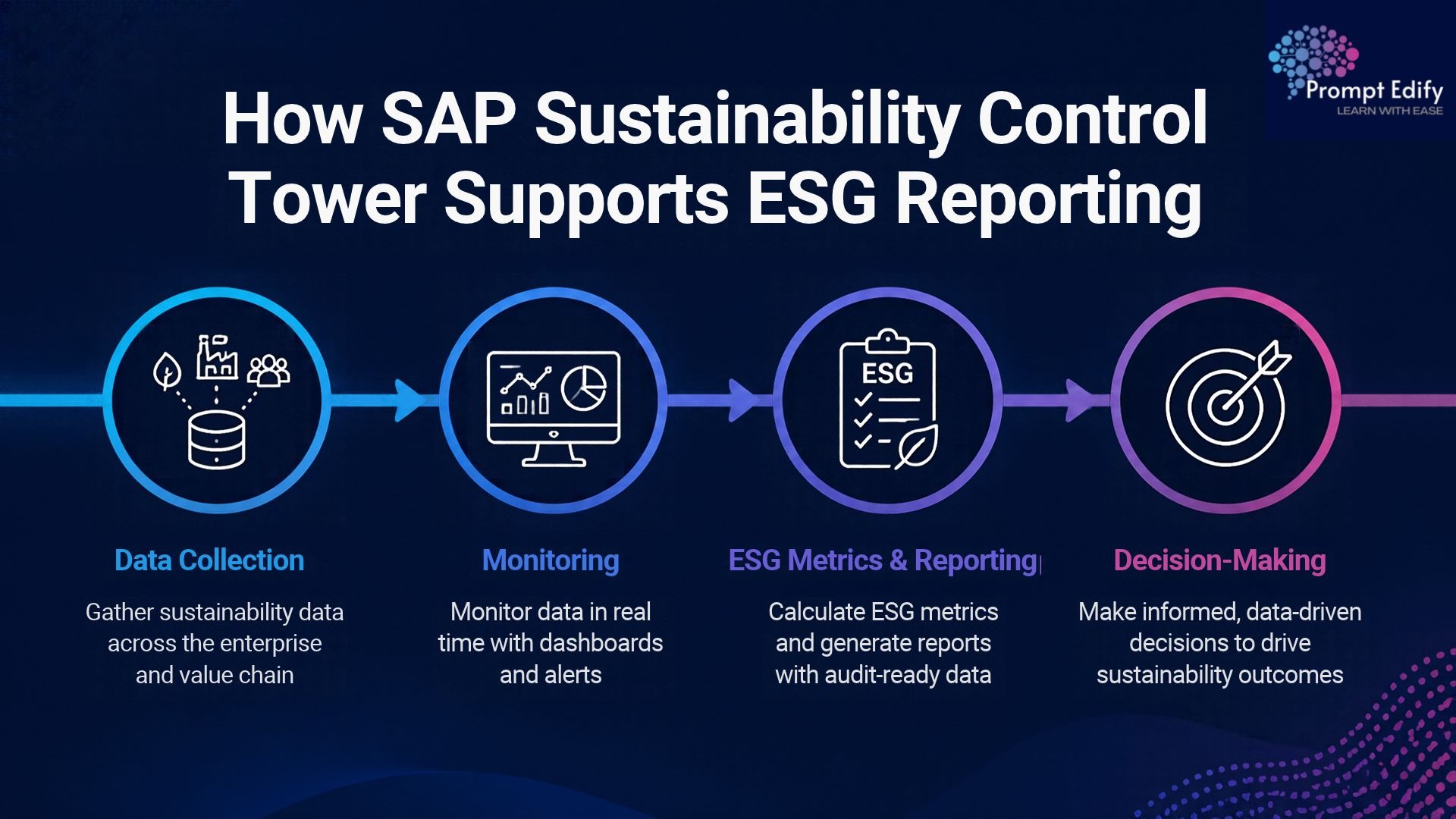
The Sustainability Control Tower of SAP could be used by organizations in different ways for sustainability reporting.
These use cases will allow organizations to move from fragmented sustainability data to proper reporting and performance monitoring.
There are many benefits which an organisation might enjoy if it decides to go for SAP Sustainability Control Tower for their sustainability reporting:
All this would enable the sustainability team to spend less time collecting sustainability data and instead concentrate on performance analysis and sustainability initiatives implementation.
Knowledge of how ESG reporting, sustainability KPIs, data gathering, and report making works may help people in acquiring knowledge of SAP sustainability.
SAP sustainability technology enthusiasts must go for SAP Sustainability Control Tower Training by Prompt Edify to get acquainted with its features and reporting mechanisms.
Prompt Edify provides SAP training, consulting, and professional learning programs to organizations or individuals who wish to build enterprise technology skills. With SAP experts and a practical approach to learning, Prompt Edify enables professionals to build their SAP skills.
By Team Prompt Edify
Have any enquiry? Call us
+(27) 740294414
(+91) 99932-86938
wecare@promptedify.com


Prompt Edify Africa (PTY) Limited
2nd Floor, Rivonia VillageCnr Mutual Road and Rivonia Boulevard Rivonia Village, 2191
Johannesburg , South Africa
Contact : +27740294414
Prompt Edify East Africa Limited
KN 78 ST, Kagarama, Kigali, Kigali, Nyarugenge, Umujyi wa Kigali, Rwanda
Contact : +250 727 845 771
Prompt Edify Private Limited
4th Floor #15, City Vista Tower, Fountain Road,
Kharadi, Pune(MH), India.
PIN- 411014
Contact : (+91) 99932 86938



Contact Us Today!
+27740294414 | (+91) 99932 86938 | +250 727 845 771
contact@promptedify.com | wecare@promptedify.com
🌐 https://promptedify.co.za/