
See how SAP Sustainability Data Exchange supports Scope 3 management using supplier emissions data, product footprints and supply chain decarbonisation efforts.
Carbon emission management has turned out to be one of the key responsibilities of organizations which want to develop sustainable supply chains. While it might be relatively easy for companies to determine how many carbon emissions have been produced within their organization, estimating the environmental impact of their suppliers, raw materials, transport and other activities is not an easy task at all. These kinds of emissions are referred to as Scope 3 emissions and may account for a substantial portion of a company's carbon footprint.
This is what SAP Sustainability Data Exchange for Scope 3 Emissions Management enables organizations to do - gather, exchange and manage carbon footprint data related to products within the context of their supply chain partners.
Scope 3 emissions are the sum total of indirect greenhouse gas emissions resulting from the company's activities in the supply chain. It encompasses everything from purchasing raw materials, third-party production, transportation and distribution, travel, and disposal of products.
It is indeed quite difficult for the companies to obtain such data because of different ways in which their suppliers use to report and calculate data on emissions; some companies are quite detailed with emissions data, whereas some just give rough estimates.
Because of the inconsistency in data, it will be quite tough for the companies to identify the source of their emissions and improve on them. This problem is solved by SAP Sustainability Data Exchange.
The supplier specific emissions data provides knowledge about the true impact on the environment due to the products and material supplies that are utilized in the organization. This information includes different things like the energy use in the production of the product, production process, raw materials used, among other things that might have an impact on the carbon footprint of the product.
For instance, when the manufacturing company buys steel from different suppliers, the carbon footprint will be different due to the method in which the steel has been manufactured by the suppliers.
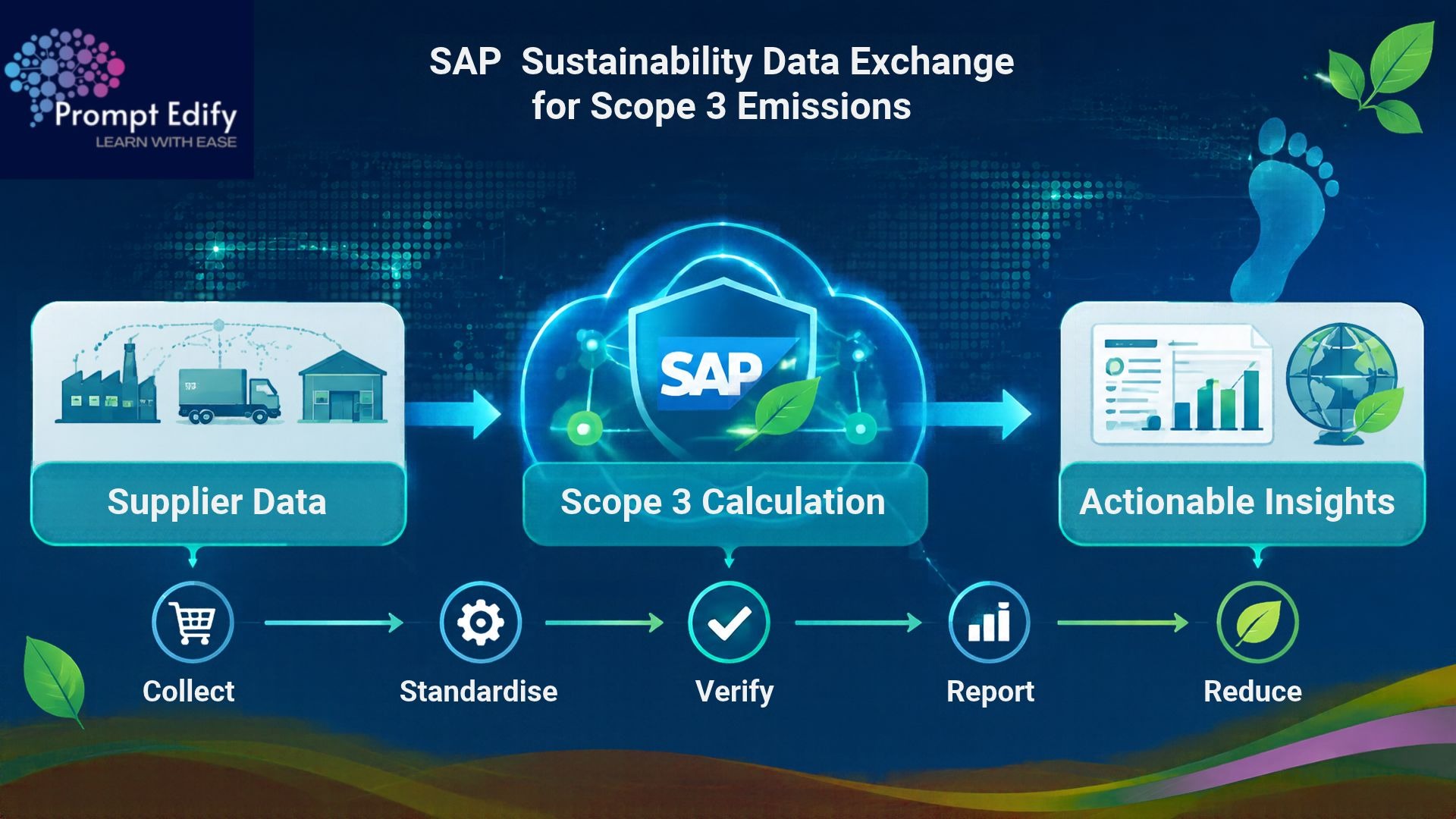
Through the SAP Sustainability Data Exchange tool, the company can send a digital request for the product carbon footprint information from the supplier. The suppliers will then provide the footprints they have through standardized methods.
The benefits of using this approach include the following:
The concept of Product Carbon Footprint (PCF) refers to a measure of greenhouse gas emissions related to the lifecycle stages of a product. The exact stages depend on the boundary used to calculate the PCF, for example, raw material extraction, manufacturing process, packaging, and transportation.
In case of organisations tracking Scope 3 emissions, product level information will be especially valuable since it provides a connection between the environmental impact and actual purchases and services.
Product Carbon Footprint information can be exchanged by suppliers and buyers via SAP Sustainability Data Exchange based on standardised data models. Suppliers can communicate their calculated footprints while buying organisations are able to benefit from the information when measuring their carbon emissions.
The platform also enables exchanging the updated footprint information.
One of the biggest problems in carbon footprint calculation lies in selecting proper emissions data.
Estimated data uses industry averages, secondary data sources, economic activity or standard emission factors. Such a type of data gathering is useful if there is no data about a particular supplier, particularly if firms have complex supply chains.
However, estimated data does not always correspond to actual environmental performance of particular suppliers.
Primary data is collected directly from suppliers and considers their actual processes, emissions calculations and product.
SAP Sustainability Data Exchange is one of the solutions which allow transition from estimated data to primary data by means of information exchange between trading partners.
Here are some of the major differences:
Estimated data: Provides only general idea of emissions based on average or secondary data.
While estimated data is useful in case there is no actual data available, a combination of both estimates and primary data of suppliers is also useful.
The collection of emissions data is just one part of sustainable management. It is necessary for businesses to take advantage of this data for finding ways to reduce their environmental impact.
SAP Sustainability Data Exchange enables cooperation in the supply chain via a request and response model. Buyers can ask for product footprint information, sellers can provide data they have, and companies can exchange their own product carbon footprint with their downstream buyers.
Standardisation and its integration with the framework of Partnership for Carbon Transparency (PACT) make the software interoperable between business partners.
Using SAP Sustainability Footprint Management integration, supplier footprint information will allow businesses to conduct more sophisticated product and organisation carbon footprints calculations.
This will enable the businesses to:
Companies looking to enhance their sustainability performance must go beyond just tracking their carbon emission levels. What they need is trustworthy data, proper processes, and collaboration within their entire business network.
SAP Sustainability Data Exchange is where the above foundation could be laid because it offers an easy way to manage carbon data requests, standardization of information exchanges, and access to product footprints of suppliers.
Alternatively, one could consider exploring SAP Sustainability Footprint Management solution to learn about calculation and management of product and corporate carbon footprints.
Professionals with interest in gaining such solution knowledge may consider SAP Sustainability Data Exchange Training.
SAP Sustainability Data Exchange Enables Management of Scope 3 Emissions due to the possibility of using real data on products received from the supplier rather than estimation of carbon footprint. Organizations that will use the data exchange process in a standardized way, will be more transparent in business collaborations and partnerships, and will be able to make better sourcing decisions.
As the demand for sustainability increases, knowledge about SAP sustainability solutions could help people and organizations cope with carbon footprint management in the future.
Prompt Edify provides training and education in SAP technology for individuals and organizations that want to learn SAP solutions. Due to its practical approach to learning and the knowledge of the industry, Prompt Edify is able to help professionals to learn new SAP solutions such as sustainability and digital transformation.
Join Prompt Edify ITIL & SAP Community network with SAP professionals, SAP trainers and SAP learners to explore industry trends, career opportunities and educational resources.
By Team Prompt Edify
Have any enquiry? Call us
+(27) 740294414
(+91) 99932-86938
wecare@promptedify.com


Prompt Edify Africa (PTY) Limited
2nd Floor, Rivonia VillageCnr Mutual Road and Rivonia Boulevard Rivonia Village, 2191
Johannesburg , South Africa
Contact : +27740294414
Prompt Edify East Africa Limited
KN 78 ST, Kagarama, Kigali, Kigali, Nyarugenge, Umujyi wa Kigali, Rwanda
Contact : +250 727 845 771
Prompt Edify Private Limited
4th Floor #15, City Vista Tower, Fountain Road,
Kharadi, Pune(MH), India.
PIN- 411014
Contact : (+91) 99932 86938



Contact Us Today!
+27740294414 | (+91) 99932 86938 | +250 727 845 771
contact@promptedify.com | wecare@promptedify.com
🌐 https://promptedify.co.za/