
Discover how Omnichannel Customer Engagement connects email, mobile, web and social media through personalisation, automation and coordinated customer journeys.
The customers interact with the companies through different channels, which include the company's official website, mobile applications, emails, social media sites, messaging apps, among others. The customers expect consistent service delivery throughout the interactions through the different channels used. Inconsistency in the communication process may lead to multiple communications and problems in acquiring the required information. This is when Omnichannel Customer Engagement strategy comes in.
An effective Omnichannel Customer Engagement strategy helps the organization maintain consistency in interacting with the customers through the various channels available. Furthermore, it will help the marketing and sales team understand their customers and deliver appropriate communication to them.
Omnichannel Customer Engagement refers to a process that integrates customers' contacts using different communication channels. As opposed to perceiving the contact channels such as email, websites, mobile apps, and social media as distinct channels, companies can use them all to create a seamless customer journey.
In this case, customers could be exposed to the product via social media, go on the company's website to know more about the product and then get an individual email before making a purchase through the mobile app.
While the concepts of omnichannel and multichannel marketing include multiple platforms, they have different approaches.
In the case of multichannel engagement, the company is able to communicate using several channels, although each of them works separately. For example, an email campaign and mobile alerting will be sending different messages without taking into account the interaction that already happened.
Integration between channels is one of the features of the omnichannel approach. Thus, if the person bought the product, the further message will be adjusted according to this fact and will not consist of promotion of the same product anymore.
Therefore, the difference lies in integration.
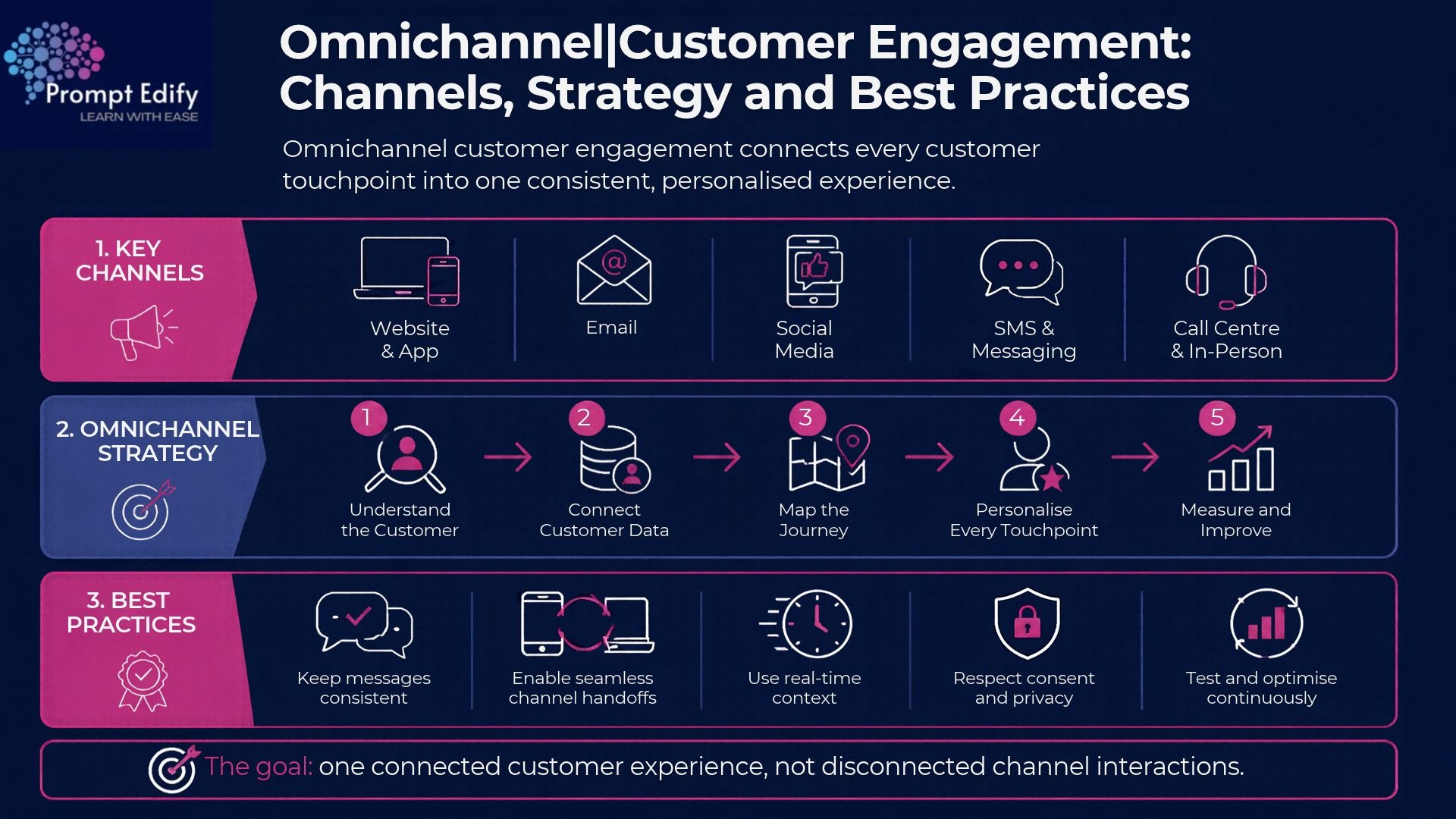
The communication channels which business organizations can use will depend upon the target audience of the business organization, its marketing objectives and consumer preferences.
The development of customer engagement strategy includes not only interaction with the client through various channels but also the knowledge of the company about its client and its communication skills.
It is necessary to understand how the client learns about the product, evaluates its advantages, buys and interacts with it. That will allow you to see all touchpoints and understand if there were any problems with communication.
For example, rather than receiving some unnecessary marketing message, a client who did not purchase after adding a product to the shopping cart may receive a relevant email notification.
Customer data is often scattered across multiple marketing channels and other internal systems of the company. This way, you will be able to understand clients' needs, purchasing history and previous interaction with the company.
Generic messages hardly cater to everyone's personal needs. Business organizations need to utilize information about their customers to tailor offers, recommendations, and communication messages.
Personalization can encompass product recommendations, location-specific information, preferred mode of communications and personalized messages based on previous purchases made by the customers.
Business organizations need to ensure that their campaign objectives are consistent across all channels of communication.
For instance, when a customer communicates back through email about a particular offer, the upcoming mobile message can be tailored accordingly.
Consent-driven communication is crucial for gaining customer confidence. Business organizations must keep track of their customer preferences regarding subscriptions and must abide by data privacy norms, if any.
The customer also needs to have control over the channel and mode of marketing communications.
Real-time customer engagement helps businesses to respond to the behaviors of their clients. However, certain elements have to be taken into account.
These are:
It is important to judge the results of campaigns in terms of metrics and not only the number of sent messages.
Campaign measurement gives the companies information on how well the engagement campaign performed. Some of the key performance measurements are:
The customer engagement services provided by SAP assist companies in managing their marketing campaigns and understanding customer behavior, and coordinating their communications through the various channels. Services like marketing automation, customer segmentation, and campaign management facilitate customer engagement.
Companies can learn about [features of SAP Engagement Cloud] if they are investigating any of these services.
With Omnichannel Customer Engagement, companies can go past the fragmented nature of marketing activities and create engaging relationships with customers. Companies can create such experiences by leveraging the integration of communication channels, customer journey mapping, customer consent and tracking the performance of campaigns.
To achieve all these, one needs to have the knowledge of customer engagement platform, marketing automation and cross-channel communication.
Prompt Edify helps individuals and organizations acquire SAP knowledge using industry specific training programs. Learn about [SAP Customer Engagement Training] and get to learn customer engagement technology and marketing capabilities and business applications.
By Team Prompt Edify
Have any enquiry? Call us
+(27) 740294414
(+91) 99932-86938
wecare@promptedify.com


Prompt Edify Africa (PTY) Limited
2nd Floor, Rivonia VillageCnr Mutual Road and Rivonia Boulevard Rivonia Village, 2191
Johannesburg , South Africa
Contact : +27740294414
Prompt Edify East Africa Limited
KN 78 ST, Kagarama, Kigali, Kigali, Nyarugenge, Umujyi wa Kigali, Rwanda
Contact : +250 727 845 771
Prompt Edify Private Limited
4th Floor #15, City Vista Tower, Fountain Road,
Kharadi, Pune(MH), India.
PIN- 411014
Contact : (+91) 99932 86938



Contact Us Today!
+27740294414 | (+91) 99932 86938 | +250 727 845 771
contact@promptedify.com | wecare@promptedify.com
🌐 https://promptedify.co.za/