
Understand preventive, corrective, and breakdown maintenance in SAP PM, when each is used, and how SAP Plant Maintenance helps manage equipment needs effectively.
Maintaining equipment is a crucial component of how any business operates, especially in fields where machinery and production equipment come into use. Problems in equipment often lead to downtime, increased maintenance expenses, damage to delivery timelines, and lower productivity of the business. This means that companies have to come up with effective methods of maintaining their equipment and keeping it in working condition.
There are three main types of maintaining equipment: preventive maintenance, corrective maintenance, and breakdown maintenance. Each of these approaches has a specific purpose based on the condition of the equipment, current operations of the company, and any possibilities of getting broken equipment.
SAP Plant Maintenance (SAP PM) allows organizations to carry out maintenance operations using documentation about the equipment, maintenance orders and notifications, as well as detailed maintenance plans. In the SAP S/4HANA platform, this tool falls under the general SAP asset management tools.
This guide describes all three approaches to maintaining equipment and discusses the possibilities of SAP solutions for the successful realization of maintenance activities.
Preventive maintenance in SAP indicates maintenance operations that are carried out on a schedule or according to machine usage and working conditions. The purpose of this process is to detect any problems in advance and ensure minimal chances of unexpected failures in equipment.
Instead of waiting for machinery to fail, it is better for companies to conduct preventive maintenance scheduling, inspections, and repairs according to the maintenance requirements outlined earlier.
For example, a manufacturer may introduce a quarterly inspection of their manufacturing machines or conduct routine maintenance after machines run a specified number of hours.
SAP Plant Maintenance gives companies the opportunity to use maintenance plans, task lists, and scheduling tools in an efficient way.
Preventive maintenance plays a significant role in the following instances:
Preventive maintenance enables the business to organize its maintenance activities in advance and carry out effective servicing of the equipment.
Corrective maintenance is the activity of determining and fixing issues or malfunctions in the equipment in order to bring it back or maintain its functionality.
Contrary to preventive maintenance, which deals with the prevention of future defects, corrective maintenance deals with the issues that have already occurred.
Nonetheless, corrective maintenance does not mean that it starts after total failure of the equipment. In some situations, it may happen that a maintenance engineer discovers a faulty part during a routine check and executes maintenance activities before the issue affects production.
Within the frame of SAP Plant Maintenance, corrective maintenance includes the process of logging a maintenance notification, investigating the problem, creating a maintenance work order, estimating resources for maintenance, and executing the maintenance.
Corrective maintenance is activated for equipment where an inspection uncovers defects in machinery that are operating but need repairs or adjustments; components that show signs of wear or deterioration; or problems identified by maintenance teams that need attention. Equally, fixing equipment so that it operates again in its required operating condition is a form of corrective maintenance. For instance, an engineer may discover a damaged component in a pump installed during the scheduled inspection. The maintenance team can arrange for corrective work to replace the component before it leads to a more serious operational problem.
Corrective maintenance therefore helps organisations address identified equipment issues through a structured process.
Breakdown maintenance follows a failure, whereby maintenance is performed after the equipment is out of order or fails in an unplanned way.
It is mainly reactive because maintenance activity is usually triggered only when a failure occurs. Breakdown maintenance aims to restore an asset to a working condition with minimum downtime and within a reasonable and safe timeframe.
For example, the stoppage of a production machine sometime during production would lead to members of the maintenance team investigating the cause, determining the damage done, and then scheduling necessary repairs.
In SAP PM, very useful breakdown information can be documented about breakdown notifications and work orders, which allow teams to plan repair activities and assign resources while documenting what has actually been completed.
Breakdown maintenance has to be undertaken in cases when:
It should be pointed out that breakdown maintenance is sometimes unavoidable, but dependence on this method may result in production downtime, expensive repair costs, and problems with maintenance management.
Although all three approaches support equipment reliability, they differ in their objectives, timing, and maintenance requirements.
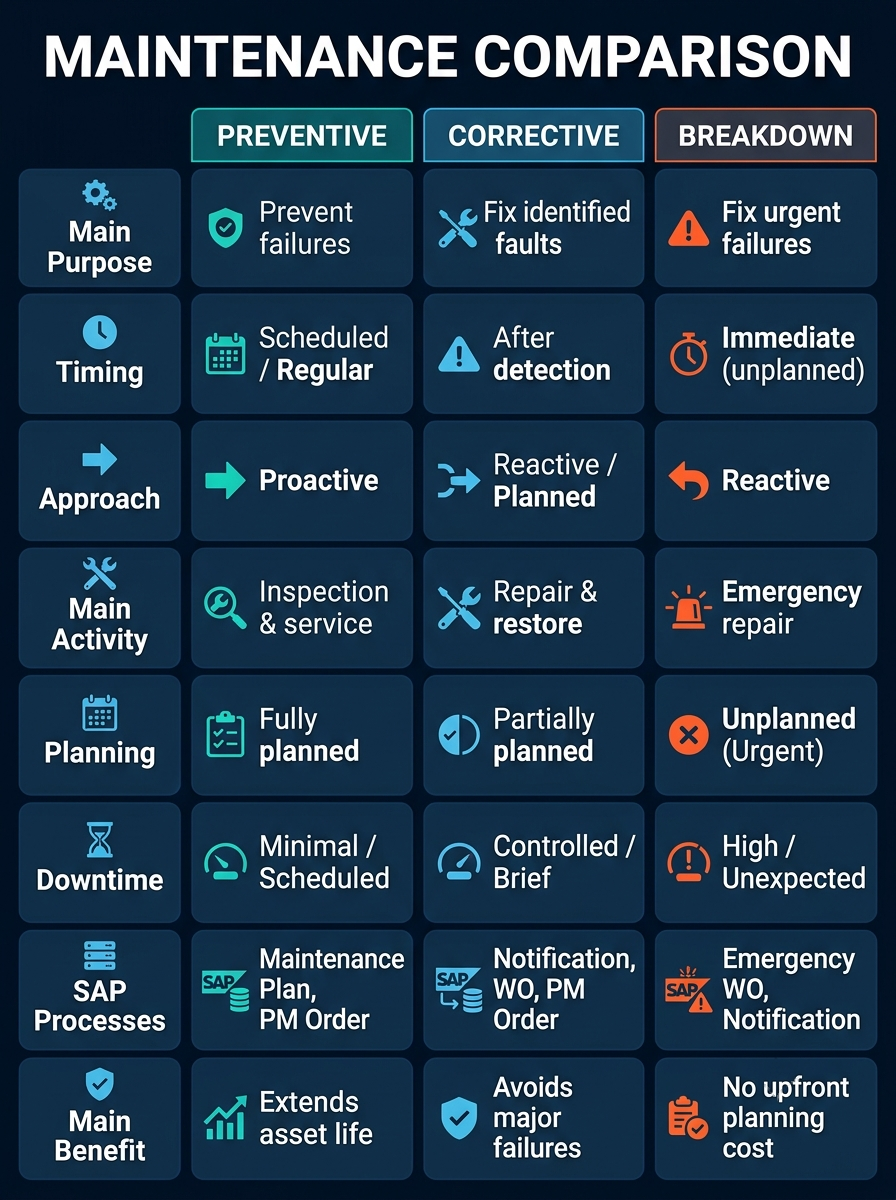
The appropriate approach depends on equipment criticality, operating conditions, maintenance costs, and business priorities. Organisations may use all three approaches within their overall maintenance strategy.
The SAP Plant Maintenance module offers organized procedures that enable organizations to control maintenance activities from the moment the problem is detected until execution of maintenance.
The following are some of the key functions of SAP PM:
Companies can keep information on their equipment and functional locations. This information helps maintenance groups to locate the equipment that needs checking or repairing.
With the help of maintenance inquiries, employees and personnel can report faults of the equipment, technical information on maintenance, and the need for maintenance.
Maintenance planning helps to carry out regular maintenance according to time or equipment running time. Scheduling makes it possible to line up maintenance operations in accordance with priorities and availability of resources.
Work orders help to construct maintenance operations since they provide information about the operations, materials used, and the results of the job.
SAP allows companies to keep records of performed maintenance processes, repairs, and servicing of the equipment.
There is no one-size-fits-all maintenance strategy applicable to every type of equipment. Firms must always take into consideration the importance of their assets, the risk of malfunctioning, expenses connected with repair, and the influence of downtime on operations and activities of their companies.
Preventive maintenance is mostly used for important machinery requiring regular maintenance. Corrective maintenance is applied when it is necessary to eliminate the problems previously identified in the machinery. Break-down maintenance is required when the equipment is out of order and needs to be fixed.
The majority of companies use a mixture of these strategies. They apply preventive maintenance for handling standard equipment needs, corrective maintenance to fix existing problems, and breakdown maintenance to react to unexpected failures.
This combination allows companies to implement efficient maintenance strategy meeting their business needs.
Professionals who deal with equipment maintenance, production processes, and asset management need to know about maintenance approaches.
SAP Asset Management Training provides learners with knowledge of technical objects, maintenance notifications, work orders, maintenance plans, scheduling, and maintenance execution.
At Prompt Edify, our SAP Asset Management Training teaches learners important and relevant concepts in SAP maintenance. The structure of the course and the training process depends on the syllabus approved beforehand.
This knowledge will allow specialists in maintenance and prospective SAP consultants get an understanding of the role of SAP in the equipment maintenance process.
In summary, there are three primary methods of dealing with equipment requirements in any given organization, namely preventive maintenance, corrective maintenance, and breakdown maintenance. Preventive maintenance is essentially scheduled work that is carried out in order to mitigate the potential for equipment failure; corrective maintenance is the process of fixing known problems that have already been discovered; while breakdown maintenance is the act of repairing the equipment after a failure has occurred.
SAP Plant Maintenance has all the features needed to support the above-mentioned maintenance processes, such as maintenance plans, notifications, work orders, scheduling, and history of equipment documentation. These aspects make up a part of the larger environment of SAP Asset Management in SAP S/4HANA and allow organizations to organize their maintenance efforts and control their fixed assets more efficiently than before.
Those who wish to learn about processes mentioned below can benefit from the SAP Asset Management training, which offers some insight into the maintenance processes and their implications for a business.
By Team Prompt Edify
Have any enquiry? Call us
+(27) 740294414
(+91) 99932-86938
wecare@promptedify.com


Prompt Edify Africa (PTY) Limited
2nd Floor, Rivonia VillageCnr Mutual Road and Rivonia Boulevard Rivonia Village, 2191
Johannesburg , South Africa
Contact : +27740294414
Prompt Edify East Africa Limited
KN 78 ST, Kagarama, Kigali, Kigali, Nyarugenge, Umujyi wa Kigali, Rwanda
Contact : +250 727 845 771
Prompt Edify Private Limited
4th Floor #15, City Vista Tower, Fountain Road,
Kharadi, Pune(MH), India.
PIN- 411014
Contact : (+91) 99932 86938



Contact Us Today!
+27740294414 | (+91) 99932 86938 | +250 727 845 771
contact@promptedify.com | wecare@promptedify.com
🌐 https://promptedify.co.za/