
Explore PCF and CCF differences, including emission scope, data collection, reporting, business applications, and how both support enterprise carbon management.

In the era of corporate sustainability, carbon emissions have become one of the main aspects that should be considered in operational processes, supply chain management, and even environmental reporting. But to comprehend where the emissions come from, it is not enough to estimate the carbon footprint of a corporation. The organization needs to estimate the carbon emissions associated with the production of particular goods.
Here comes into play such topics as Product Carbon Footprint vs Corporate Carbon Footprint. Both methodologies allow for measuring the GHG emissions, but the differences lie in other aspects.
The Product Carbon Footprint (PCF) is a measurement of the greenhouse gas emissions of a certain product in the specified part of its entire life cycle. According to the scope of the study, the PCF includes raw materials extraction, production, transportation, packaging, usage of the product, and recycling.
It is a useful tool that allows companies to know what amount of carbon corresponds to the production and delivery of a certain product. It can be calculated by any manufacturing company for such products as steel, food products, electronics, material, and so forth.
The process of assessment involves:
It is usually measured in kilograms or tonnes of CO₂e per product or functional unit.
Corporate Carbon Footprint (CCF) refers to the amount of greenhouse gases that an organization emits during its activities for the reporting period, which is usually one year.
As opposed to PCF, which refers to a specific product, CCF provides information about the environmental impacts of the organization as a whole. It is used in corporate carbon accounting to help organizations identify sources of emissions in their activities.
The most common types of emissions included in CCF are as follows:
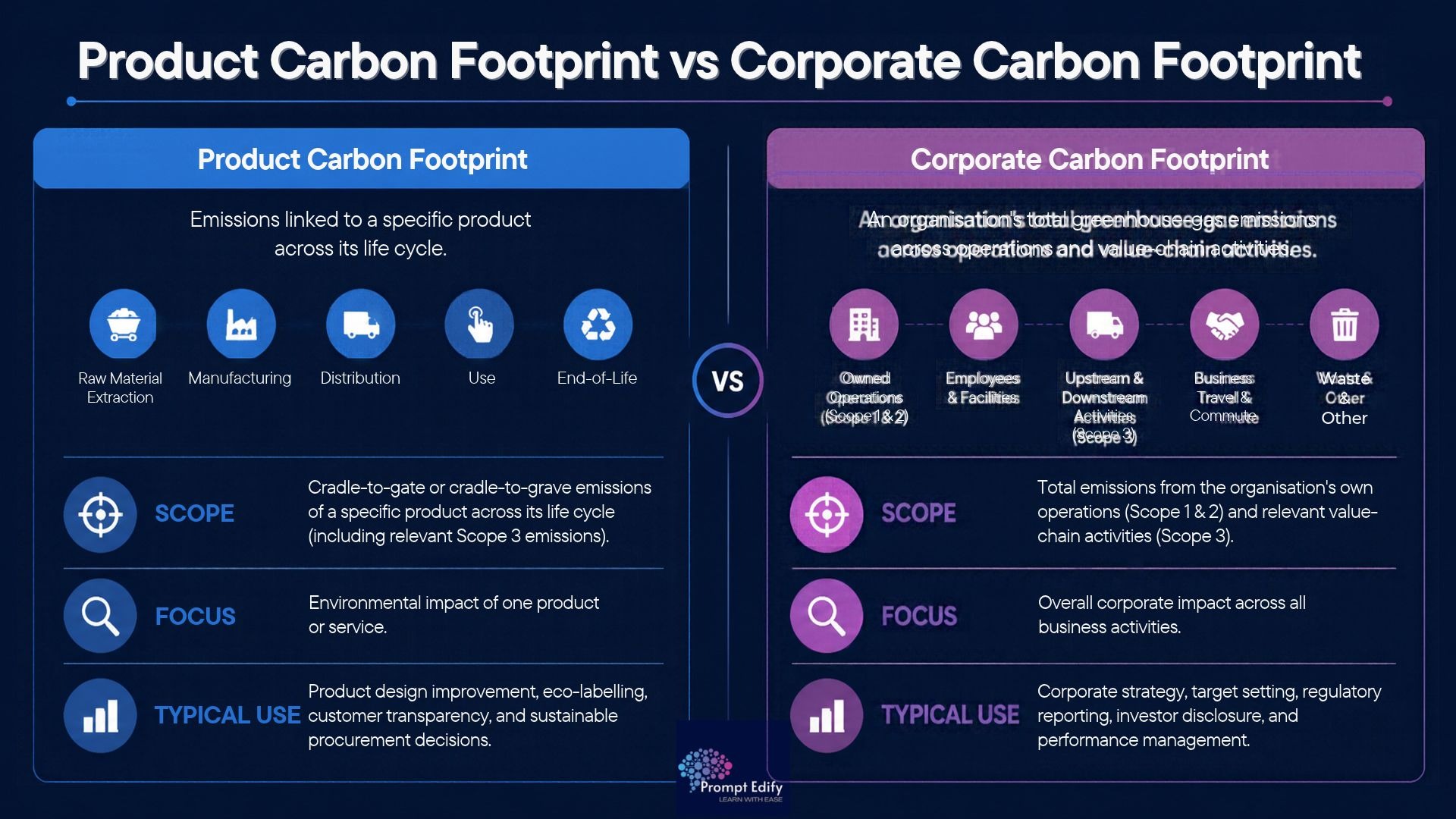
PCF (Product Carbon Footprint) and CCF (Corporate Carbon Footprint): Difference Between the Terms
Although PCF and CCF both relate to emissions of greenhouse gases, the slight difference lies in their method of calculation of those emissions.
PCF measures the emissions during the entire life cycle of a particular product (cradle to gate, cradle to grave, etc).
CCF takes into account the activities of a particular company along with the activities of its value chain.
For the calculation of PCF, information is needed about the product in relation to the consumption of materials, energy input, transportation, emissions from the suppliers and manufacturing.
Sources of data collection for CCF are fuel use, electricity use, employee travel, purchasing and activity data.
PCF calculations are done on a per-product basis or per functional unit, and this allows for an evaluation of the environmental impact of a particular product.
CCF calculations are done across organization-level operations, and are reported on an annual basis in tonnes of CO2e.
PCF can be used in product development, eco-design, sustainable procurement, comparative purposes for customers, and communication of the product’s environmental impact.
CCF can be used in sustainability reporting, emissions reductions planning, regulatory readiness, and communication.
Both PCF and CCF should not be considered competing sustainability indicators. The two are complementary and offer distinct perspectives on the environment impact.
Carbon accounting allows the firm to assess its overall emissions inventory while product carbon footprint measurement allows us to understand the environmental impact of particular products.
For example, a manufacturing firm may discover through CCF measurement that its emissions under Scope 3 are mainly because of the use of materials. At this point, PCF measurement becomes useful in understanding the products or suppliers causing such emissions.
This will enable the firm to make wise decisions regarding its suppliers, energy consumption, material substitution, production process, and product design.
Manually managing the carbon footprint of products and enterprises could be difficult when the enterprises have several sites, products, vendors, and geographical locations involved.
Digital sustainability solutions aid in linking business data with environmental data. These could include emissions calculations, business data integration, application of emission factors, analysis of results, and visibility of sustainability performance.
Digital solutions like SAP Sustainability Footprint Management assist organizations in assessing their carbon footprint of products and enterprises with business data and sustainability calculation capabilities.
Enterprises interested in learning more about this could check out SAP Sustainability Footprint Management Training for learning about footprint calculations, data integration, sustainability analysis, and enterprise carbon management.
Read our previous blog SAP Sustainability Footprint Management: Complete Guide for an overall understanding of its purpose, capabilities, and application in sustainability management.
PCF and CCF can be differentiated on the basis of assessment boundary and its purposes. While PCF deals with the assessment of greenhouse gas emissions produced by one particular product, CCF measures the organization's emissions as a whole.
Both measurements are equally useful for companies aiming at sustainable development. The use of both measurements allows revealing hotspots and making further improvement and optimization of the supply chain as well as the company's strategy of reducing its carbon footprint.
The knowledge of PCF and CCF becomes the primary step towards building a data-driven strategy for enterprise sustainability.
Prompt Edify provides professionals and companies with an opportunity to become experts in SAP technology and digital transformation solutions through industry-based training.
Learn more about our programs to enhance your knowledge in SAP sustainability solutions.
By Team Prompt Edify
Have any enquiry? Call us
+(27) 740294414
(+91) 99932-86938
wecare@promptedify.com


Prompt Edify Africa (PTY) Limited
2nd Floor, Rivonia VillageCnr Mutual Road and Rivonia Boulevard Rivonia Village, 2191
Johannesburg , South Africa
Contact : +27740294414
Prompt Edify East Africa Limited
KN 78 ST, Kagarama, Kigali, Kigali, Nyarugenge, Umujyi wa Kigali, Rwanda
Contact : +250 727 845 771
Prompt Edify Private Limited
4th Floor #15, City Vista Tower, Fountain Road,
Kharadi, Pune(MH), India.
PIN- 411014
Contact : (+91) 99932 86938



Contact Us Today!
+27740294414 | (+91) 99932 86938 | +250 727 845 771
contact@promptedify.com | wecare@promptedify.com
🌐 https://promptedify.co.za/