
Discover sales territory management strategies, including territory structures, account allocation, workload balancing and sales coverage optimization.

As a company expands its reach and scope of operations in different geographical locations and industrial sectors, it becomes difficult to manage its sales staff. Lack of proper planning can result in the following consequences:
Many salespeople will be contacting the same clients;
Important clients may not get enough attention from salespeople; and
Some regions will produce better sales results than others.
It is here that sales territory management comes in handy. Sales territory management makes sure that sales activities are organized by dividing markets into territories and allocating clients to each representative.
Sales territory management refers to the act of segmenting geographical regions, customer accounts, or markets and then assigning them to people or groups in sales.
A sales territory can be segmented in different ways including geographical location, industry, size of customers, category of products or revenue opportunity. A business that operates in all of South Africa will have to segment their sales into Johannesburg, Cape Town, Durban and many other territories.
These territories will then be assigned to particular salespersons who will be charged with building relationships with the customers and generating sales.
Territory management will ensure that companies have clear sales responsibility as well as offering customers consistency.
Sales territory hierarchy is a concept which helps describe how companies classify their sales territories using a hierarchy system.
There is an existing relationship between large sales territories and small sales territories.
The sales territory hierarchy system consists of the following elements:
For example, the parent territory of a company could be South Africa while the sub-territories include Johannesburg, Cape Town, Durban and others.
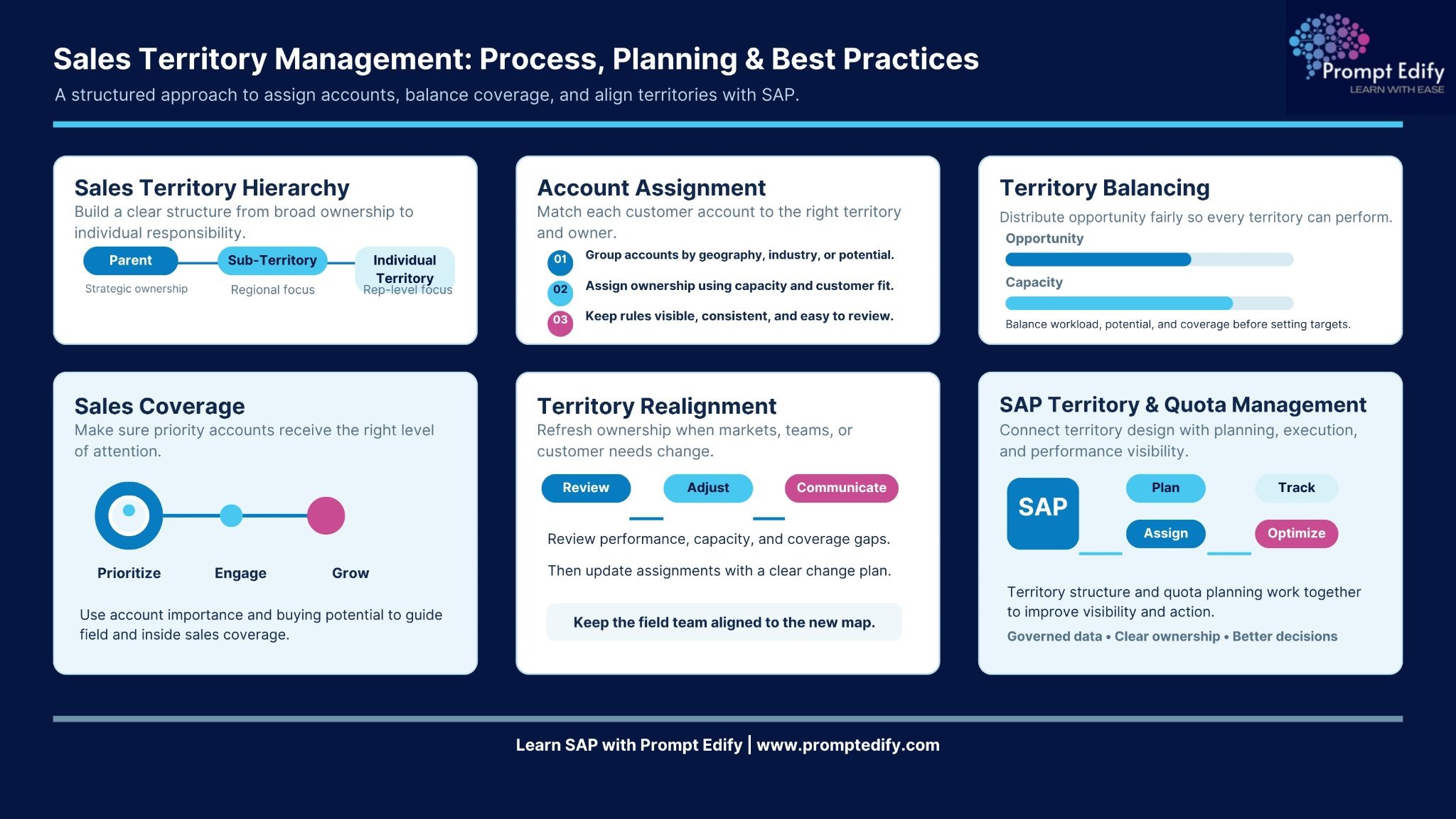
Account allocation consists of allocating customers to appropriate sales territories and account representatives. In other words, each customer receives the attention from appropriate sales force.
The firm will always have some guidelines that it uses in allocating accounts:
Proper allocation of accounts prevents duplication of efforts from the sales force members.
Territory balancing means balancing the sales opportunity and workload across different territories. All the territories do not have the same number of accounts, revenue potential and demand from the market.
One salesman might have 200 customer accounts, whereas another salesman may have 50 enterprise customer accounts. Comparing the number of accounts will not be a good measure of their workload.
A good territory balancing approach takes into account:
Balanced territories ensure that the organizations do not overburden certain salesmen and also don’t miss out on any good market opportunities.
Sales coverage means how well the firm is able to cover and serve its potential and current clients within its allocated territories.
Efficient sales coverage enables firms to discover new market opportunities, build good relations with the clients, and enhance sales.
Some of the ways through which firms can enhance sales coverage within their territories include:
Sales coverage enables the sales team to focus on profitable opportunities rather than focusing on only their known clients.
Redistricting of territories involves reevaluating and reshaping the current state of affairs in regard to territories due to changes in business or the market.
Territory that was successfully used 2 years ago might not be suitable for the current needs of the business. New clients, new employees, company growth and market requirements can make this change necessary.
Common circumstances of territorial redistricting include:
Before making any territorial changes, it is advisable to look at the history of sales, client relations, prospects of the region, and impact on current accounts.
The administration of the territory structure, account assignments, and sales quotas via different spreadsheet files can be rather complicated. SAP sales management functionality is able to assist companies in better understanding customer accounts, sales operations, and territories.
Companies can take advantage of appropriate SAP products in order to plan territories, track sales opportunities, assign accounts, and analyze sales performance.
If people want to acquire practical skills in the matter, they can enroll in SAP Quota Management Training and other SAP Territory and Quota Management courses at Prompt Edify.
Management of the sales territories makes sure that the organization is able to establish a suitable sales environment with the help of establishing sales territories, customer accounts allocation, balancing work load, and covering market areas. By continuously reviewing and modifying sales territories, it will be useful in making sure that the sales process remains effective according to the needs of the business.
Proper planning and SAP sales management can help in making the sales process more effective for the organization.
Industry-specific SAP training provided by Prompt Edify allows professionals to understand better their business processes and SAP solutions.
Discover industry-specific SAP training modules.
By Team Prompt Edify
Have any enquiry? Call us
+(27) 740294414
(+91) 99932-86938
wecare@promptedify.com


Prompt Edify Africa (PTY) Limited
2nd Floor, Rivonia VillageCnr Mutual Road and Rivonia Boulevard Rivonia Village, 2191
Johannesburg , South Africa
Contact : +27740294414
Prompt Edify East Africa Limited
KN 78 ST, Kagarama, Kigali, Kigali, Nyarugenge, Umujyi wa Kigali, Rwanda
Contact : +250 727 845 771
Prompt Edify Private Limited
4th Floor #15, City Vista Tower, Fountain Road,
Kharadi, Pune(MH), India.
PIN- 411014
Contact : (+91) 99932 86938



Contact Us Today!
+27740294414 | (+91) 99932 86938 | +250 727 845 771
contact@promptedify.com | wecare@promptedify.com
🌐 https://promptedify.co.za/