
Explore SAP APM for asset health, condition monitoring, predictive maintenance, and reliability insights for smarter equipment maintenance and planning at work.
For an effective conduct of operations, it is necessary that the industry has the correct equipment and machinery. Problems in terms of machine breakdowns and increased maintenance costs can affect the performance and efficiency of the process. There is need for better assessment and decision making about equipment conditions for solving such problems.
This is where SAP APM plays a vital role. SAP APM makes it possible for organizations to get insight on the health of the assets, performance monitoring of the equipment and use of the insights obtained to carry out maintenance works. SAP APM Condition Monitoring Insights will help in understanding the connection between asset health monitoring and condition-based maintenance.
SAP Asset Performance Management (SAP APM) is a management strategy that facilitates the measurement, monitoring, analysis, and optimization of the performance and reliability of tangible assets of an organization.
It combines all the information about the assets and their performance for the purpose of helping the maintenance personnel assess the state of the assets and the possible risks involved in operations.
The capabilities of SAP APM include asset condition monitoring, performance analysis, risk assessment, and decision making in the context of maintenance activities.
Asset Health Monitoring is a process through which an entity assesses the health and performance of its assets in real time. It allows the company to tell if the asset is operating normally and does not show any signs of wear and tear.
The Maintenance department of the organization is able to monitor several indicators including temperature, vibrations, pressure, runtime, and performance level of the assets.
Unexpected increase in temperature, for example, may indicate the presence of some issues with the machinery. By monitoring these data, one can investigate the asset health condition and see whether it requires maintenance.
With SAP APM, organizations can utilize asset information to make asset health decisions.
Condition monitoring is the practice of monitoring equipment parameters that might signify possible future failure.
The data collected from various sources such as sensors, inspection reports, and operation systems is used to analyze the condition of the equipment.
Examples of common parameters for condition monitoring include:
SAP APM Condition Monitoring allows one to understand how condition data can be useful for the analysis of equipment conditions.
Predictive maintenance involves using condition information of the equipment, information from the past as well as the analysis that would help predict equipment failure in the future.
While reactive maintenance is done after equipment failure, predictive maintenance focuses on predicting the failure patterns and developing a maintenance plan from the results.
These involve:
The concepts involved in SAP Predictive Maintenance are very simple for learners to understand how the process works.
Some significant elements for systematic knowledge about SAP APM are as follows:
All the above-mentioned elements help organizations to understand the behavior of equipment and decide about the necessity of maintenance.
Asset Performance Monitoring comprises assessing the performance of machinery by means of relevant operational parameters.
Examples of commonly assessed parameters include equipment availability, operating temperature, vibration, failure rate, cost of maintenance, and equipment usage.
Asset Performance Analysis enables maintenance staff to detect the performance deficiencies, recognize the recurring problems, and assess equipment reliability.
For instance, excessive vibration changes may suggest a growing mechanical problem. With the help of the above information, maintenance staff can examine the equipment and take corrective action.
Detection of abnormal asset conditions is one of the key elements of equipment reliability management.
The presence of abnormal conditions means that the equipment is performing not according to its normal range and behaves unpredictably.
This may include increase in temperature, pressure changes, vibration and decrease in efficiency.
Thus, by analyzing the state of the equipment, the companies are able to identify these problems and understand their causes.
This enables Equipment Failure Prediction.
Information about the asset status is important when conducting maintenance operations. Information gathered through operational readings, maintenance records, equipment inspection, and performance indicators provide useful information about the status of the equipment.
The maintenance staff can utilize this information in:
Through this, organizations will be able to conduct maintenance operations based on the status of their equipment rather than prearranged times.
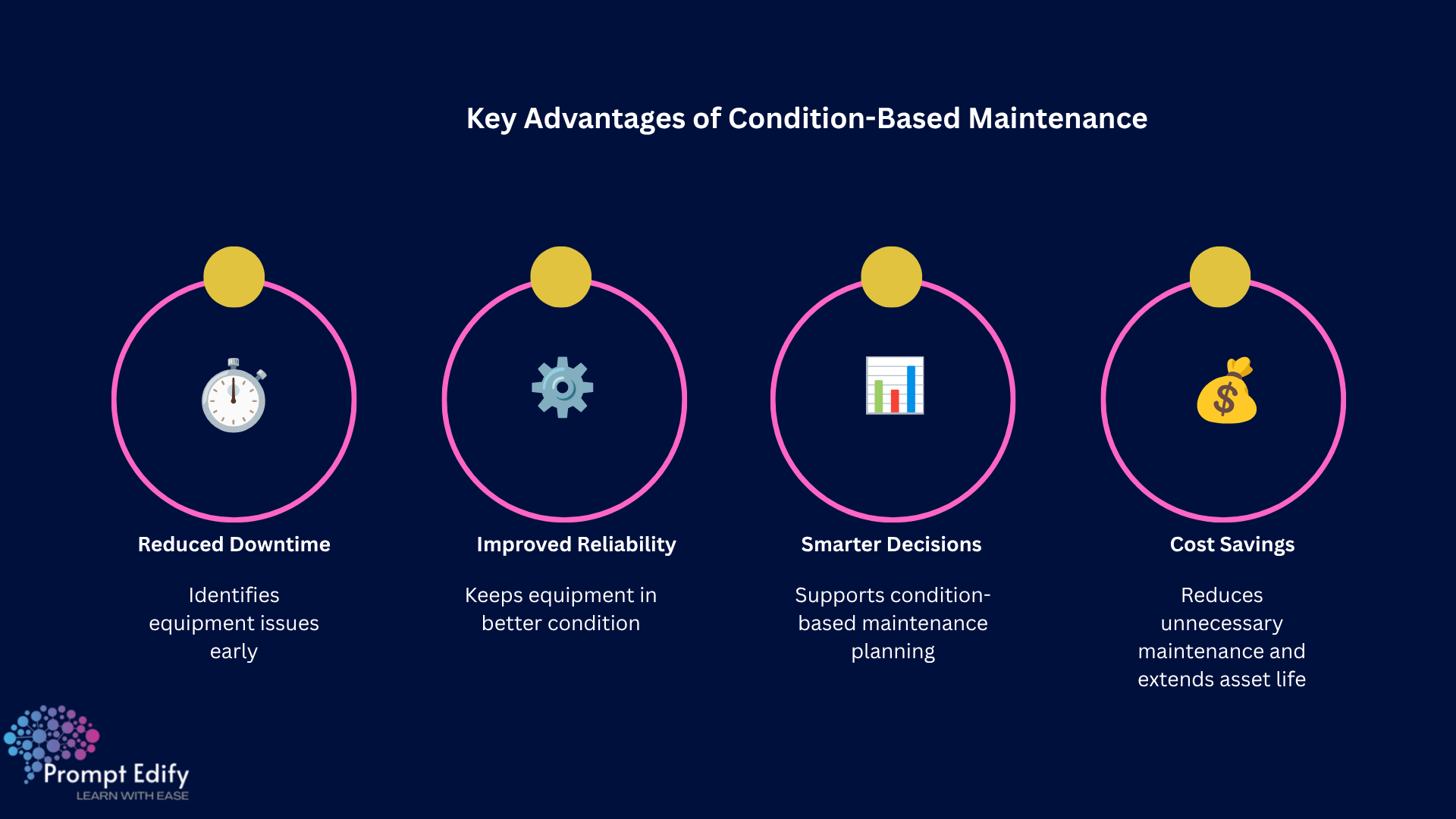
Condition-Based Maintenance entails carrying out maintenance activities at the time when there is a need for it based on the state of the equipment.
While conventional methods of maintenance entail the use of fixed schedules, the new method is based on the condition of the equipment.
Benefits of the strategy include:
The knowledge gained from SAP APM learning will enable the learners to gain insight into the current asset management methods and the manner in which technology is employed to enhance the performance of the equipment.
The course syllabus should contain topics like SAP APM basics, asset health monitoring, condition monitoring, predictive maintenance, performance metrics, and real-life examples of the application of the above.
The integration of asset monitoring health, condition monitoring, and predictive maintenance is done through SAP APM to enable better management of assets.
With the knowledge gained from learning SAP APM Condition Monitoring, one gains an insight on how condition-based information can help in Asset Performance Management and equipment reliability.
Would you like to learn more about SAP Asset Performance Management? Feel free to get in touch with Prompt Edify.
By Team Prompt Edify
Have any enquiry? Call us
+(27) 740294414
(+91) 99932-86938
wecare@promptedify.com


Prompt Edify Africa (PTY) Limited
2nd Floor, Rivonia VillageCnr Mutual Road and Rivonia Boulevard Rivonia Village, 2191
Johannesburg , South Africa
Contact : +27740294414
Prompt Edify East Africa Limited
KN 78 ST, Kagarama, Kigali, Kigali, Nyarugenge, Umujyi wa Kigali, Rwanda
Contact : +250 727 845 771
Prompt Edify Private Limited
4th Floor #15, City Vista Tower, Fountain Road,
Kharadi, Pune(MH), India.
PIN- 411014
Contact : (+91) 99932 86938



Contact Us Today!
+27740294414 | (+91) 99932 86938 | +250 727 845 771
contact@promptedify.com | wecare@promptedify.com
🌐 https://promptedify.co.za/