
Discover SAP Asset Performance Management, its key features, asset monitoring, risk management, predictive maintenance, and benefits for equipment reliability.

It is important to manage equipment and physical assets efficiently in order to maintain efficient operation of the business. Ineffective management of these assets can result in equipment malfunction, expenses related to maintenance of the equipment and downtime that might impact the business performance. Businesses require solutions that would allow them to monitor asset conditions and enhance reliability of the equipment.
This is when SAP Asset Performance Management comes into play. This solution allows businesses to understand asset condition, evaluate equipment performance and decide about necessary maintenance of the equipment. However, what is SAP Asset Performance Management and why do businesses need it?
An Asset Performance Management (APM) methodology involves the process where companies will be able to measure, analyze and enhance the performance and reliability of physical assets throughout their lifecycles.
This methodology involves analyzing the condition of the equipment, recognizing possible hazards and planning maintenance processes.
This method allows for making proactive decisions regarding equipment using information about assets and performance metrics.
This is an issue that is being asked by many people who have an interest in asset management solutions.
SAP Asset Performance Management is one of the SAP solutions used by organizations to enhance the reliability of their assets, check equipment health and plan on maintenance through asset information and analytics.
SAP Asset Performance Management is also referred to as SAP APM, which provides support to maintenance and reliability personnel in understanding the condition of equipment, risks related to assets and performance improvements.
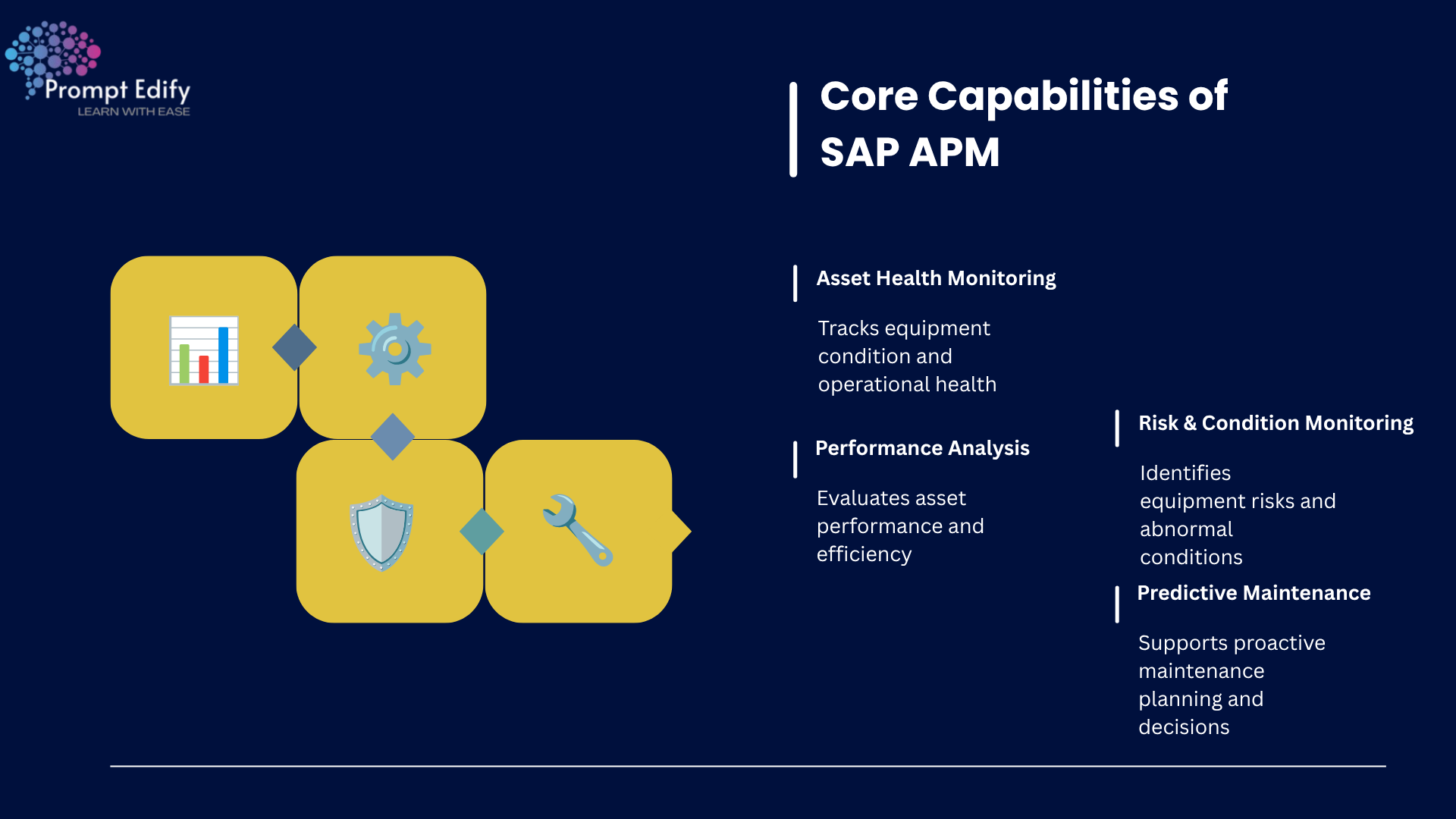
Some of the functionalities of SAP APM that are useful in monitoring and evaluation of the equipment as well as increasing their reliability include:
Asset Health Monitoring is a key component of SAP Asset Performance Management. This makes sure that companies know whether their machines operate as expected.
Temperature, vibration, pressure, operating time, and performance of the machine can be analyzed by the maintenance team.
Sudden increase in machine vibration could indicate the presence of some mechanical issue in the machine.
Also, through Asset Performance Monitoring, companies can gauge the availability of their equipment and performance issues.
Risk management of assets requires knowing the possible risks that can occur from the equipment and its effects on business operations.
All assets do not carry the same degree of importance when it comes to business operations. Failure in important production equipment will impact the whole production process, while the less important production equipment may not have much effect.
SAP APM is a system that helps with the evaluation of equipment conditions and their risk assessment.
Asset Reliability Management aims at increasing equipment reliability.
Predictive maintenance and condition monitoring are some of the terms that are commonly associated with modern asset management.
Condition monitoring is defined as the process of monitoring the conditions of equipment to detect any abnormal condition that might be developing.
Predictive maintenance utilizes equipment conditions, data, and analytics to aid in the detection of any possible equipment failure before it happens.
As an illustration, if a machine exhibits any abnormal temperatures or vibrations, it would be prudent to analyze the condition of the machine and undertake the appropriate action.
Using SAP Asset Performance Management is likely to enable organizations to enhance the reliability and maintenance of their physical equipment.
The major benefits that such implementation can provide are:
Those who are interested in the area of asset management can learn from SAP APM training on how technology can be used to manage equipment performance.
Training should include such topics as SAP Asset Performance Management basics, asset health monitoring, condition monitoring, risk assessment of assets, performance analysis, and predictive maintenance.
It is also important for learners to know how asset information is used in maintenance activities and equipment reliability management.
It is necessary to look into the syllabus of a training course, examples and learning goals when choosing training courses.
SAP Asset Performance Management assists enterprises in monitoring the health of their assets, measuring risks related to equipment, and increasing asset reliability. Its features include condition monitoring, performance evaluation, and proactive maintenance.
Knowing what SAP Asset Performance Management is will enable the professionals to understand how the modern techniques of asset management assist in improving the performance of equipment.
Interested in enhancing your understanding of SAP asset management? Reach out to us at Prompt Edify for SAP APM training and courses.
By Team Prompt Edify
Have any enquiry? Call us
+(27) 740294414
(+91) 99932-86938
wecare@promptedify.com


Prompt Edify Africa (PTY) Limited
2nd Floor, Rivonia VillageCnr Mutual Road and Rivonia Boulevard Rivonia Village, 2191
Johannesburg , South Africa
Contact : +27740294414
Prompt Edify East Africa Limited
KN 78 ST, Kagarama, Kigali, Kigali, Nyarugenge, Umujyi wa Kigali, Rwanda
Contact : +250 727 845 771
Prompt Edify Private Limited
4th Floor #15, City Vista Tower, Fountain Road,
Kharadi, Pune(MH), India.
PIN- 411014
Contact : (+91) 99932 86938



Contact Us Today!
+27740294414 | (+91) 99932 86938 | +250 727 845 771
contact@promptedify.com | wecare@promptedify.com
🌐 https://promptedify.co.za/