
Explore each stage of the SAP Ariba Sourcing Process, from defining business requirements and inviting suppliers to evaluating bids and awarding contracts.

Procurement process is the crucial process that helps firms function properly, reduce cost and develop connections with the supplier. However, it may be difficult for companies to evaluate and negotiate the terms and conditions between themselves and suppliers through emails and spreadsheets. This is why there is a need for a systematized process in order to manage the sourcing and procurement process effectively.
And this is where the SAP Ariba Sourcing Process could be of great use. It allows firms to execute their sourcing operations online starting from evaluating the purchasing needs, comparing offers and awarding suppliers with their offers. Having all the sourcing information organized in one place will make it easier for firms to coordinate with suppliers and procurement teams.
Thus, let us have a look on how the SAP Ariba Sourcing Process works.
SAP Ariba Sourcing is a platform designed to handle the tasks of strategic sourcing such as supplier sourcing, sourcing events, bidding, negotiations, and awarding of bids. The solution offers procurement professionals tools to handle competitive sourcing events while assessing the bids received from suppliers based on the business requirements set out.
Depending on the particular SAP Ariba platform used by an organization and the configuration & licensing thereof, possible functionalities can range from sourcing projects, RFIs, RFPs, RFQs, auctions, and supplier collaboration.
Ultimately, the main purpose of the SAP Ariba Sourcing process is to make the sourcing process more structured.
In the first place, the procurement department should learn what the organisation needs to procure. The team cooperates with other departments to gather information about the goods, materials or services needed for the company.
Among the key information the teams obtain at this stage, there are the following:
Clear requirements allow the procurement specialists to explain expectations to suppliers and avoid misunderstanding while sourcing.
After that, the procurement team creates a sourcing project plan. In the SAP Ariba Sourcing tool, users have an opportunity to structure all activities within sourcing projects, depending on the configuration of the solution.
Project planning includes setting objectives, identifying stakeholders, planning timeframes and selecting criteria for evaluating suppliers.
For instance, a manufacturing company procuring raw materials may prioritize such factors as product quality, reliability of delivery, prices and supplier capacity.
After proper planning comes source event creation, which is where the procurement team invites suppliers to submit their data, quotations or proposals.
Based on the business needs, there are several types of events that organizations can choose from:
The source event contains all the necessary specifications and other relevant details regarding the submissions.
After publishing the event, the selected suppliers are invited to take part in it. Suppliers are able to review the requirements, seek clarifications, and send their responses through the portal that is made for the supplier.
It becomes easier for the procurement teams to manage the participation of the suppliers in the events.
This process is beneficial in eliminating lengthy email communications.
Following the submission deadline, the procurement team moves on to the evaluation of supplier proposals. This is one of the most critical steps of the SAP Ariba Sourcing process since the decision should be based not only on the most favorable quotation.
Among those aspects that may be included in the evaluation process are:
There is software available for this step within SAP Ariba Sourcing. The teams can use scoring and scenario analysis according to the configuration.
It should be noted that the procurement process does not end after the proposal evaluation process as there may still be negotiations with the selected suppliers. It is done in order to make sure that the agreement is commercially viable, but the quality and deliveries meet the required criteria.
After the completion of proposal evaluation and negotiation process, the awards can be made.
The process of making award decisions may entail the selection of one supplier or the use of several suppliers.
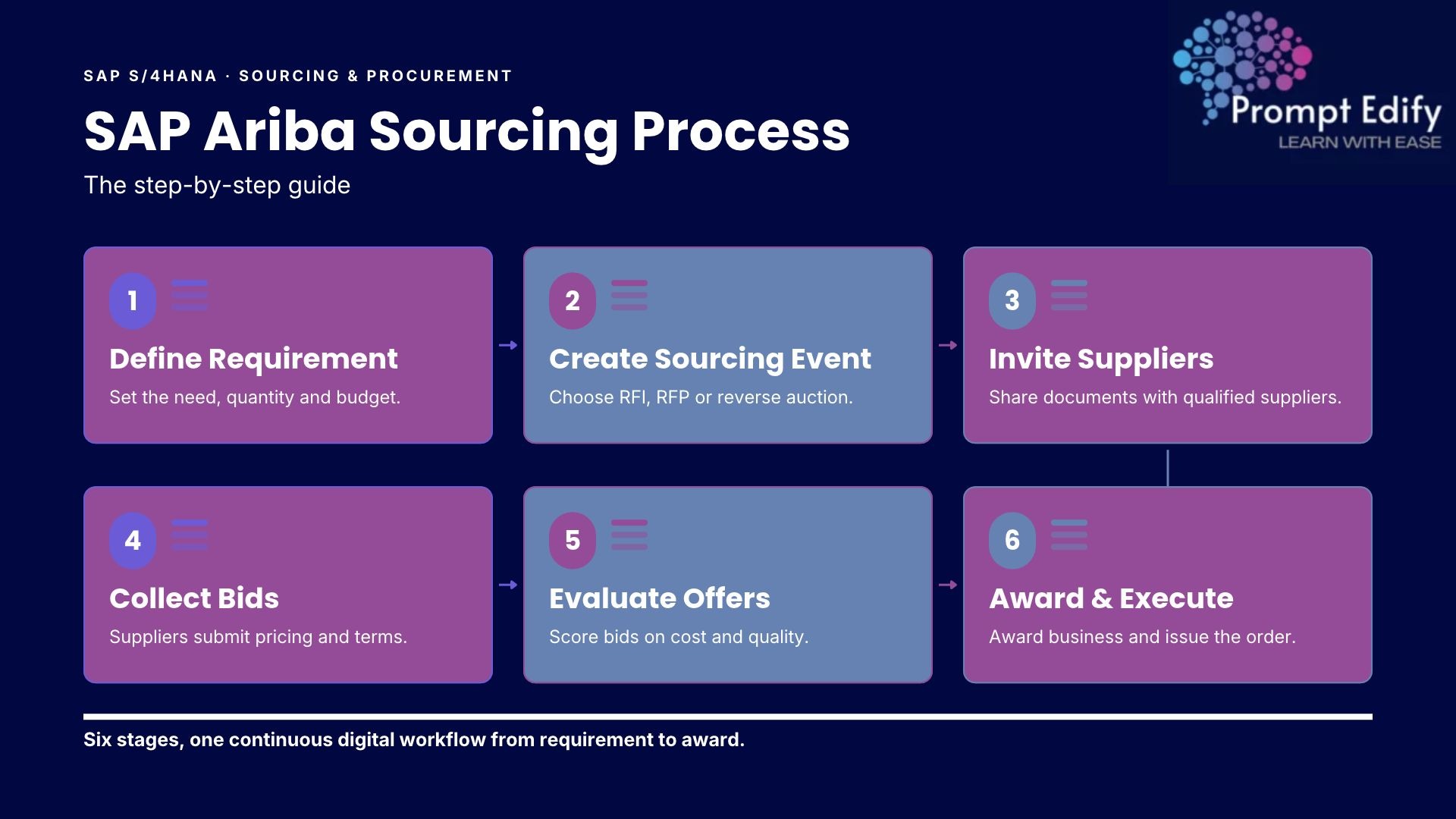
This step involves the closure of the sourcing process, as well as preparation for the subsequent procurement process. Depending on the organizational structure and SAP solutions in use, the selected data will be used in the creation of the contract or in the other procurement process.
The documents of the sourcing process are also crucial in assessing the performance of the suppliers.
There is quite a number of advantages that sourcing in a process can bring for a company:
The above mentioned advantages are based on certain SAP Ariba solutions.
SAP Ariba Sourcing Process gives companies a framework that helps them organize their sourcing needs, plan projects, execute sourcing processes, get supplier proposals and bid evaluations, and take decision on awarding. All these contribute to better procurement process management and smarter supplier selection.
Knowing about these stages will be helpful for procurement professionals to work effectively with the help of the digital sourcing solution.
At Prompt Edify, we provide professional expertise and training services which help professionals gain practical understanding about SAP solutions. Know more about SAP Ariba and its concepts with our training programs.
By Team Prompt Edify
Have any enquiry? Call us
+(27) 740294414
(+91) 99932-86938
wecare@promptedify.com


Prompt Edify Africa (PTY) Limited
2nd Floor, Rivonia VillageCnr Mutual Road and Rivonia Boulevard Rivonia Village, 2191
Johannesburg , South Africa
Contact : +27740294414
Prompt Edify East Africa Limited
KN 78 ST, Kagarama, Kigali, Kigali, Nyarugenge, Umujyi wa Kigali, Rwanda
Contact : +250 727 845 771
Prompt Edify Private Limited
4th Floor #15, City Vista Tower, Fountain Road,
Kharadi, Pune(MH), India.
PIN- 411014
Contact : (+91) 99932 86938



Contact Us Today!
+27740294414 | (+91) 99932 86938 | +250 727 845 771
contact@promptedify.com | wecare@promptedify.com
🌐 https://promptedify.co.za/