
Explore SAP B2B vs B2C Commerce, their differences in pricing, ordering, customer experience, and business use cases, and learn how SAP Commerce supports both models.
Digital commerce platforms are used by companies nowadays to sell their products and services to clients around the world. Nevertheless, not all online stores operate alike. Business-to-business (B2B) commerce describes transactions between businesses, while business-to-consumer (B2C) commerce is defined as selling directly to customers. Knowing the differences in the functioning of these models is important for businesses to select the proper strategy and technology.
SAP Commerce allows businesses to implement both B2B and B2C strategies by enabling them to control their product catalogues, prices, accounts, shopping carts, orders, and digital stores. Although these two models operate in a similar way, their goals are substantially different.
B2B commerce stands for the trading of goods and services between enterprises. One example of B2B commerce is when a manufacturer sells materials to another manufacturer, and a wholesaler sells to retailers.
Whereas consumers buy a small number of items, business buyers are used to ordering a large quantity of products, negotiating prices, and following a systematic buying strategy. B2B transactions are more complex than B2C transactions and may include several departments, approval flows, and long-term relationships with suppliers.
Among the key B2B commerce features are:
B2B commerce technology facilitates the management of these complicated processes
B2C commerce is characterized by transactions where a company sells its products directly to individuals or consumers. This form of commerce is visible in online retail shops, fashion and clothing websites, electronics stores, and even direct-to-consumer brands. B2C commerce primarily centres around giving customers the best convenience when shopping, making this process easy. Normally, customers would go through catalogs of products, compare offers, select items, and pay for the selected items on their own.
The essence of B2C commerce can be summarized in the following points:
Although B2B and B2C commerce share basic functions such as product browsing, shopping carts, and order management, they differ in how these capabilities are used.
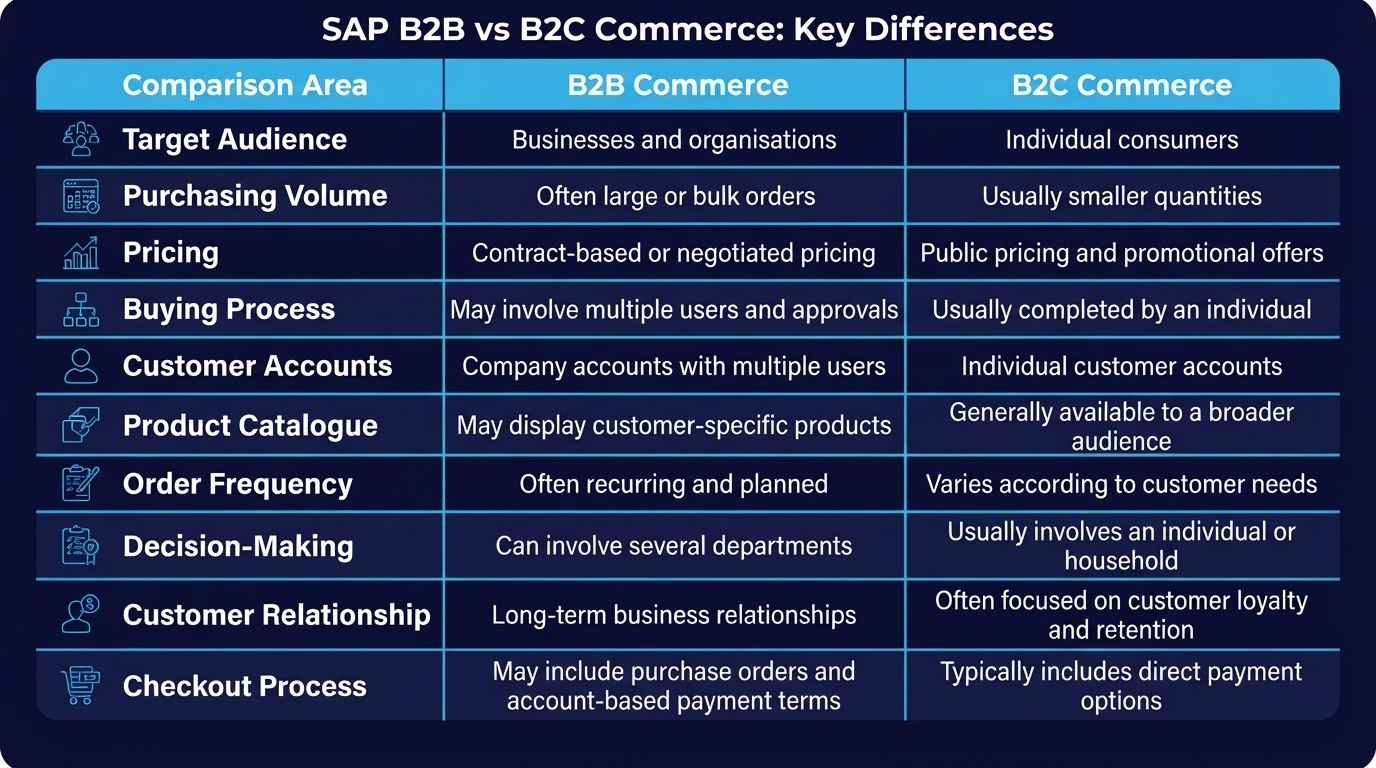
These differences influence how businesses configure their commerce platforms and manage customer interactions.
B2B commerce is beneficial for companies that provide goods and services to clients. It aids in simplifying the procurement process, enhancing order follow-up, and facilitating the sustainability of business relationships.
Manufacturers tend to offer items that other companies need, including parts, machines, spare parts and raw materials. A B2B commerce system makes it possible for corporations to gain access to product details, specific prices, and ways of placing orders.
For instance, a car maker can directly place orders from suppliers via the digital channel.
Wholesale dealers buy goods in bulk and pass them along to customers. They deal with numerous orders and lengthy product lists.
With the help of B2B commerce, companies can sell goods online and allow business clients to buy them regularly without the hassle of making frequent orders.
Large firms frequently buy office supplies, machinery, maintenance supplies, and other operational materials. B2B e-commerce can facilitate organized procurement processes, including managing accounts and approving orders.
This can assist companies to enhance visibility in their purchasing processes and minimize manual processing of orders.
B2C e-commerce is ideal for companies that directly sell to their customers via their websites, mobile apps, and other digital media.
Retailers that sell clothes, electronics, furniture, and household items can utilize B2C business to deliver online shopping experience. Potential customers can view various categories of goods available, and they can compare prices and buy the desired item without visiting brick-and-mortar shops.
Businesses that make direct sales to their clients can leverage B2C e-commerce to manage their digital assets, their product information, their offers, and their consumers’ accounts as well.
For instance, a cosmetics company can sell through its own website and offer personalized recommendations and product choices.
Companies providing cell phones, laptops, gadgets, and lifestyle products depend heavily upon product discovery, promotional campaigns, and a convenient checkout experience.
B2C companies facilitate businesses in controlling online product catalogs and accompany customer accounts and actions.
SAP Commerce is a platform for digital commerce helping companies with different selling models and requirements. It is equipped with commerce functionalities necessary for executing different B2B and B2C activities.
The key functionalities include:
For B2B businesses, these capabilities can support account-based purchasing, complex pricing requirements and repeat ordering. For B2C businesses, they can help deliver convenient storefront experiences, product discovery and promotional campaigns.
The platform's configuration and available features depend on the business model, implementation approach and specific solution components.
Certainly! Some businesses utilize both B2B and B2C commerce models. For example, some manufacturers will distribute their goods in bulk but additionally sell certain products directly to consumers.
In such a case, a business will need to manage various customer groups, pricing policies, and order fulfillment procedures. The commerce solution that can manage both processes can unite different operations while providing each type of customer with the necessary experience.
However, before utilizing these two models in practice, a business will need to formulate the requirements for its implementation. It is necessary to define the customer account structure, the visibility of products or service catalogues, pricing policies, customer payment methods, and order flow implementation.
Selecting the suitable commerce model is based on the audience, product, and nature of the business.
Here are some key factors to be taken into account:
These factors can help identify the business capabilities necessary to run the business process.
B2B and B2C are two completely different types of commerce with their own customer base and purchasing needs. B2B focuses on business interactions, negotiated prices, purchasing in large quantities and well-structured procurement, while B2C revolves around providing personal shopping experiences, product discovery and easy transactions.
SAP Commerce can help companies apply both business models because it gives them access to catalogue management, pricing, customer management, checkout and order processing capabilities. Knowing how B2B and B2C differ helps the company outline its online commerce needs and choose the proper strategy that fits its customers and long-term goals.
By Team Prompt Edify
Have any enquiry? Call us
+(27) 740294414
(+91) 99932-86938
wecare@promptedify.com


Prompt Edify Africa (PTY) Limited
2nd Floor, Rivonia VillageCnr Mutual Road and Rivonia Boulevard Rivonia Village, 2191
Johannesburg , South Africa
Contact : +27740294414
Prompt Edify East Africa Limited
KN 78 ST, Kagarama, Kigali, Kigali, Nyarugenge, Umujyi wa Kigali, Rwanda
Contact : +250 727 845 771
Prompt Edify Private Limited
4th Floor #15, City Vista Tower, Fountain Road,
Kharadi, Pune(MH), India.
PIN- 411014
Contact : (+91) 99932 86938



Contact Us Today!
+27740294414 | (+91) 99932 86938 | +250 727 845 771
contact@promptedify.com | wecare@promptedify.com
🌐 https://promptedify.co.za/