
Discover how SAP Cash Management and SAP TRM differ in cash visibility, liquidity forecasting, treasury transactions, investments and financial risk management.
Managing cash and financial risk is a key responsibility for any organisation. The finance team will need to be constantly aware of bank balances, be able to plan future payments, manage liquidity, and ensure that there is sufficient cash to meet the day to day running of the business. They will also need to be managing loans, investments, foreign exchange exposure and a range of other financial risks.
SAP provides a range of capabilities to support these activities. Two of the key ones are SAP Cash Management and SAP Treasury and Risk Management (SAP TRM). They both support corporate finance and treasury activities but are very different in their purpose and function.
Understanding SAP Cash Management versus SAP TRM enables the finance professional to see how the capabilities work, what problems they solve and how they support financial decision-making.
SAP Cash Management is a capability within the SAP S/4HANA Treasury Management environment which enables organisations to monitor and manage their cash positions, bank accounts and liquidity requirements.
It gives the finance team a view of the bank balances on hand, of the payments coming in and going out, of the actual cash flow and of the expected liquidity. That gives the cash manager a real sense of how much money is actually available and whether or not the business is going to be able to meet its obligations.
For instance, a multinational company operating in South Africa, India and the UK might have a number of bank accounts in various currencies. SAP Cash Management enables the finance team to look at the relevant cash information and plan their fund transfers, their payments, and their liquidity needs.
Its primary function is the management of day-to-day cash flow and the planning of future cash availability.
SAP Treasury and Risk Management is a specialist capability within SAP Treasury Management and is designed to assist organisations in the management of their transactions, investments, borrowings and financial risks.
It enables treasury people to manage their financial instruments and understand the risks of movements in interest rates, foreign exchange rates, market rates and their business counterparties.
For example, a company that has borrowed in a foreign currency could end up with additional costs if the exchange rate moves. SAP TRM can be used to record and manage the financial transactions and can also be used to analyse and manage the company's foreign exchange exposure.
SAP TRM also supports the processing and valuation of financial transactions right through their lifecycle, including the transfer of the relevant financial information into accounting.
Its primary remit is the management of treasury transactions and financial risk rather than simply the monitoring of available bank balances.
SAP Cash Management and SAP TRM are related, but their business objectives are different.

SAP Cash Management offers a set of functionalities to handle the daily cash operations and support liquidity planning.
Monitoring of cash position: Analysing the available and expected cash balances across accounts will provide organisations with insight into the current and future cash position. Finance teams will be able to assess the balances and movements in cash and take appropriate action on payments and funds transfers.
The management of bank account information can be centralized, including opening, editing, reviewing, and closing. Workflows and approval controls are additional elements that can promote more effective management.
Finance teams can examine actual cash flows and see where payments are coming in and out of the business. This insight can show payment behaviour and review cash flow at different levels of the organisation.
Cash flow projection: Cash flow projection can be used to estimate available cash by providing a prediction of actual, planned and forecasted cash flows. It can determine when a cash shortage or funding gaps will occur.
Cash operations may involve scanning bank statements, assessing cash positions, using bank transfers, dealing with cash pools, and approving payments, if the solution scope supports that.
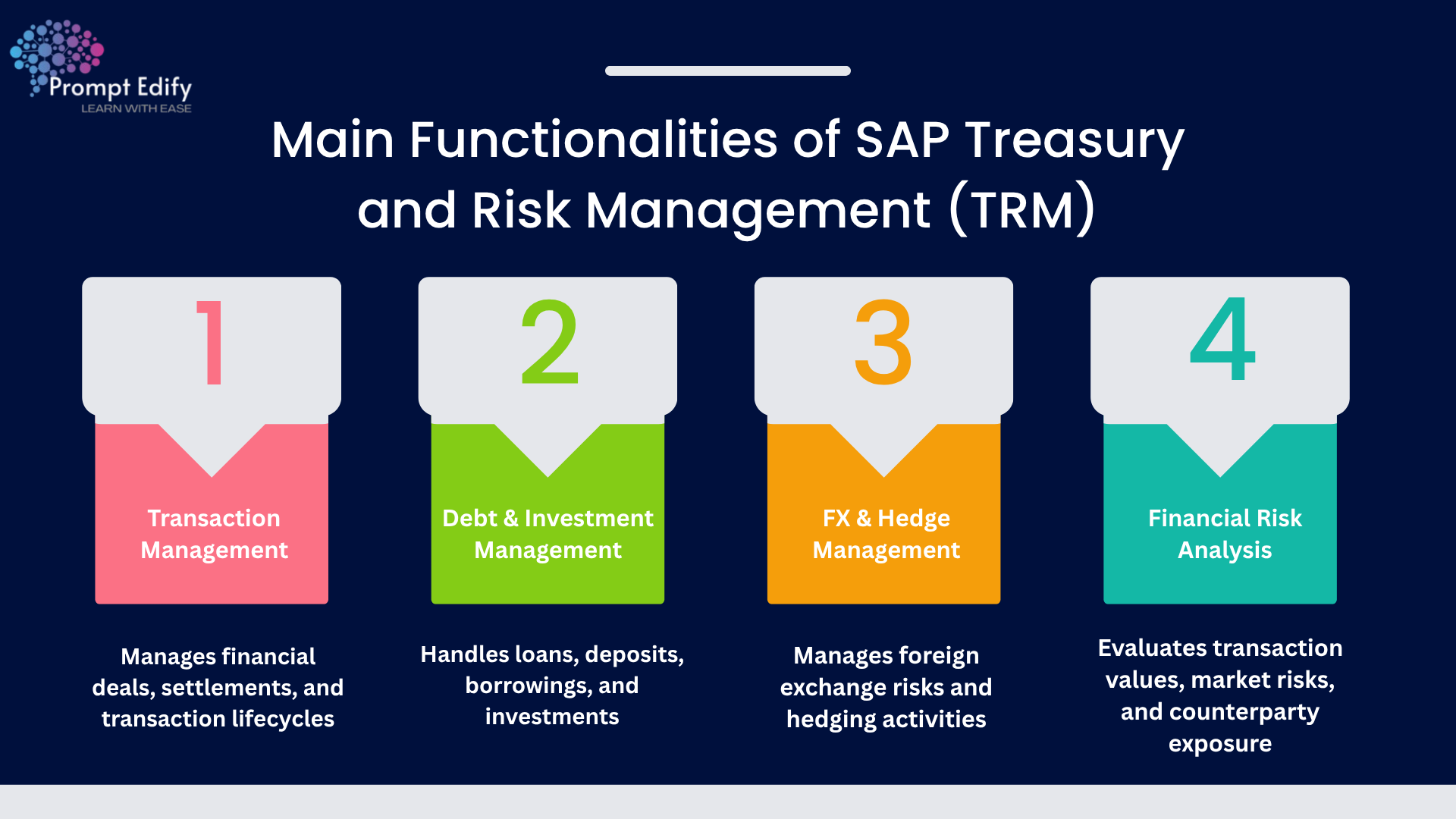
Financial transactions and Risk management: SAP TRM provides the following key functionalities:
The Transaction Manager functions as the vehicle for managing the transaction lifecycle: entering deals, maintaining deal details, performing settlement and communicating with Financial Accounting.
This functionality enables organisations to manage their financial investments and borrowings, including loans, deposits and other financial instruments. It assists in the accounting and management of such financial transactions.
Cross-border organisations might have foreign exchange rate risk exposure SAP TRM can assist with the administration of FX rate exposures and FX rate hedging.
Hedge management enables a firm to identify and manage certain financial risks through the use of appropriate hedging instruments. It also facilitates the correct accounting treatment for all qualifying hedging relationships under applicable accounting standards.
SAP TRM can perform a valuation of transactions and counterparty risks. Using market data and valuation results, treasury professionals can analyze the potential financial exposure.
Although SAP Cash Management and SAP TRM are fundamentally different in their function, they can integrate with each other in the overall SAP Treasury Management.
SAP Cash Management gives insight into the operational cash flow and cash requirements. SAP TRM handles the financial transactions such as loans, deposits, and investments.
In SAP TRM, forecasted cash flows of a relevant type can be transferred to the One Exposure from Operations information hub that is used by the Cash and Liquidity Management organisation. The treasury-related cash flows would then be accounted for in the overall cash position and liquidity analysis of the organisation.
For example, when a company records in SAP TRM a loan repayment or an investment maturity, its associated expected cash flow may also be relevant for cash management planning. The finance departments can take these expected cash flows into consideration along with the cash flows from payments or receipts.
That integration contributes to a more holistic view of the financials.
It will be decided based on the organisation's financial activities and needs.
Using these SAP features can be valuable for finance, accounting and corporate treasury professionals.
Knowing the difference between SAP Cash Management and SAP Treasury and Risk Management will not only help you see through the complexities of the treasury function, but also make you a better finance professional.
Prompt Edify provides SAP training and learning support for those who wish to extend their knowledge of SAP S/4HANA Finance and other ERP activities. Contact Prompt Edify to find out more about SAP training and learning opportunities.
By Team Prompt Edify
Have any enquiry? Call us
+(27) 740294414
(+91) 99932-86938
wecare@promptedify.com


Prompt Edify Africa (PTY) Limited
2nd Floor, Rivonia VillageCnr Mutual Road and Rivonia Boulevard Rivonia Village, 2191
Johannesburg , South Africa
Contact : +27740294414
Prompt Edify East Africa Limited
KN 78 ST, Kagarama, Kigali, Kigali, Nyarugenge, Umujyi wa Kigali, Rwanda
Contact : +250 727 845 771
Prompt Edify Private Limited
4th Floor #15, City Vista Tower, Fountain Road,
Kharadi, Pune(MH), India.
PIN- 411014
Contact : (+91) 99932 86938



Contact Us Today!
+27740294414 | (+91) 99932 86938 | +250 727 845 771
contact@promptedify.com | wecare@promptedify.com
🌐 https://promptedify.co.za/