
Learn how SAP Central Finance and SAP S/4HANA Finance work together to centralise financial data, support reporting, map master data and enable transformation.
Organisations that have more than one ERP environment (for example if a part of a business is using SAP ECC and another business has SAP S/4HANA, or all parts of the business have SAP S/4HANA but different modules) can find it challenging to create and manage consolidated financials. Finance teams may struggle to reconcile reporting, track transactions and have a holistic view of the business.
SAP S/4HANA Finance is an integrated financial management platform SAP Central Finance is a methodology for collecting financial data from several source systems into a centralized SAP S/4HANA system.
When you know how SAP Central Finance and SAP S/4HANA Finance relate to each other, finance managers and SAP consultants can better appreciate the benefits of centralising finance and planning a gradual transition.
SAP S/4HANA Finance SAP S/4HANA Finance is the SAP S/4HANA business suite's financial component. It enables businesses to better financial accounting, control, financial statement reporting, and other financial functions.
It offers a unified financial data model that helps organizations organize their financial data and track performance across various parts of the business.
SAP S/4HANA Finance enables organisations to operate with a common set of financial data, while improving their integrated financial processes.
SAP Central Finance is an SAP S/4HANA-based solution that enables organisations to bring financial transactions from multiple SAP and supported non-SAP source systems into a central SAP S/4HANA system.
Instead of immediately replacing every existing ERP system, an organisation can connect its current systems to a central finance environment. Relevant financial accounting and management accounting postings can then be replicated into the central system.
This approach is particularly useful for large organisations with multiple subsidiaries, different ERP platforms or complex financial landscapes.
SAP Central Finance can support:
SAP Central Finance are connected specifically because Central Finance relies on SAP S/4HANA and is based on SAP S/4HANA finance system.
SAP S/4HANA Finance across all of the connected ERP systems.
E.g., an organisation might have three ERP systems, one each for the organisation's businesses in South Africa, India and UK. These each post financial transactions locally. Financial postings from these separate systems can be pushed into a central SAP S/4HANA instance with Central Finance.
At this point, financial teams can use this platform to retrieve harmonised financial data and facilitate organisation-wide reporting.
In layman's terms, SAP S/4HANA Finance is the financial system and SAP Central Finance is a method for integrating and consolidating financial data from different source systems.
Although the two are related, they have different roles within an organisation's finance landscape.
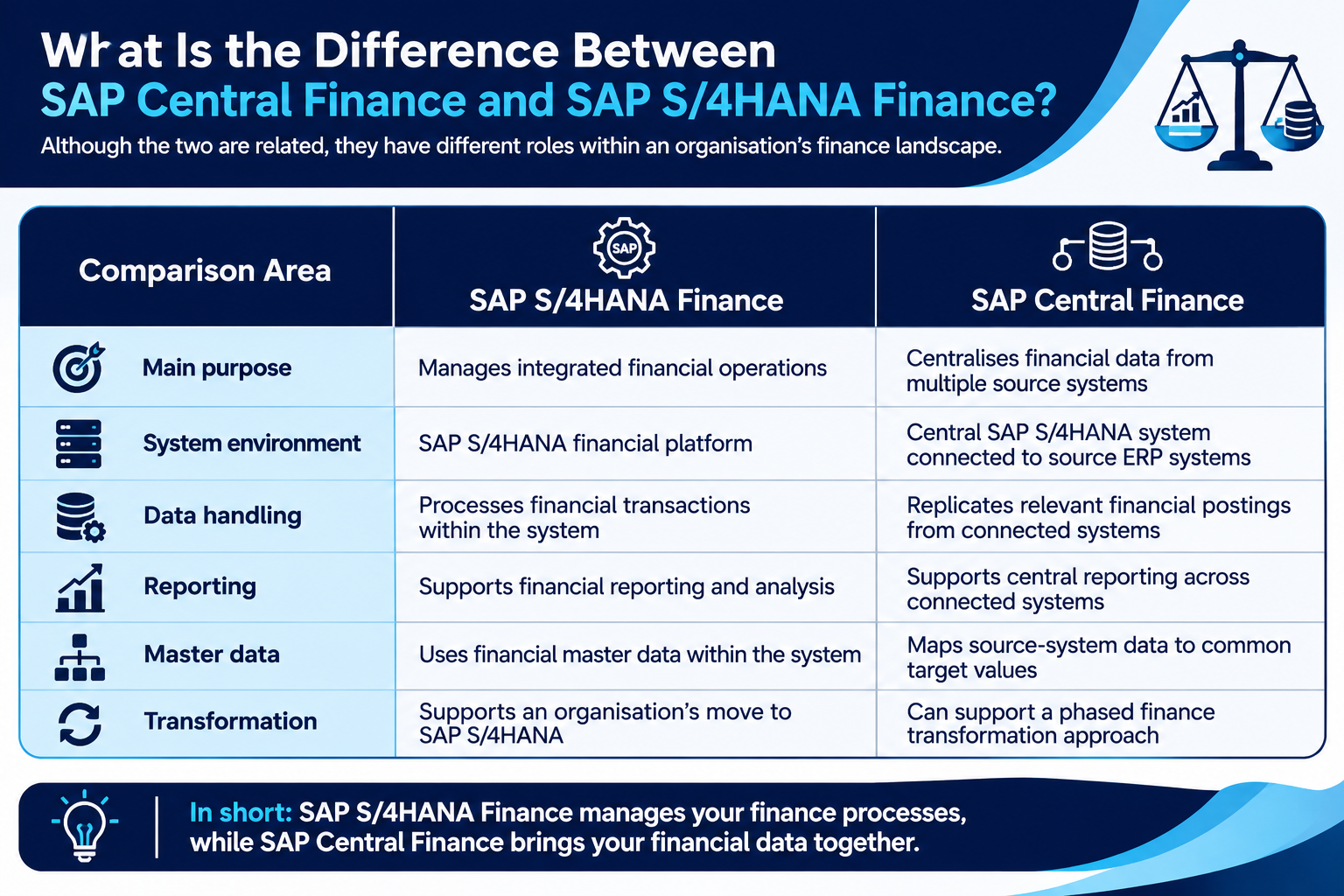
The main difference is that SAP S/4HANA Finance represents the broader financial platform, whereas SAP Central Finance focuses on centralising financial information from different ERP systems within that platform.
SAP Central Finance implements a number of functionalities within SAP S/4HANA Finance for handling and processing duplicated financial data.
The Universal Journal is a core feature of SAP S/4HANA Finance. It combines financial accounting and management accounting data in a single data model. As a result, you can have harmonized financial data and integrated reporting in the Central Finance system.
Certain financial postings from source systems which are connected can be replicated to Central Finance. This allows a company to view financial data from multiple ERPs centrally.
General ledger accounts, company code, cost centres, profit centres can differ across source systems. Mapping can be used to represent the same general ledger account or general ledger accounts, cost centre, profit centres from other company code or source system.
While replicating the data errors can arise due to missing master data, mapping errors or processing errors. The ability to check and handle errors will alert and enables the technical team and the finance team to rectify them.
Organisations with complex ERP landscapes may not be able to replace all their existing systems at the same time. A phased transformation approach can help them introduce central finance capabilities while continuing to operate their existing systems.
Some important benefits include:
The actual benefits depend on the organisation's source systems, integration requirements, data quality and implementation design.
Knowledge of both areas can be useful for professionals involved in SAP finance, ERP integration and business transformation projects.
This includes:
A basic understanding of financial accounting, management accounting and ERP systems can help learners understand how Central Finance works within the wider SAP S/4HANA environment.
Understanding SAP S/4HANA Finance and SAP Central Finance can help professionals build knowledge of modern financial systems, data integration and centralised reporting.
Prompt Edify provides SAP training and learning support for professionals seeking to develop their understanding of SAP Finance, SAP FICO and other ERP solutions. Contact our team to discuss your SAP training requirements and available learning options.
By Team Prompt Edify
Have any enquiry? Call us
+(27) 740294414
(+91) 99932-86938
wecare@promptedify.com


Prompt Edify Africa (PTY) Limited
2nd Floor, Rivonia VillageCnr Mutual Road and Rivonia Boulevard Rivonia Village, 2191
Johannesburg , South Africa
Contact : +27740294414
Prompt Edify East Africa Limited
KN 78 ST, Kagarama, Kigali, Kigali, Nyarugenge, Umujyi wa Kigali, Rwanda
Contact : +250 727 845 771
Prompt Edify Private Limited
4th Floor #15, City Vista Tower, Fountain Road,
Kharadi, Pune(MH), India.
PIN- 411014
Contact : (+91) 99932 86938



Contact Us Today!
+27740294414 | (+91) 99932 86938 | +250 727 845 771
contact@promptedify.com | wecare@promptedify.com
🌐 https://promptedify.co.za/