
Learn SAP Central Finance Architecture: source systems, SLT replication, data mapping, document processing and error monitoring in SAP S/4HANA Finance

Many large organisations have various ERP systems both within and outside of their organisations. Certain parts of the organisation could be SAP ECC, while other areas of the business could be SAP S/4HANA – or even a non SAP ERP system. This landscape of multiple ERP systems causes many challenges in financial reporting, reconciliation and general ledger management.
SAP Central Finance is a solution for bringing together financial data from source systems into one centralized SAP S/4HANA system. SAP Central Finance Architecture enables finance professionals and SAP consultants to understand the process of centralising data replication, mapping and processing and monitoring within the landscape.
SAP Central Finance Architecture is the technical and functional architecture that facilitates the replication of financial transactions from source systems to a central SAP S/4HANA Finance system.
Financial consolidation Central Finance enables an organisation to have one financial reporting environment in place without the need to replace all of their ERP systems straight away. Financial transactions from source systems such as SAP or other non-SAP supported systems can be replicated and then loaded into the Central Finance system.
This approach will allow a staged move to SAP S/4HANA while running your existing operational systems.
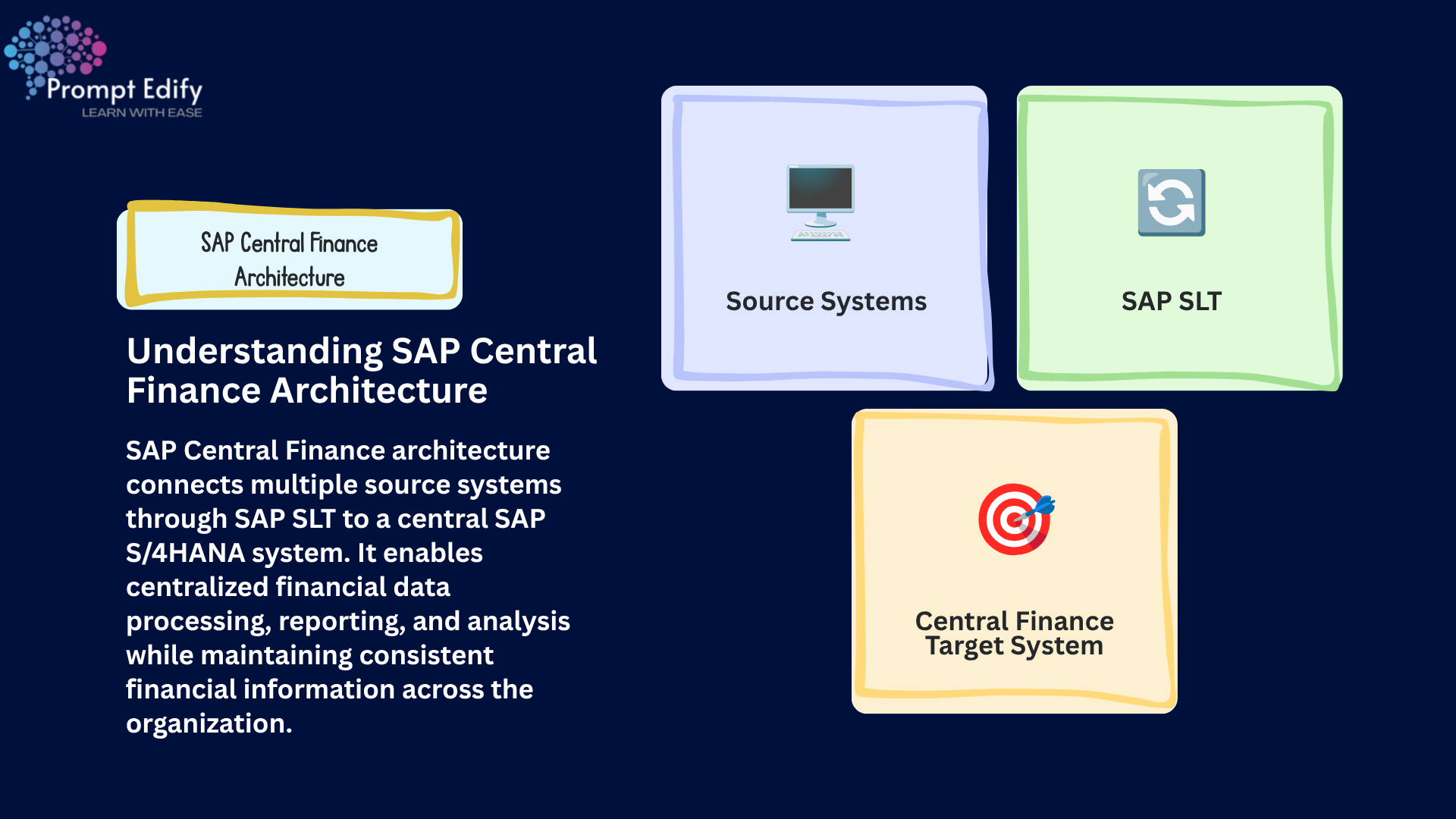
In a typical SAP Central Finance landscape, there are three main parts: the SAP source systems, the SAP Landscape Transformation Replication Server, and the SAP Central Finance target system.
Source systems – ERP systems in which business transactions are first created and posted. These include SAP ECC, SAP S/4HANA and supported non-SAP ERP systems.
For instance, the company has three SAP systems (as described in the previous section): one each for their South African, Indian and UK businesses. Each business has one integrated set of books. These are the sources of financial data feeding into the Central Finance system.
SAP SLT (SAP Landscape Transformation Replication Server) is a critical technical component of a standard Central Finance architecture.
It facilitates the replication of relevant data from source systems to the Central Finance target system. SLT uses database triggers and replication technology to detect the changes and replicate the relevant data.
This is to aid continued replication of the financial transactions following the data load.
The target system of Central Finance is SAP S/4HANA. It is the central system in which financial transactions originating from source systems are received and processed.
The target system offers a common financial structure for reporting and analysis. SAP S/4HANA functions, such as the Universal Journal, are employed to unify financial accounting and controlling data.
Data Replication is one of the most critical activities within SAP Central Finance Architecture. It enables the flow of financial data from heterogeneous source systems to the central SAP S/4HANA.
The exact replication infrastructure is based on the Source system, SAP Release, Integration scenario and project requirements.
An ERP system from a different vendor may have different account numbers, company codes, cost centres, profit centres and so forth in its master data. These must be harmonized before the information can be centrally processed.
In SAP Central Finance, you use mapping features to map the source-system values to the target-system values.
For instance, two subsidiaries may use different general ledger accounts numbers to record similar types of business expenses. The mapping links the source accounts to the correct target accounts in the global reporting structure.
SAP Master Data Governance (MDG) can facilitate for central master data management (MDM) and mapping, when working within a Central Finance landscape.
SAP Application Interface Framework (AIF) enables interface monitoring and error handling in the Central Finance scenario.
During initial data loading and continued replication, a transaction fails. This can be caused by missing master data, mapping issues, setup or configuration issues, or general processing errors.
AIF supports users in detecting the errors, in viewing the messages and in tracing why they were unable to post. Financial and technical teams can resolve the issues and reprocess the affected data where that is possible.
This ability to monitor will ensure there can be accurate financial data replication between connected systems.
SAP Central Finance offers a solution for organisations to federate financial data while still leveraging their current ERP landscape.
In summary, injecting relevant financial transactions into SAP S/4HANA enables organisations to create a unified structure of reporting and provide greater transparency across operational areas.
The Central Finance solution makes use of SAP S/4HANA Universal Journal to marry up financial accounting and controlling data in a single journal entry.
This will facilitate core financial reporting, analysis and some financial processes. It may also provide the foundation to enable a wider SAP S/4HANA transformation.
Overview of SAP Central Finance Architecture will enable any individual working in SAP finance implementation, integration and transformation projects.
Some knowledge of SAP FI, SAP CO, financial accounting and ERP integration provides learners with an insight into its architecture.
Gain an overview of SAP Central Finance Architecture as we give an explanation of how financial data is transferred between systems and is consumed within the central SAP S/4HANA landscape.
Prompt Edify provides SAP training and learning support to professionals seeking SAP Finance, SAP FICO and other ERP solutions. Reach out to our team to learn more about SAP courses & learning options.
By Team Prompt Edify
Have any enquiry? Call us
+(27) 740294414
(+91) 99932-86938
wecare@promptedify.com


Prompt Edify Africa (PTY) Limited
2nd Floor, Rivonia VillageCnr Mutual Road and Rivonia Boulevard Rivonia Village, 2191
Johannesburg , South Africa
Contact : +27740294414
Prompt Edify East Africa Limited
KN 78 ST, Kagarama, Kigali, Kigali, Nyarugenge, Umujyi wa Kigali, Rwanda
Contact : +250 727 845 771
Prompt Edify Private Limited
4th Floor #15, City Vista Tower, Fountain Road,
Kharadi, Pune(MH), India.
PIN- 411014
Contact : (+91) 99932 86938



Contact Us Today!
+27740294414 | (+91) 99932 86938 | +250 727 845 771
contact@promptedify.com | wecare@promptedify.com
🌐 https://promptedify.co.za/