
Learn how SAP Change Numbers and Change Master Records work together to manage engineering changes, maintain documentation and control product updates.

Change management is inevitable in manufacturing and the development of products. Companies have to make adjustments to replace parts, redesign their products, update bills of material or modify production documents. Still, managing changes is not just about modifying information in the SAP database, and companies have to keep track of the changes, the reason for these modifications, and the timing of the modification.
Here is where SAP Change Number and SAP Change Master Record come into play. These terms are integral parts of SAP Engineering Change Management, but each of them performs different functions.
A SAP Change Number is an identifying number issued for an engineering change. This serves as a reference by means of which changes to the respective business object can be managed in SAP.
When a firm decides to make changes to product specification or manufacturing components, it may issue a change number for identification of this particular change. Change number can thus be used for controlling changes made to other objects that may include material master, bill of material (BOM), documents, and routings.
For instance, when a manufacturing firm wants to replace a particular component with a more efficient one, change number serves as a tool for identification of the change and linking product related information to the same engineering change.
It thus becomes clear that a change number is not just a reference number but plays a key role in management of engineering changes and their validity.
A SAP change master record is the main record containing all the information needed for managing an engineering change. It is automatically created when a change number is assigned and contains the information related to the change.
It enables users to know about the objective of the change, its scope, and the circumstances in which it is supposed to be made.
Based on the version and setting of SAP software, a change master record may include the following information:
The change master record contains documentation and controls related to the change while the change number refers to a specific change.
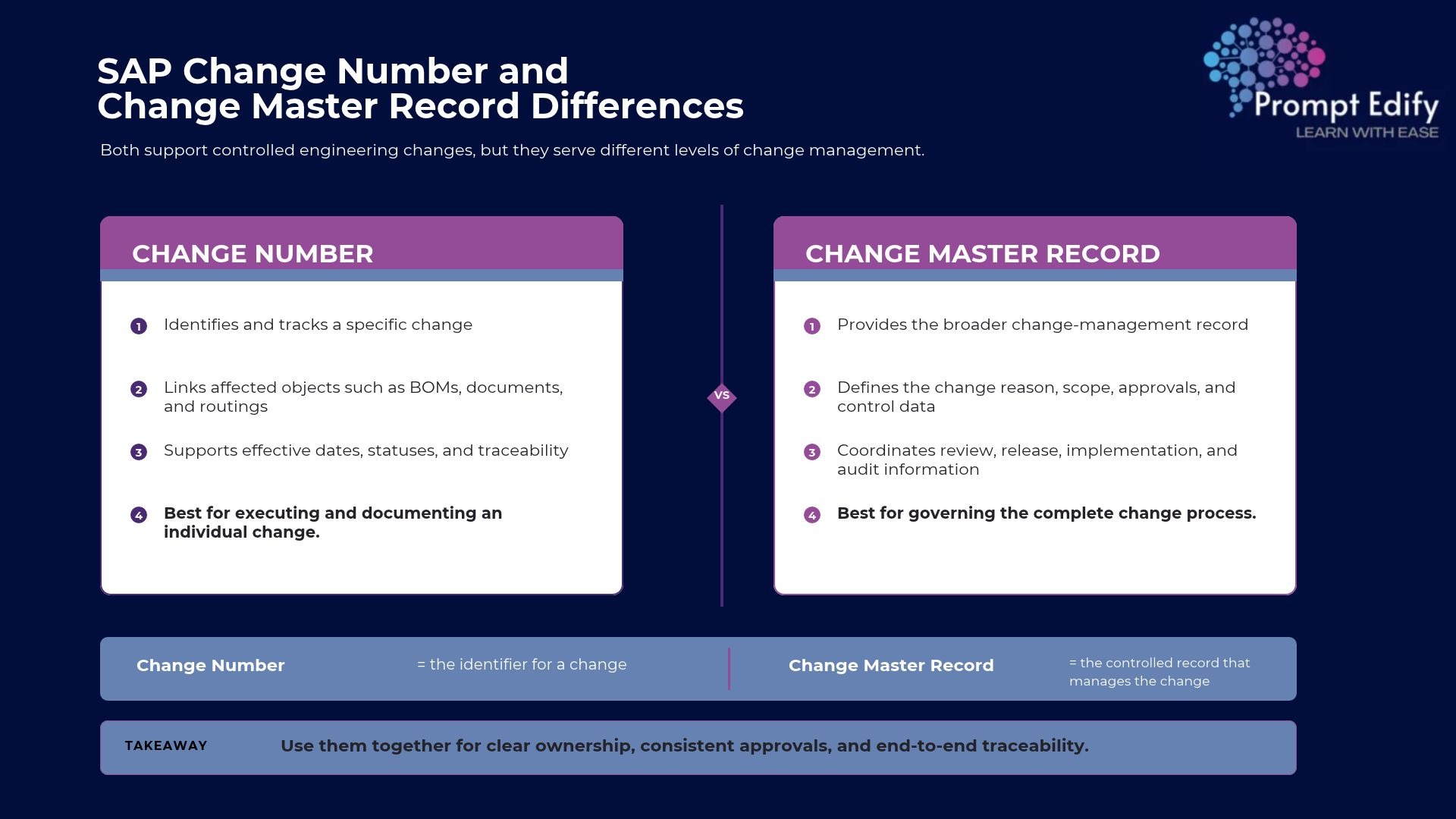
These two terms, even though similar, are not the same. It is important to know the difference between them when using SAP ECM.
1. Purpose
The SAP Change Number is a reference number of a certain engineering change, whereas the change master record holds all the information related to this change.
2. Function
Change number is used for identification and management of the modifications of the affected objects. Change master record holds all the information needed to understand and manage the modification.
3. Information held
The change number is mainly an identifier, but the change master record holds additional information, which includes, among others, description of the change and reasons for change.
4. Connection with affected objects
The change number is used to identify modifications of the affected objects such as materials, BOMs, and routings. The change master record is used as a place where you manage these modifications.
5. Documentation
The change number makes referencing to the modification easy, and the change master record allows holding documentation for the modification.
In other words, the change number identifies the engineering change and the change master record explains and manages it.
Both are components of engineering change control in SAP. Their relationship can be better understood with the help of the following manufacturing scenario.
Let us assume that a company produces industrial pumps and the management decides to use a different motor in place of an existing component due to a more suitable supplier.
It will result in an engineering change and change master record which will have a change number of SAP. The record will contain reasons for change and other important details.
A single change number can be used while doing change of materials master, BOM, and production routing. It will enable the organization to link several changes to one engineering change and not make them separate entities.
With the implementation of changes, all the necessary information will become available to understand which change took place and when it will be applicable.
Change validity decides the time period after which a specific modification will be effective. It is one of the key aspects of SAP ECM, as manufacturing enterprises might have to handle both older and newer versions of products while changing configurations.
Date validity is implemented by SAP in its change master record. For instance, an enterprise might choose a certain date when an updated version of a component will be used; hence, the engineering change would have to be maintained for that particular date.
Parameter validity is supported by SAP for more sophisticated requirements, in some configurations. Thus, change management can be done using other criteria, apart from just date.
Validity depends upon the SAP product, object and system setup.
Application of SAP Change Numbers and Change Master Data can bring several benefits:
The correlation of change number and change master record is an important aspect of professionals in the domain of SAP Production Planning, Materials Management, Engineering & Manufacturing.
Professionals have the opportunity to learn from practical sessions at Prompt Edify that will help them understand the functionality of SAP and its implementation within the business process. Sign up for the SAP ECM training program to gain knowledge of engineering change management, change numbers, change master record and the management of SAP objects.
Discover the SAP training programs at Prompt Edify and learn about enterprise applications.
By Team Prompt Edify
Have any enquiry? Call us
+(27) 740294414
(+91) 99932-86938
wecare@promptedify.com


Prompt Edify Africa (PTY) Limited
2nd Floor, Rivonia VillageCnr Mutual Road and Rivonia Boulevard Rivonia Village, 2191
Johannesburg , South Africa
Contact : +27740294414
Prompt Edify East Africa Limited
KN 78 ST, Kagarama, Kigali, Kigali, Nyarugenge, Umujyi wa Kigali, Rwanda
Contact : +250 727 845 771
Prompt Edify Private Limited
4th Floor #15, City Vista Tower, Fountain Road,
Kharadi, Pune(MH), India.
PIN- 411014
Contact : (+91) 99932 86938



Contact Us Today!
+27740294414 | (+91) 99932 86938 | +250 727 845 771
contact@promptedify.com | wecare@promptedify.com
🌐 https://promptedify.co.za/