
Learn about the SAP Commerce Type System, including item types, atomic types, attributes, relationships, and items.xml configuration.
Modern e-commerce companies need a structured organization of their data to improve operational efficiency. E-commerce websites generally comprise of products, customers, orders, addresses, and company data, which requires the company to define how each of the objects will be created, processed, and related to each other.
The Type System in SAP Commerce provides this specific structure and defines the various types of items on the platform, such as their characteristics and relationships with others. Additionally, it helps its users gather the data needed by the application.
It is essential to understand the SAP Commerce Type System as a developer or an IT consultant working with SAP Commerce Cloud.
SAP Commerce type system is the structure that enables the organization of business data within SAP Commerce. This structure explains how items are defined, what properties they possess, and how they relate to each other.
For instance, if one looks at an e-commerce site, various items are involved in transactions. Items can be products, clients, orders placed, and so on. Each of these items carries distinct features and attributes. A product can be named with specific numbers, descriptions, and pricing, while the client would be characterized by his name, email address, and some other contact information.
The type system states how all of the items will be shown in the SAP Commerce system.
In SAP Commerce Cloud, developers apply this type system to develop new business items, add some features to the existing objects, define their characteristics, and establish connections between different types of items.
The type system is mainly adjusted through XML configuration files, mainly items.xml in describing the structure of objects and their attributes.
The SAP Commerce Type System consists of several components that explain how business information is structured.
Item Types are the different business objects existing in the SAP Commerce system. They provide a basic framework for storing and handling business information.
For instance, an online store may consist of multiple item types, such as:
Moreover, developers can add their item types when the platform predefined item types do not fulfil business needs.
The SAP Commerce Type System consists of several components that explain how business information is structured.
Item Types are the different business objects existing in the SAP Commerce system. They provide a basic framework for storing and handling business information.
For instance, an online store may consist of multiple item types, such as:
Moreover, developers can add their item types when the platform's predefined item types do not fulfil business needs.
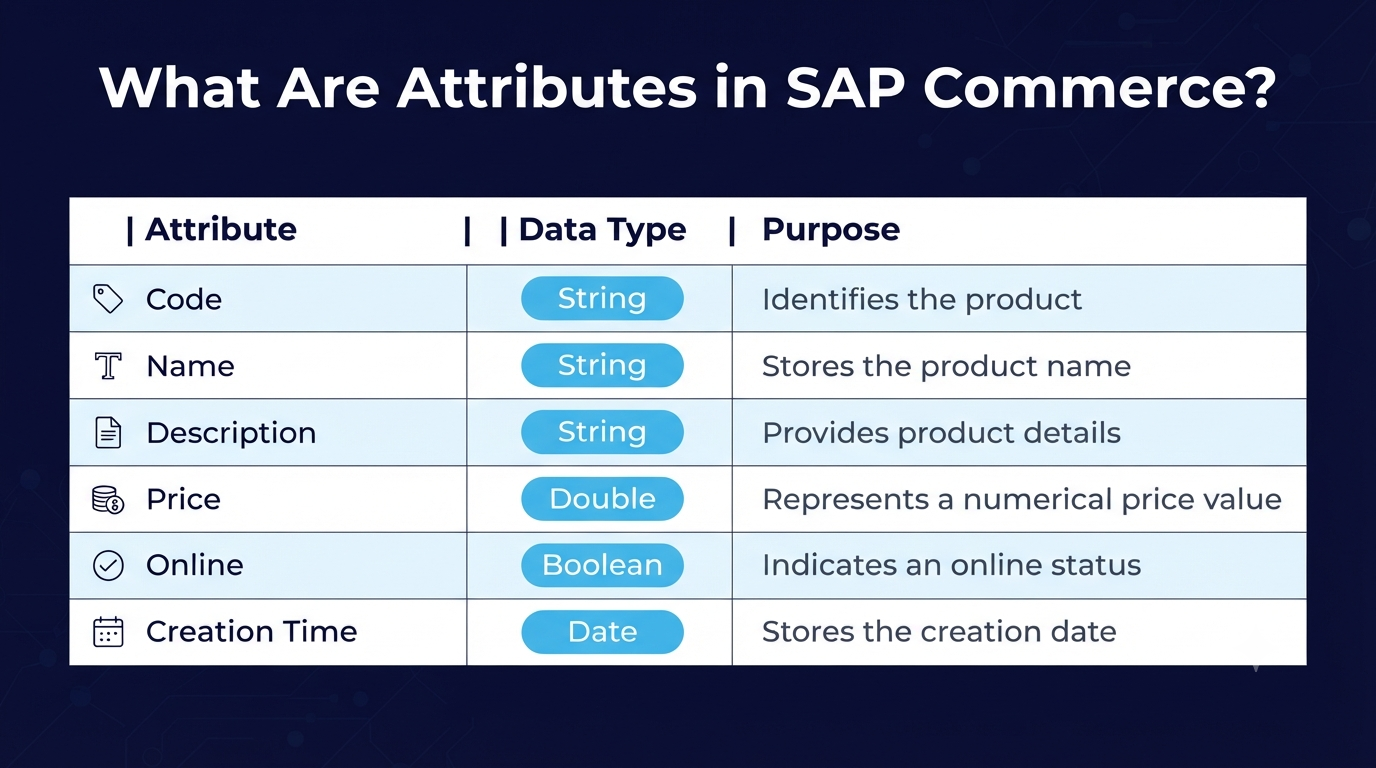
Some important attribute characteristics include:
These configurations help developers manage business data according to specific application requirements.
Relationships connect different item types and help establish how business objects interact with each other.
For example, an e-commerce application may have a relationship between customers and orders. A customer can place multiple orders, while each order belongs to a customer.
Similarly, products can be associated with categories to organise an online product catalogue.
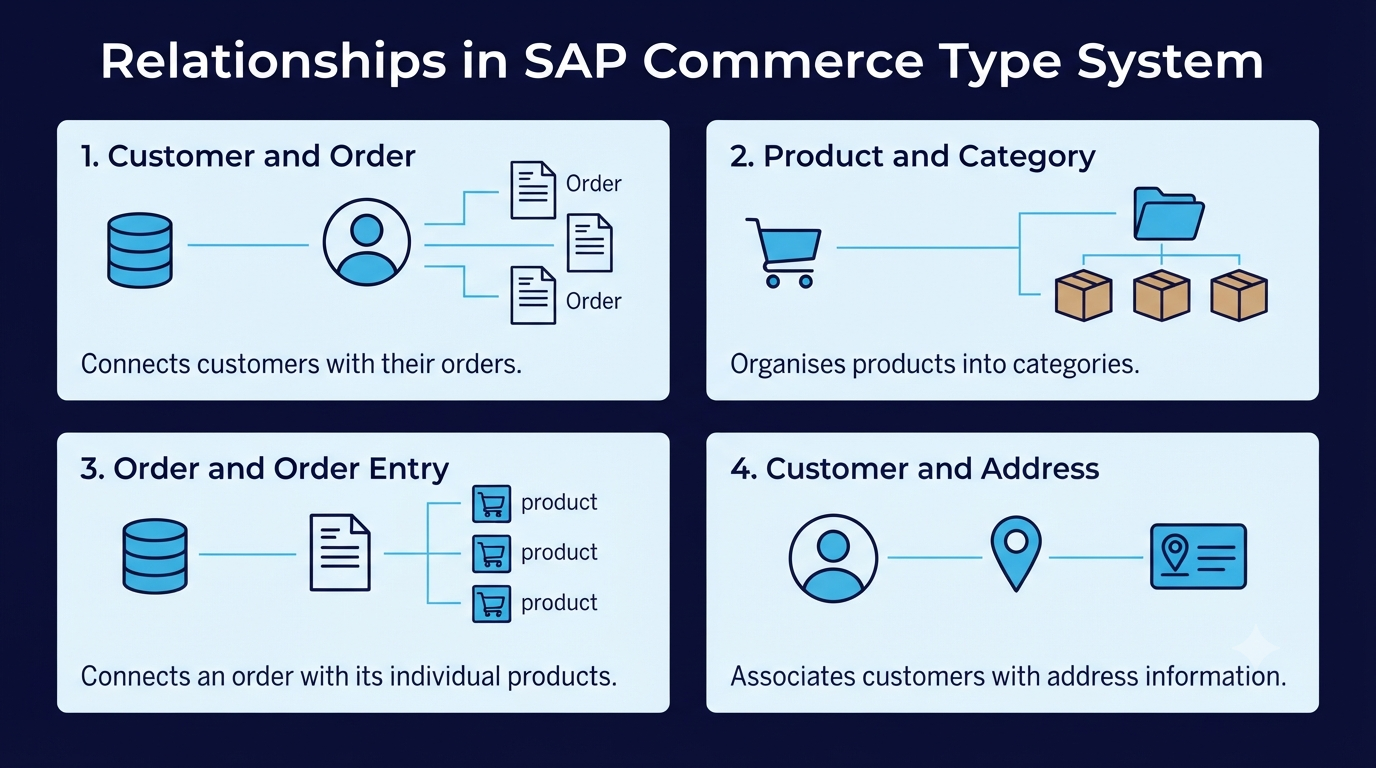
SAP Commerce supports relation definitions with source and target item types, including cardinality configurations that determine how many items can participate in a relationship.
Understanding these relationships helps developers build organised data structures and manage information more effectively.
The items.xml file is an integral component of the setup of SAP Commerce's Type System.
Using the XML configuration file, developers indicate different item types, characteristics and connections that an application needs.
For instance, if a business needs a custom item type to preserve some more product information, the developers will define the needed structure of the item type in its extension's items.xml file.
The usual course of the project will include:
The suggested scheme allows developers to increase the value of SAP Commerce as per the current business needs.
The Type System is the basis for the organisation of business data in SAP Commerce Cloud.
The importance of the Type System can be observed in its advantages:
The SAP Commerce Type System is one of the key components of SAP Commerce Architecture. It determines the structure of business objects, their properties, and relationships between various items.
SAP Commerce consists of many components such as atomic types, item types, collections, enumerations, and relation types, with each component helping organize the business information of the platform.
Having a grasp of the Type System, item types, relations, and the attributes specified in items.xml will allow programmers to create and customize commerce applications more efficiently. For SAP Commerce Cloud learners, this understanding of the Technical architecture is an important base for getting to know data modeling and development of extensions.
By Team Prompt Edify
Have any enquiry? Call us
+(27) 740294414
(+91) 99932-86938
wecare@promptedify.com


Prompt Edify Africa (PTY) Limited
2nd Floor, Rivonia VillageCnr Mutual Road and Rivonia Boulevard Rivonia Village, 2191
Johannesburg , South Africa
Contact : +27740294414
Prompt Edify East Africa Limited
KN 78 ST, Kagarama, Kigali, Kigali, Nyarugenge, Umujyi wa Kigali, Rwanda
Contact : +250 727 845 771
Prompt Edify Private Limited
4th Floor #15, City Vista Tower, Fountain Road,
Kharadi, Pune(MH), India.
PIN- 411014
Contact : (+91) 99932 86938



Contact Us Today!
+27740294414 | (+91) 99932 86938 | +250 727 845 771
contact@promptedify.com | wecare@promptedify.com
🌐 https://promptedify.co.za/