
Learn SAP Supply Chain Control Tower Training, including visibility, analytics, alerts, exception management, inventory optimization, and practical skills.
Modern supply chain management requires many suppliers, warehousing locations, transport partners, and clients. Managing all these processes individually may make it complicated for companies to stay informed about everything that happens and react fast to any problems. In such a case, SAP Supply Chain Control Tower comes to help. It enables organizations to manage their supply chains, identify problems, and make decisions based on collected and analyzed information.
Those who want to improve their skills in the sphere of supply chain technology will be interested in Supply Chain Control Tower Training. Future participants should be aware of the topics covered during the classes, the practical learning process, and the results one can achieve.
SAP Supply Chain Control Tower is a solution meant to bring together relevant information for visibility of operations in the supply chain. Organizations are able to track shipments, inventory, suppliers, and customer orders via the supply chain control tower.
The approach that utilizes the supply chain control tower is more than mere reporting; instead, supply chains make use of dashboards, alerts, and analytics to gain insight into their performance and any anomalies that may arise.
A comprehensive course in SAP Supply Chain Control Tower entails all the relevant concepts required.
Some important subject matters that will be covered in the course are:
The SAP Supply Chain Control Tower course materials provide the basis for learners to learn how companies apply technology to their complex supply chain activities.
Supply Chain Visibility is an important concept that will be covered during the training. Learners need to know how companies monitor their activities in the supply chain environment.
The training must help the learners understand how dashboards facilitate monitoring:
The learners must understand how through monitoring they can detect any potential issues before the business operations get affected.
The disruptions may occur due to transportation delays, issues with suppliers, changing demand or shortage of inventory. The training must help the learners understand how alerts can help organizations recognize such issues.
Exceptions Management includes:
For instance, in the case of a delay in the shipment, the control tower would help the team identify customer orders that are impacted and assess the other courses of action. In case there is a shortage of inventory, the team would try to understand the cause and plan for the replenishment of goods.
It is necessary for the learners to be able to interpret alerts and prioritize exceptions and also how to communicate with each other in order to solve problems.
Another vital component of the Supply Chain Control Tower training program is knowledge on analytics and metrics of the supply chain.
Analytics enables organizations to analyze the operations and trends which affect the supply chain performance. Some of the common performance metrics include:
The training must incorporate disruption cases as well, including increased demand, failure in suppliers, interruption in transportation, and unforeseen shortage of stock.
The learners must be taught how to interpret the dashboard data, identify performance deficiencies, and employ analytics for making better business decisions.
It is crucial for inventory control since the balance of product availability and associated costs must be established. Training must cover how supply chain personnel manage their inventory and align supply with demand.
Possible subjects under Inventory Optimization include:
From these concepts, the students will learn how companies overcome inventory problems while meeting their service standards.
It will be impossible to fully understand the operations of the supply chain control tower only through theoretical knowledge. There is a need for learners to experience dashboards and decision making.
The practical tasks can comprise:
After completion of the course students will be able to:
Each course does not have the same level of detail. The learner should look at each syllabus before registering for the course.
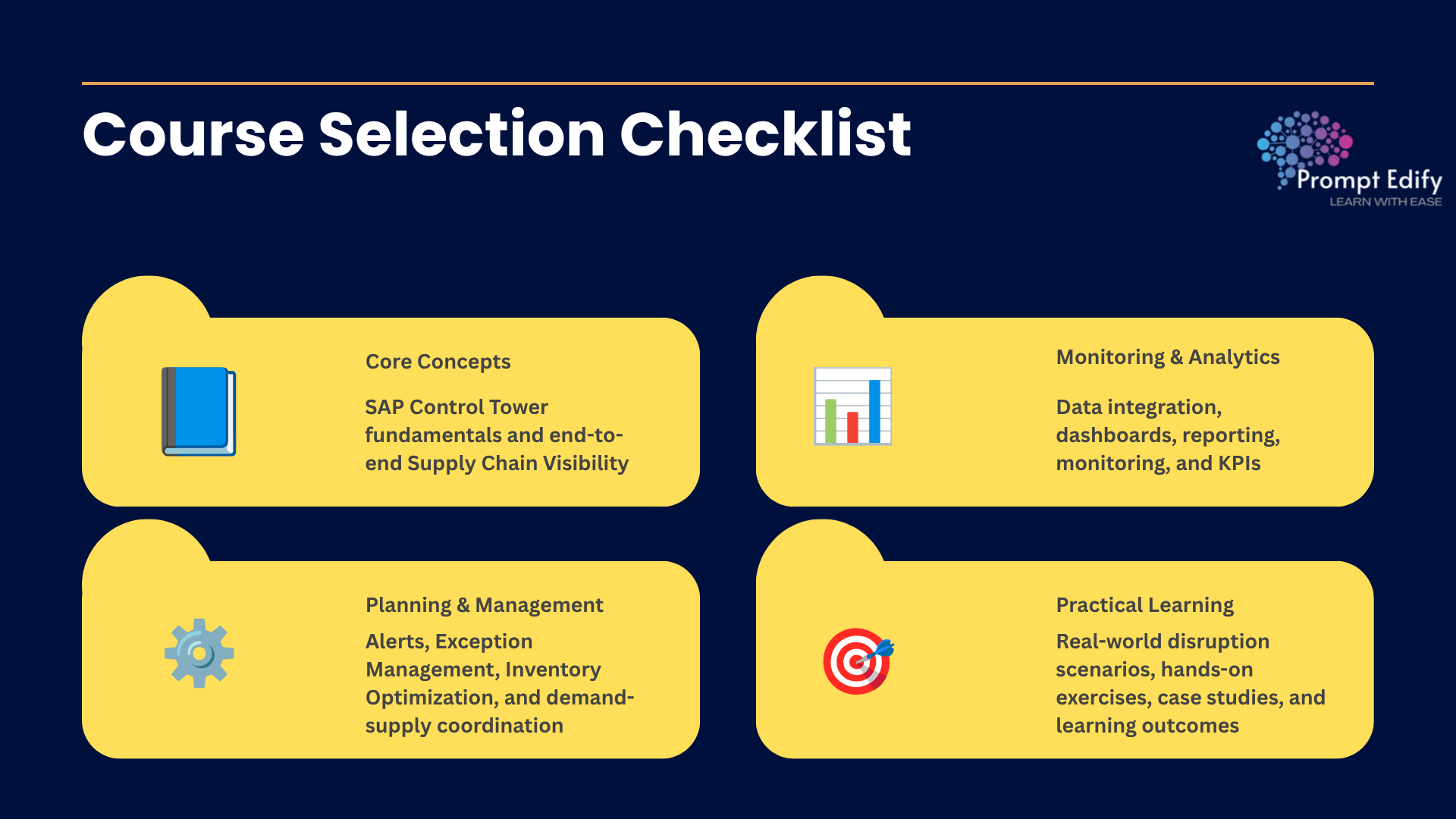
Use the following list to determine whether a particular course has all the learning components.
The SAP Supply Chain Control Tower Training can be an effective way for students to grasp how companies ensure supply chain visibility, monitoring operations, exception management, and decision-making based on data. The training must include basic and applied aspects from analytics to inventory optimization and disruption management.
The selection of the best Supply Chain Control Tower Training depends on the evaluation of its course content, practical exposure, and learning objectives.
Looking for SAP supply chain training? Get in touch with Prompt Edify for more information about SAP Supply Chain Control Tower Training, topics covered, and learning options.
By Team Prompt Edify
Have any enquiry? Call us
+(27) 740294414
(+91) 99932-86938
wecare@promptedify.com


Prompt Edify Africa (PTY) Limited
2nd Floor, Rivonia VillageCnr Mutual Road and Rivonia Boulevard Rivonia Village, 2191
Johannesburg , South Africa
Contact : +27740294414
Prompt Edify East Africa Limited
KN 78 ST, Kagarama, Kigali, Kigali, Nyarugenge, Umujyi wa Kigali, Rwanda
Contact : +250 727 845 771
Prompt Edify Private Limited
4th Floor #15, City Vista Tower, Fountain Road,
Kharadi, Pune(MH), India.
PIN- 411014
Contact : (+91) 99932 86938



Contact Us Today!
+27740294414 | (+91) 99932 86938 | +250 727 845 771
contact@promptedify.com | wecare@promptedify.com
🌐 https://promptedify.co.za/