
Explore SAP Cost Center Accounting, including master data, planning, cost allocation, actual postings, reporting, and examples across business departments daily.
Every organisation has different departments and business functions that involve regular expenses. Departments such as marketing, production, human resources, administration, and finance all use resources to perform their activities. Businesses need a reliable way to track these expenses and understand where their money is being spent.
This is where SAP Cost Center Accounting becomes useful. It helps organisations monitor costs across different departments, allocate expenses, and analyse spending patterns. By understanding cost centre information, management can evaluate departmental expenses and make better financial decisions.
In this guide, we will explore what SAP Cost Center Accounting is, how it works, its key concepts, and practical examples of how businesses use it.
SAP Cost Center Accounting, which is a part of SAP Controlling (SAP CO) deals with the recording, monitoring, and analysing of costs incurred by different departments and thus assists organisations. Each cost center is a separate organizational unit or area where costs are incurred; for instance, a manufacturing company could create separate cost centers for production, maintenance, human resources, administration, and marketing activities.
Each cost center allows an organisation to understand all expenses related to a particular department or activity. Thus, it becomes much easier to see how resources are consumed and whether these expenditures fall under the budget limits.
To put it in simple words, we can say that SAP Cost Center Accounting allows organisations to answer the question: Who incurs the cost?
A cost centre is referred to as an organizational section in SAP that is used to track costs. It is the area that incurs costs in the form of wages, salaries, or other charges, and which belongs to some department or fulfills a function but does not directly generate income. For instance, a company can have the following departments:
The organization is entitled to create a cost centre for each of its departments. Salaries, supplies and other expenditures are assigned to the respective cost centres.
This mechanism allows for a clearer understanding of expenses for management and helps successfully implement cost control procedures.
It is important to know the basic principles of SAP Cost Center Accounting, so students can understand the way companies control internal costs.
Cost center master data helps create the important information necessary for establishing the cost center in SAP.
Such information as cost center name, number, description, responsible person, period of validity, and relation to a controlling area may be included in this data.
For instance, the company may create a cost center called IT Support, which would help gather data on the expenditure on the organization’s internal IT services.
Cost center planning is a process of defining the potential expenses of the department or business sector in a particular time period.
For instance, the marketing department does the planning for the coming year for its advertising expenses, expenses for events, expenses on employees, and expenses on promotion.
SAP provides assistance in planning so that the company can compare the expected expenses with the actual ones.
Cost allocation in SAP is the act of disseminating expenses across relevant cost centres.
For instance, if a company receives a common electricity bill for its head office, rather than assigning the complete expense to one department, the company distributes costs based on a cost allocation principle.
SAP Controlling accommodates costs allocation operations via different methods such as distribution or assessment, depending on the requirements of the business as well as system configuration.
Actual cost posting is a concept in SAP that refers to the expenses incurred by the business.
For instance, when a company calculates the salary expense of an employee, it will assign the associated cost information to the relevant cost centre so that the finance department can track how expenditures are incurred.
Cost centre reporting allows organizations to analyze and examine expenses recorded for different cost centres.
Finance departments can utilize reports to measure budgeted against the actual costs, find out the deviations from spending and grasp the trends of costs incurred by each department.
Such data becomes useful for managers in assessing whether each of the departments utilizes its allocated resources effectively.
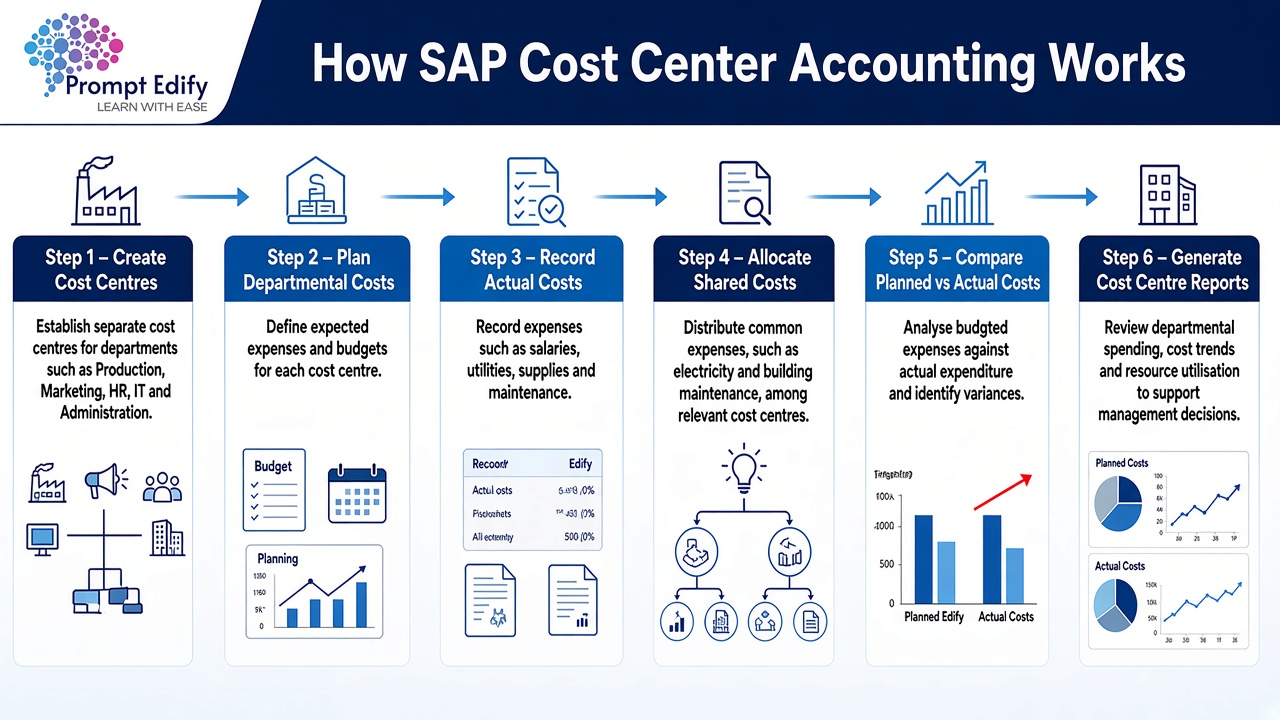
The process of Cost Center Accounting in SAP mainly involves creation of Cost Centers, expense planning, cost recording, cost allocation and report generation.
For illustration, let's take an example of a company that has different departments responsible for its production/marketing/administration.
It means that company would have to develop separate Cost Centers for each one of the departments first.
Later, the finance department has to come up with cost plans to be followed.
After the business starts running, the company starts to record actual expenses incurred by each of the departments.
Occasionally, the company has to allocate common expenses such as electricity and related maintenance costs.
Management of the organization can get familiar with cost reports and the difference between actual and planned expenses.
SAP Cost Center Accounting can be utilized in many sectors and functions.
A manufacturing company creates separate cost centers for production, maintenance, and quality assurance departments. Expenses related to maintenance of the machines, support for production processes, and inspection activities can be controlled through the appropriate cost centers.
A company establishes an IT services cost center to control expenditures on software licenses, consulting, salaries and equipment repair.
The company creates a marketing cost center to control its advertising, promotional and other marketing expenses.
These examples illustrate how cost centers provide companies with the necessary knowledge about their departments’ expenditures and internal budget management.
SAP Cost Center Accounting integrates the information provided by other SAP systems to link financial data to business processes.
For example, SAP Financial Accounting (SAP FI) feeds data on financial transactions which can also be used for cost accounting purposes. The information from SAP Materials Management (SAP MM) can be used to handle spending related to purchases and expenses. Also, SAP Human Capital Management (SAP HCM) can provide useful employee information for cost accounting and cost planning.
Additionally, SAP Production Planning (SAP PP) can help organize cost centre-related activities by supporting processes of production.
Thus, it allows organizations to combine their operations with internal cost management processes.
SAP Cost Center Accounting is suitable for those who would like to learn how costs are managed by departments and how the management accounting processes function.
It can be helpful for:
Basic knowledge of accounting, business expenses, and cost management can help in understanding the topic.
Grasping the concept of SAP Cost Centre Accounting introduces students to the way businesses budget, keep track of, divide, and analyze costs incurred by departments.
Prompt Edify is involved in SAP education and consulting that assists individuals and organizations in comprehending SAP solutions and workflows. The SAP finance courses cover a variety of topics within the areas of finance accounting, controlling, and SAP S/4HANA Finance.
If you are on the initial stage of your SAP training or want to enhance your basic knowledge of management accounting, then education in SAP CO may help you succeed.
By Team Prompt Edify
Have any enquiry? Call us
+(27) 740294414
(+91) 99932-86938
wecare@promptedify.com


Prompt Edify Africa (PTY) Limited
2nd Floor, Rivonia VillageCnr Mutual Road and Rivonia Boulevard Rivonia Village, 2191
Johannesburg , South Africa
Contact : +27740294414
Prompt Edify East Africa Limited
KN 78 ST, Kagarama, Kigali, Kigali, Nyarugenge, Umujyi wa Kigali, Rwanda
Contact : +250 727 845 771
Prompt Edify Private Limited
4th Floor #15, City Vista Tower, Fountain Road,
Kharadi, Pune(MH), India.
PIN- 411014
Contact : (+91) 99932 86938



Contact Us Today!
+27740294414 | (+91) 99932 86938 | +250 727 845 771
contact@promptedify.com | wecare@promptedify.com
🌐 https://promptedify.co.za/