
Understand SAP Digital Supply Chain, its components and benefits and how planning, procurement, manufacturing, warehousing and logistics connect end to end too.
The current corporate world has forced organizations to operate the supply chain process in an efficient manner while addressing customer requirements and market and business conditions.
This is where the concept of SAP digital supply chain comes into play. It allows the organization to bring the supply chain operations together such as planning, procurement, manufacturing, warehousing, and logistics with the help of digital technology and business solutions.
It is imperative for the business and professionals who wish to have knowledge regarding the modern day supply chain and its digitalization to understand what is SAP digital supply chain.
In this blog, we will talk about the SAP digital supply chain overview, its components, major benefits, and different processes of the supply chain.
"Digital SAP Supply Chain" can be explained as the adoption of SAP solutions and digital technologies that would allow integration and optimization of all the processes of the supply chain from one end to the other.
In this way, organizations will be able to integrate business processes, increase their visibility, automate their actions and decision-making by means of using business data.
The point here is that it allows organizations to create a connected supply chain in which the processes of planning, procurement, manufacturing, inventory and transportation become one integrated process instead of being separate.
A number of key business processes should be considered within the framework of SAP digital supply chain:
A number of SAP solutions are available for these business functions including SAP Integrated Business Planning (IBP), SAP S/4HANA, SAP Digital Manufacturing, SAP Extended Warehouse Management (EWM) and SAP Transportation Management (TM).
The SAP SCM software modules take care of many aspects of the supply chain management process. The software modules perform a specific task by sharing data between different business functions.
Supply chain planning allows organizations to forecast the demand for their customers and plan their supply requirements while keeping sufficient stock levels.
The SAP Integrated Business Planning (SAP IBP) solution helps in planning demand, supply, inventory, and Sales and Operations Planning (S&OP).
Procurement is the process through which organizations obtain materials, products, and services.
The SAP solutions help organizations in managing their procurement activities, supplier relationship management, purchase order, and material requirements.
Digital procurement leads to better coordination with suppliers and effective sourcing of business activities.
Manufacturing management includes the process of converting raw materials to products through efficient means and processes.
SAP Digital Manufacturing is a solution that helps in production execution, shop floor control, and manufacturing processes.
It assists in the coordination of production processes and in the monitoring of the manufacturing processes to identify problems in these processes.
Warehousing management involves processes such as receiving, warehousing, picking, packaging, and shipping of goods.
SAP Extended Warehouse Management (EWM) is a solution that helps in the coordination of warehouse processes, inventory movement, and warehousing processes.
The transportation management involves moving goods from the suppliers to the manufacturing location, warehouse, and to the customers at the end.
The SAP TM manages transportation planning, freight management, execution, and freight costing management.
It ensures coordination in delivery services and optimization of transportation management.
One of the most prominent advantages of digital supply chain management is that all operations are interconnected due to information sharing.
Let's take an example of a manufacturer getting an order from the customer. The process is as follows:
The above methodology ensures that there is exchange of information between various departments.
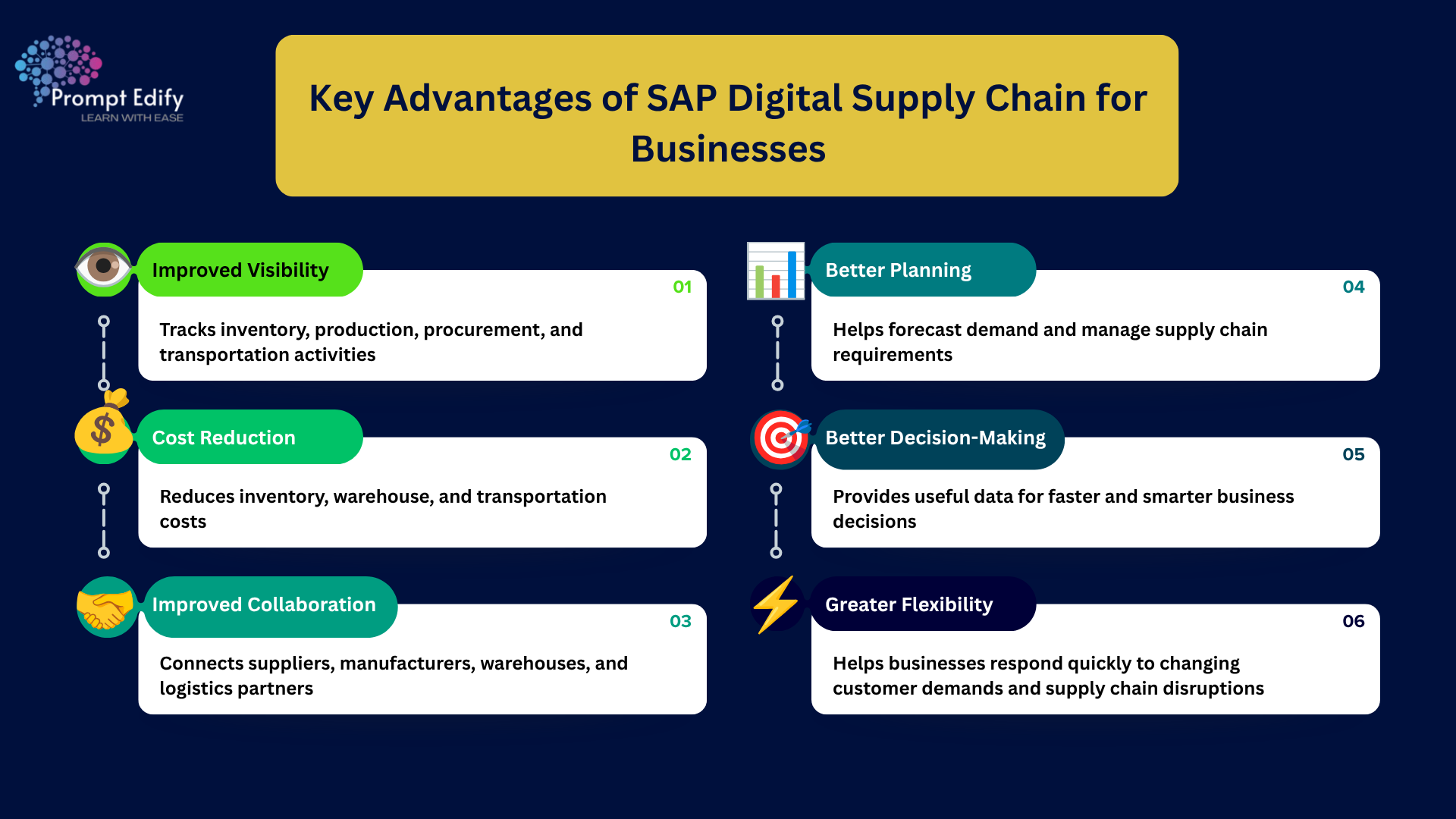
The use of digital solutions for the supply chain may bring some benefits for the organisation. They are:
These advantages may help to improve the performance of the organisation, customers' satisfaction and effectiveness of the supply chain.
The SAP Supply Chain Management solution plays an essential role due to its ability to facilitate coordinated business activities through integrated digital solutions.
In case there is no proper integration of the solution, various departments will operate on different data, leading to miscommunication, decision-making delays, overstocking, and delivery issues.
Such problems are solved using the solutions offered by SAP, allowing for integration between planning and execution. Organizations will be able to track supply chain processes, enhance resource management, and manage processes in different regions.
For instance, increased demand will allow planning to update the supply needs while procurement and production will have enough time to make adjustments.
The SAP Digital Supply Chain solutions can prove beneficial for those who are working in different departments like:
These individuals are interconnected and strive for improving their business performance.
The SAP Digital Supply Chain allows firms to integrate planning, procurement, manufacturing, warehousing, and logistics in one place. Visibility is enhanced, and decision-making becomes easier. The SAP solution also helps firms optimize the process of supply chain management.
As companies keep incorporating digital technologies into their operations, it may become helpful for people willing to pursue a career in supply chain management to get an idea of SAP solutions for supply chain management.
Would you like to learn more about SAP supply chain solutions? Get in touch with Prompt Edify and find out more about SAP courses for professionals.
By Team Prompt Edify
Have any enquiry? Call us
+(27) 740294414
(+91) 99932-86938
wecare@promptedify.com


Prompt Edify Africa (PTY) Limited
2nd Floor, Rivonia VillageCnr Mutual Road and Rivonia Boulevard Rivonia Village, 2191
Johannesburg , South Africa
Contact : +27740294414
Prompt Edify East Africa Limited
KN 78 ST, Kagarama, Kigali, Kigali, Nyarugenge, Umujyi wa Kigali, Rwanda
Contact : +250 727 845 771
Prompt Edify Private Limited
4th Floor #15, City Vista Tower, Fountain Road,
Kharadi, Pune(MH), India.
PIN- 411014
Contact : (+91) 99932 86938



Contact Us Today!
+27740294414 | (+91) 99932 86938 | +250 727 845 771
contact@promptedify.com | wecare@promptedify.com
🌐 https://promptedify.co.za/