
Explore SAP Digital Supply Chain Training modules, syllabus, practical exercises and learning outcomes to understand procurement, planning, manufacturing and logistics.
With the evolution of technology and integration of systems, there is rapid transformation in the field of the supply chain. There is a demand for individuals who can plan, procure, manufacture, store, and transport using new SAP systems.
SAP Digital Supply Chain Training will help you learn about the integration of various SAP systems in managing the end-to-end processes of the supply chain. You will learn key concepts, business processes, software functionalities, and practical exercises involved in the supply chain.
If you are a beginner, a working professional, or plan to make a career in SAP, it is essential that you have knowledge about the syllabus of the course.
In this blog, you will learn about SAP SCM syllabus, critical modules, practical training, and learning objectives of the course.
Training for SAP in Supply Chain Management should not only contain theoretical and practical knowledge but also the knowledge on how the integration of different aspects of supply chain management process through SAP software is achieved.
The training program can cover such aspects as:
This training program should not have separate modules of functions of particular software.
The SAP supply chain modules cater to various processes of doing business, ranging from planning of customer demand to delivery of products.
Below are some of the important modules that one must learn.
SAP IBP caters to demand planning, supply planning, inventory planning, and Sales and Operations Planning (S&OP).
Some of the key areas of learning would be:
Learning Objective: Learn how demand planning, supply planning, and inventory planning can work together.
The SAP MM module encompasses the procurement and material management process. It helps the organization in the management of its purchasing processes and material management.
Main Areas Covered are:
Learning Outcome: Understanding of the purchasing process, material movement, and procurement process.
The SAP EWM module is meant to help in the management of the warehouse activities and improve inventory visibility for the organization.
Main Areas Covered are:
Learning Outcome: Management of the warehouse activities using SAP EWM.
It consists of transportation planning, transportation execution, and freight management.
The following areas are included in this module:
Learning objective: How to manage transportation and shipment of goods.
SAP Digital Manufacturing deals with production execution and shop floor process management.
The following areas are included in this module:
Learning objective: How digital manufacturing technologies help in making the production process visible.
These modules form various parts of SAP supply chain solutions. They can be taught in a training course independently as separate modules or as part of the entire course as a whole.
The exposure in practice is an essential element when it comes to learning about SAP SCM. Students have to have chances to learn how to conduct transactions and processes through SAP.
Some practical subjects that can be considered during SAP SCM training include the following:
For instance, one of the practical exercises can include creating a purchase order, getting materials into the warehouse, managing inventory, and transporting products to the destination.
In this way, students will understand how departments work together through SAP.
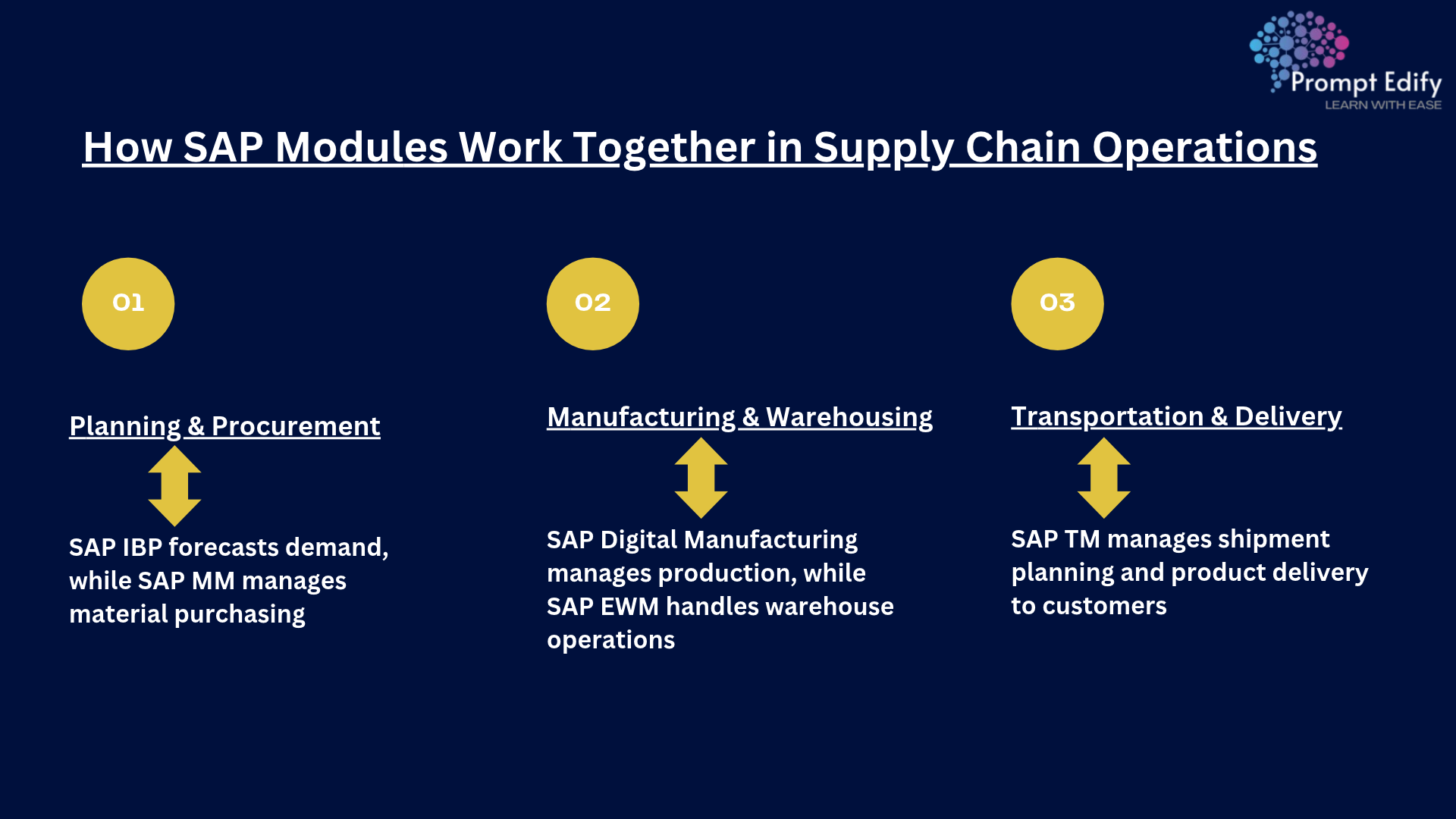
The best training program should include information on how the various SAP modules work together to accomplish the business process.
For example, consider a case where the manufacturing company receives an order from the customer. The training can have the following steps:
Before joining any course, it is essential for the learner to verify the version of SAP software and the type of environment where the training is performed.
The SAP supply chain solution changes and evolves continuously, therefore knowing the version of the system is essential.
An adequate syllabus should include:
It is also worth asking whether the learner would get access to a real-life environment.
Upon completion of this training course, the trainee would have achieved the following learning objectives regarding the basic concepts of supply chain and SAP functionality.
These include the following learning objectives:
Learning outcomes would act as foundation stones for those trainees who want to establish themselves in SAP supply chain modules.
The selection of the appropriate training program is indeed extremely important to obtain information and exposure.
Following factors should be considered prior to selection of the training program:
SAP Digital Supply Chain Training is a process by which learners learn about how SAP software can assist in planning, procurement, manufacturing, warehousing, and logistics.
Through learning about various SAP supply chain modules and practicing business scenarios, learners can develop the necessary knowledge base on digital supply chain management.
Learners should always check the curriculum of the course before choosing one.
Ready to make a career in SAP Supply Chain Management? Get in touch with Prompt Edify to learn more about professional SAP training programs and gain knowledge for the digital supply chain industry.
By Team Prompt Edify
Have any enquiry? Call us
+(27) 740294414
(+91) 99932-86938
wecare@promptedify.com


Prompt Edify Africa (PTY) Limited
2nd Floor, Rivonia VillageCnr Mutual Road and Rivonia Boulevard Rivonia Village, 2191
Johannesburg , South Africa
Contact : +27740294414
Prompt Edify East Africa Limited
KN 78 ST, Kagarama, Kigali, Kigali, Nyarugenge, Umujyi wa Kigali, Rwanda
Contact : +250 727 845 771
Prompt Edify Private Limited
4th Floor #15, City Vista Tower, Fountain Road,
Kharadi, Pune(MH), India.
PIN- 411014
Contact : (+91) 99932 86938



Contact Us Today!
+27740294414 | (+91) 99932 86938 | +250 727 845 771
contact@promptedify.com | wecare@promptedify.com
🌐 https://promptedify.co.za/