
Transform your global tax compliance with SAP DRC consulting, covering readiness assessments, country localization, integration design, and strategic roadmaps.
When companies operate in several countries, they often face issues with electronic invoice handling, tax reporting, and meeting compliance obligations within SAP. This can lead to confusion regarding varying requirements for various places, such as tax laws, document formats, reporting methods, compliance requirements, and many more.
With this in mind, it’s important to know that SAP DRC consulting services can simplify the understanding of compliance elements.
SAP DRC stands for SAP Document and Reporting Compliance, which enables electronic documents and reporting for compliance purposes. However, success cannot be achieved through activating the solution alone.
It is crucial to know what is the current SAP landscape within organizations, the rules of the countries, and tax process before implementing the solution.
Properly organizing the approach to SAP DRC consulting will allow organizations to understand all the requirements before technical implementation starts.
SAP DRC consulting means examining an organization’s SAP environment, compliance needs, and business processes to identify ways that SAP Document and Reporting Compliance can help to meet its regulatory obligations.
The consulting procedure may comprise:
The aim is to connect business, tax and technical needs prior to configuration and deployment.
When businesses contemplate adopting DRC, new invoicing compliance laws, statutory reporting requirements, tax agency updates, or entering new markets often drive this decision.
However, starting the setup without first analyzing requirements can lead to complications.
By conducting an SAP DRC consulting evaluation, businesses can ascertain:
This provides a clearer vision of the task ahead, which needs to be tackled well before moving ahead with the system installation.
An evaluation of SAP DRC preparation gauges if an organization’s SAP environment as well as its business processes, are in order in terms of compliance needs.
There would be much to cover in the evaluation.
In this regard, consultants will have a look at the SAP environment, which may be represented by SAP ERP, SAP S/4HANA, SAP S/4HANA Cloud or other SAP deployment types.
The aim is to see how DRC can be integrated into the existing architecture.
This assessment also looks at processes such as issuing invoice, calculating taxes, generating reports and managing documents.
Such analysis helps determine if current business processes are able to ensure the desired compliance situation.
Manage master and transactional data is important because compliance documentation relies on accurate data.
Our analysis can help identify missing, inconsistent or incomplete data that may pose problems in electronic document preparation or submission.
Companies may have middleware, tax platforms or APIs that generate connections with other systems.
Having information regarding these systems will help determine how the DRC software will work with the related information technology.
Compliance analysis entails understanding if a country’s tax authorities and other organizations where taxes are filed have specific requirements related to the actual tax laws and processes that affect SAP procedures. First of all, compliance analysis has to follow these steps:
SAP DRC is designed to comply with local tax authorities’ rules, unlike other products that follow a standard procedure in all countries. In Nigeria, it complies with the e-invoicing regulation from FIRS; in Kenya, it is in line with KRA’s eTIMS; in South Africa, it is adapting to cope with SARS’s e-VAT. In Zambia, DRC links to Smart Invoice by ZRA and in Egypt, it combines with one of the most sophisticated e-invoicing systems in Africa. In the USA, it fulfills the requirements of the IRS and those of state tax authorities, while in the UK, it complies with the Making Tax Digital program by HMRC. Moreover, DRC connects to such systems as India’s GSTN and ZATCA in Saudi Arabia. That is, invoices and tax reports are produced in every country as expected by the taxation office. Thus, instead of designing a compliance system for each of the countries of operation, businesses can have the same SAP system for a multinational.
This perspective on compliance is particularly necessary for companies operating anywhere in Africa. Organizations should evaluate each compliance element for the DRC, including submission procedures and applicable technologies before implementing it in a particular market.
A SAP landscape evaluation assesses what is required for DRC to exist in the technology architecture of the company.
Consultants can study:
The evaluation can help determine the interfaces and connection challenges before the DRC project is initiated.
SAP DRC consulting is further mandated to evaluate the tax and compliance operations being undertaken.
Many organizations might still use manual methods for the following activities:
A tax-process evaluation will determine which processes should be automated, integrated, or redesigned as part of the DRC initiative.
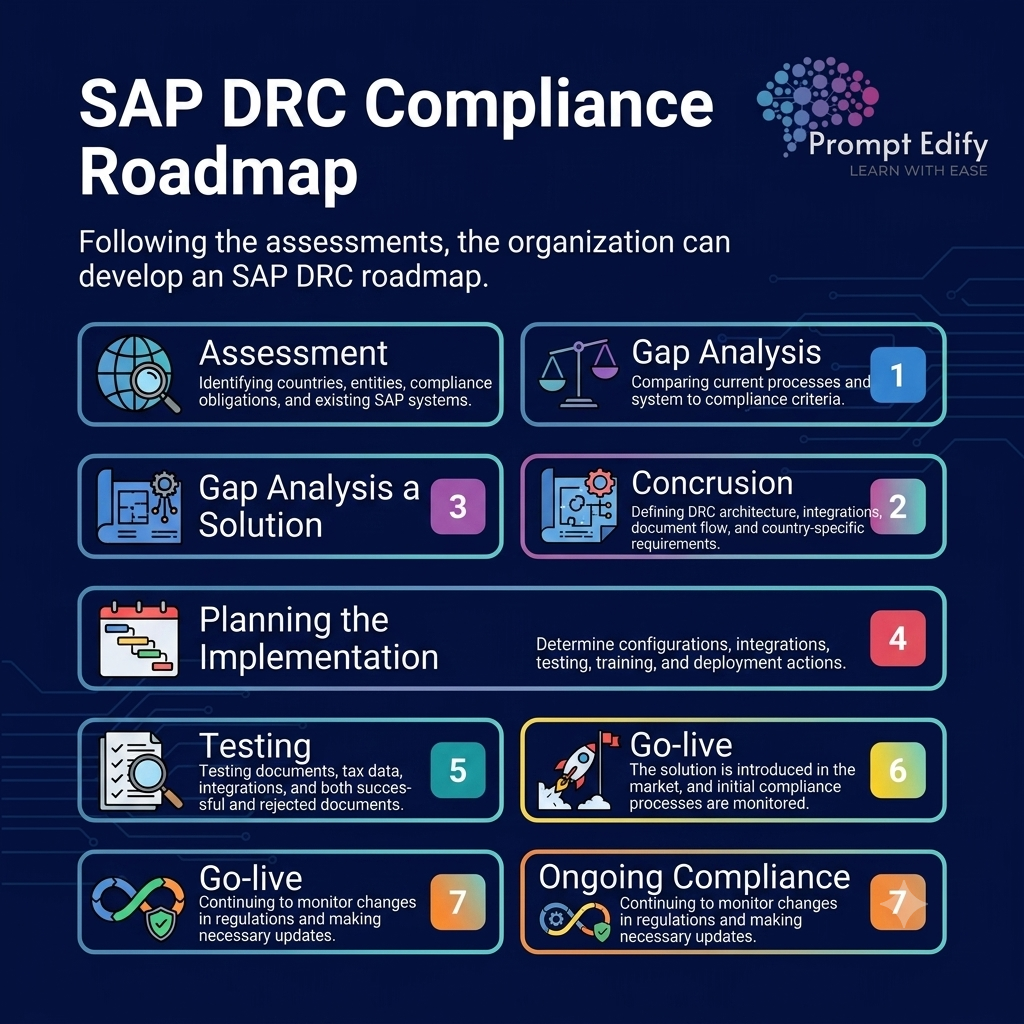
Once there is a clear understanding of both business and compliance needs, consultants are ready to design the solution architecture.
The possible architecture can be depicted in a simplified manner:
SAP ERP / SAP S/4HANA→ SAP DRC→ Integration Layer→ Tax Authority/E-invoicing Platform
In practice, the actual architecture varies depending on the country, compliance scenario, SAP deployment model, and possible options for integration.
Data flow, document processing, integration, authentication and validation, response processing, monitoring and security have to be taken into account in the architecture.
Localization in fundamental for enterprises working in multiple markets.
Localization assessment helps to understand how country-specific requirements influence the SAP environment.
For instance, one country may require the submission of electronic invoices through a governmental platform, whereas the other one requires different documentation or reporting.
Thus, companies must not think that DRC configuration useful for one country can be easily used in another state.
Each jurisdiction must be evaluated in line with the legal requirements existing there and the capabilities of SAP.
Organizations can be faced with a number of challenges while consulting and planning.
Tax authorities may introduce new requirements for e-invoicing and reporting.
Multinational corporations may have to manage different systems of compliance at the same time.
Outdated software and personalization options might rely on certain technologies.
Missing or wrong information about main data can affect the compliance documents.
External platforms can have different requirements in terms of technology and verification.
Finance, tax, and IT departments might have different interests that make their collaboration from the first steps crucial.
A systematic consulting method can assist firms in:
The main benefit is that businesses are able to take implementation decisions taking into account real-life conditions instead of assumptions.
Prompt Edify assists organizations with their SAP DRC consultancy needs throughout Africa.
Our service offering includes:
Prompt Edify helps organizations that operate in many African countries to analyze the SAP environment and take into account the compliance needs of the specific country.
Organizations can improve their DRC planning by implementing certain practices.
Before starting with technical configuration, determine associated requirements.
DRC is relevant for the business process, tax, and technical aspects, which is why all stakeholders must be engaged in the assessment.
Do not assume that if compliance procedures are valid in one country, they will automatically be applicable to another one as well.
Determine the absence or inaccuracy of information before the electronic document is being tested.
Reviewing the current systems, integrations and customizations will be quite useful in solution development.
Based on the results of the assessment, create a compliance plan with practical milestones.
Consulting services in the area of SAP DRC can assist enterprises in understanding how to implement the SAP Document and Reporting Compliance system.
A good DRC plan is derived from a readiness assessment, a review of country-specific compliance requirements, an analysis of the SAP landscape, and a look into the process of taxation. These activities create the basis for crafting solution design, localization strategies, and compliance roadmaps that can be effectively implemented.
For organizations working throughout the African continent, a compliance plan must be adapted to the specifics of the country in which the company operates, since electronic invoices, tax regulations, and other norms differ in each region.
A review of the tax and business requirements prior to the implementation allows businesses to create a better-organized approach to SAP DRC.
Prompt Edify helps companies in the African region through SAP DRC readiness assessment, country compliance assessment, SAP landscape assessment and the development of compliance roadmap and solution architecture services.
Consult an SAP DRC specialist to evaluate your SAP system.
By Team Prompt Edify
Have any enquiry? Call us
+(27) 740294414
(+91) 99932-86938
wecare@promptedify.com


Prompt Edify Africa (PTY) Limited
2nd Floor, Rivonia VillageCnr Mutual Road and Rivonia Boulevard Rivonia Village, 2191
Johannesburg , South Africa
Contact : +27740294414
Prompt Edify East Africa Limited
KN 78 ST, Kagarama, Kigali, Kigali, Nyarugenge, Umujyi wa Kigali, Rwanda
Contact : +250 727 845 771
Prompt Edify Private Limited
4th Floor #15, City Vista Tower, Fountain Road,
Kharadi, Pune(MH), India.
PIN- 411014
Contact : (+91) 99932 86938



Contact Us Today!
+27740294414 | (+91) 99932 86938 | +250 727 845 771
contact@promptedify.com | wecare@promptedify.com
🌐 https://promptedify.co.za/