
Keep your electronic invoicing and tax compliance seamless with SAP DRC managed services, offering continuous monitoring, incident resolution, and updates.

SAP Document and Reporting Compliance (SAP DRC) enables companies to control electronic invoicing, tax filings, statutory documents, and country-specific legislative compliance via their SAP interface. But implementing SAP DRC is just the first step. As tax legislation changes, integrations require tracking, and business processes develop, companies need dependable SAP DRC support to keep their compliance processes functioning effectively.
With SAP DRC managed services, companies can rely on ongoing support for monitoring, incident management, regulatory updates, testing, improvements, and reporting. Therefore, finance and IT teams can concentrate on their essential duties while specialists take care of the reliability and compliance of the DRC infrastructure.
SAP DRC support is defined as the continuous assistance provided to organizations that make use of SAP Document and Reporting Compliance. This technique is used to solve issues related to electronic documents, tax submissions, reporting procedures, integrations, and compliance workflows.
SAP DRC support can comprise SAP DRC troubleshooting, error analysis, document monitoring, integration support, configuration help, testing, and regulatory change management.
SAP DRC support is not a one-off service. It is useful for all organizations that do business in countries with different taxes, where IT and tax authorities require different forms, validation, and reporting methods, as well as electronic invoices.
SAP DRC environments entail a few connected elements such as SAP S/4HANA, SAP ERP, tax procedures, document processing, integration solutions, and government-related platforms. Thus, encountering a problem in one of the areas can lead to delays in invoicing.
SAP DRC managed services involve ongoing management of these processes systematically rather than handling each incident separately. To achieve that, organizations create a monitoring system, incident procedures, testing processes, and improvement plans.
Using this process leads to the following advantages:
A qualified SAP DRC support system must embrace every part of the compliance function.
Constant monitoring enables the DRC team to detect failed documents, rejected submissions, integration issues, processing issues, and more.
The monitoring process guarantees timely identification of issues, therefore allowing support teams to take action before the user complaint arrives. Moreover, this enables them to understand transaction volumes, document statuses, and repeat errors.
Incident management ensures a structured approach towards the resolution of SAP DRC-related incidents.
Typically, incidents may include rejected e-invoicing, failed document creation, tax misinformation, integration failures, authentication issues, or communication problems with third-party systems.
To effectively troubleshoot SAP DRC, it is essential to find the root cause instead of addressing only the affected transactions.
The regulations on tax compliance tend to change often. New reporting formats, standards for electronic invoicing, requirements from tax authorities, and validation standards may require SAP processes to be modified.
With SAP DRC managed services, organizations can stay informed about regulatory changes, evaluate how these changes affect them, and determine the configuration, testing, and deployment steps that they need to take.
Each country has a different tax authority with its own requirements, and SAP DRC is designed to ensure each country's demands are met. In Nigeria, the DRC meets the needs of the FIRS e-invoicing system; in Kenya, it has been integrated with the KRA eTIMS; while in South Africa, it is working to comply with SARS's new digital VAT reporting. In Zambia, the DRC conforms to the ZRA Smart Invoice methodology, and in Egypt, is aligned with one of the most advanced e-invoicing systems in Africa. In the USA, it meets all tax obligations required by the IRS and other states, and in the UK, complies with the HMRC Making Tax Digital requirements. In addition to those already mentioned, the DRC has been successfully integrated with other systems like GSTN in India and the Saudi Arabia eGST system.
E-invoicing is one of the areas where continuous SAP DRC assistance can be valuable. The e-invoicing procedures require precise data on transactions, creation of documents, verification, submission, and handling of responses.
SAP e-invoicing assistance enables companies to analyze rejected invoices, fix data problems, track submission statuses, and keep stable links with regulatory platforms outside SAP.
For organizations working in Africa and other international markets, a central support system also allows the management of various country-specific requirements from a single SAP landscape.
The process of testing needs to keep going after the first SAP DRC deployment. Law modifications, SAP updates, adjustment changes, and changes in business processes could affect compliance procedures.
Ongoing testing can include:
The structured testing process allows faults before changes are introduced into operation.
It's possible that business requirements may shift over time. Companies may target new markets, adopt new business procedures, modify invoice processes, or update their SAP setup.
As a result, SAP DRC support may consist of improving its configuration, optimizing processes, changing integrations, improving reports, and other assistance with new compliance requirements.
Improvements that are implemented in advance will help companies ensure that their DRC is up to date with operational and regulatory requirements.
After implementing SAP DRC, organizations may face some issues. These include changing tax laws, complex integrations, data quality issues, repeated document errors, legacy SAP systems, and restricted internal knowledge.
Managing numerous countries in one SAP landscape is a challenge as well. Each country has different obligations in the field of electronic invoicing, tax reporting, validation, and submission.
A proactive model of support can help organizations tackle such challenges systematically rather than approaching each compliance issue as a separate case.
An effectively organized managed service can bring many benefits, which are:
The most important thing about managed support is that it provides companies with a consistent way of maintaining their SAP DRC environment after the implementation phase.
Prompt Edify is a consultancy service of SAP specialists with enough experience to help clients with SAP environment management. We can manage SAP DRC monitoring, incident management, regulation updates, testing, improvements, and reporting.
Our services include helping businesses deal with the problem of recurring DRC issues, support e-billing, provide assessments of the changes required for compliant operations, and maintain progress between SAP issues and local legislation.
In particular, for companies operating all over Africa or in many countries at a time, the possibility of obtaining continuous support will allow to secure the business and compliance processes’ relevant work despite changes in business requirements and regulations.
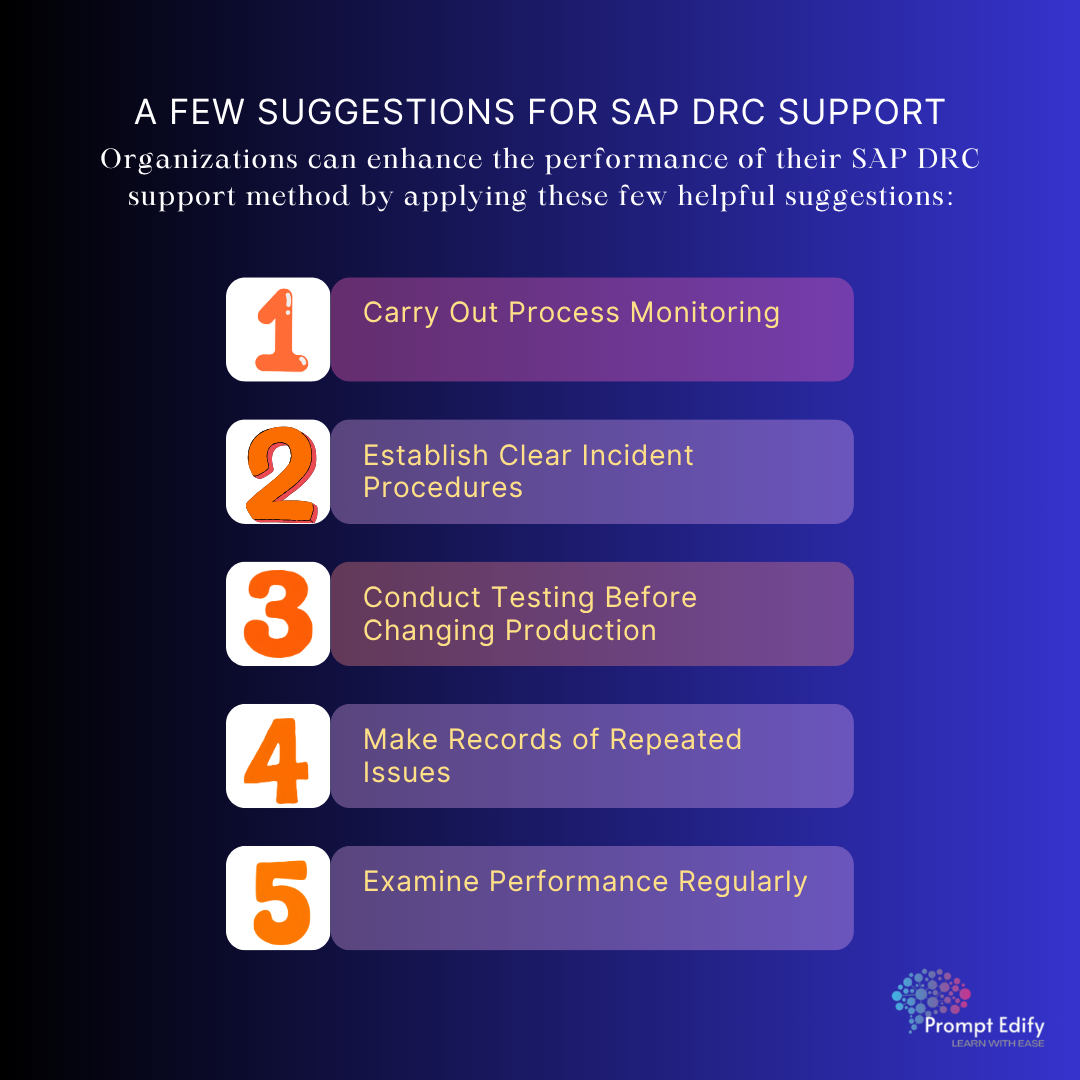
Organizations can enhance the performance of their SAP DRC support method by applying these few helpful suggestions:
Don't wait for customers to notify you about failed transactions. Rather, engage in process monitoring to help notice problems ahead of time.
Be sure to set priorities, escalation paths, response procedures, and responsibilities concerning DRC-related incidents.
Constantly check on changes made in tax authority rules and evaluate their effect on existing SAP processes.
Always test configurations, integrations, and compliance before making changes in production.
Building an issue database is important for your support personnel to deal with the same problems in a shorter period.
Make use of observations and support data to identify frequent failures, bottlenecks, and areas for improvement.
Support for SAP DRC is a necessity for companies that rely on electronic invoicing, tax reporting, and other digital compliance processes. SAP DRC managed services give companies organized coverage of everything from Monitoring → Incident Management → Regulatory Updates → Testing → Enhancements → Reporting.
Using a proactive approach helps companies carry on effective monitoring and operations of DRC, respond to legal changes, quickly solve problems, and keep compliance across various countries. No matter the type of need (for instance, SAP e-invoicing support, and tax compliance support, or troubleshooting), when the right support model is in place, the company’s SAP will always be ready to meet compliance requirements.
By Team Prompt Edify
Have any enquiry? Call us
+(27) 740294414
(+91) 99932-86938
wecare@promptedify.com


Prompt Edify Africa (PTY) Limited
2nd Floor, Rivonia VillageCnr Mutual Road and Rivonia Boulevard Rivonia Village, 2191
Johannesburg , South Africa
Contact : +27740294414
Prompt Edify East Africa Limited
KN 78 ST, Kagarama, Kigali, Kigali, Nyarugenge, Umujyi wa Kigali, Rwanda
Contact : +250 727 845 771
Prompt Edify Private Limited
4th Floor #15, City Vista Tower, Fountain Road,
Kharadi, Pune(MH), India.
PIN- 411014
Contact : (+91) 99932 86938



Contact Us Today!
+27740294414 | (+91) 99932 86938 | +250 727 845 771
contact@promptedify.com | wecare@promptedify.com
🌐 https://promptedify.co.za/