
Understand SAP Engineering Change Management, its change process, change numbers, master records, key advantages and practical manufacturing applications.

Changes to materials, product specifications, bill of materials, and manufacturing orders can be necessary during development and production. They can be introduced due to requests from customers, quality problems, changes in regulations, and improved functionality of products. Without any process for managing changes, companies will be dealing with outdated information, errors in manufacturing and problems in communication between departments.
This is when SAP Engineering Change Management can help. This software allows businesses to organize, control and manage engineering changes to business objects. Through tracking changes and controlling when the changes become valid, it ensures that up-to-date information is available at all stages of the product life cycle.
SAP Engineering Change Management is a feature in SAP where enterprises can control the changes in product-related data. The feature allows companies to update the changes in objects like material master records, bill of materials (BOM), and documents/routings.
Rather than making changes in objects without keeping an organised record, companies can use SAP ECM to track the reason behind a change, the objects where changes will be made, and when the updated information will come into effect.
For instance, in the case where a manufacturer decides to update one of its components, there could be changes in its material master, product BOM, and production routing. Using SAP ECM, all these changes can be done in one place.
This makes SAP ECM very suitable for organisations where product information has to be managed across engineering, procurement, manufacturing and quality departments.
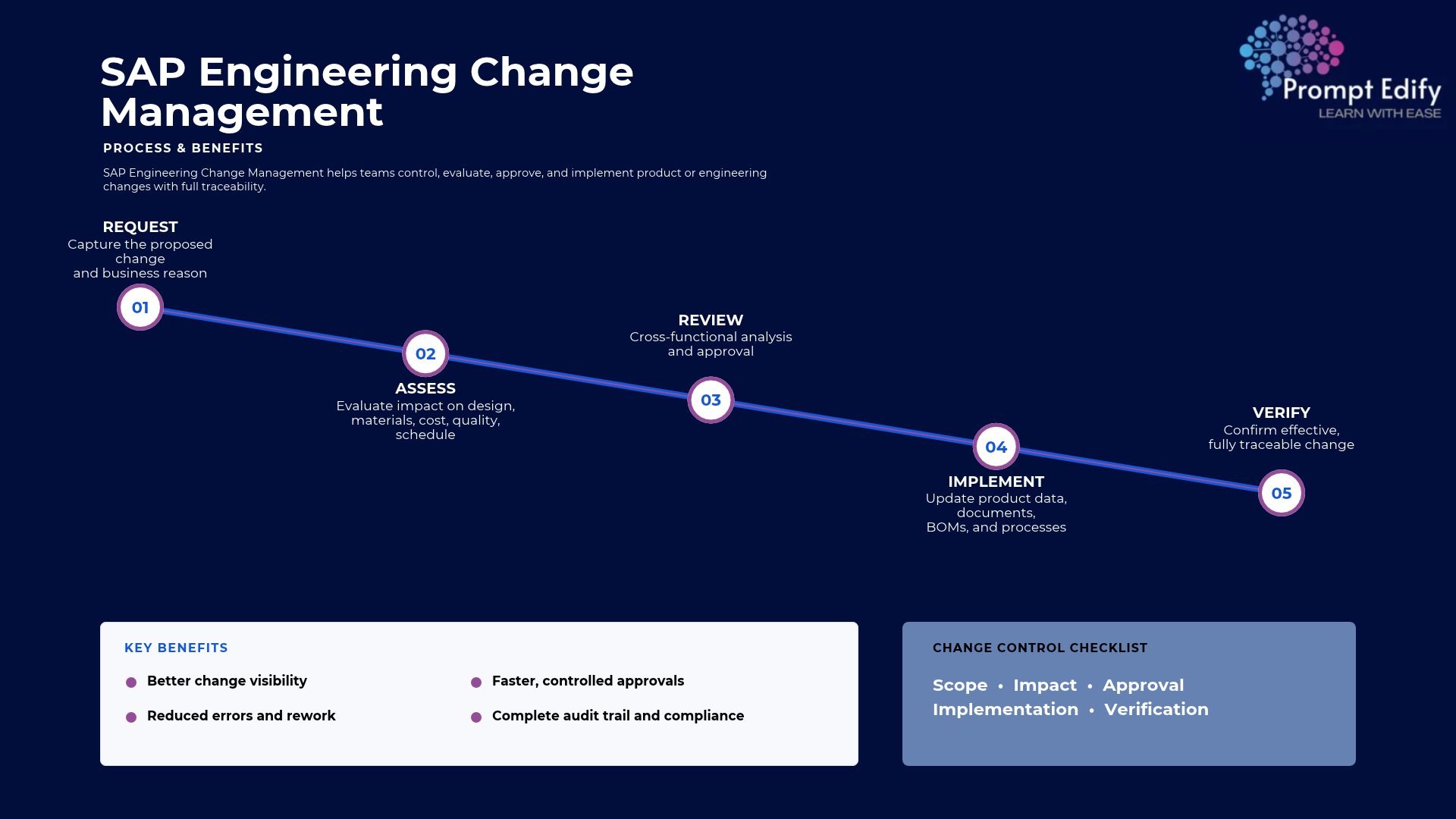
The engineering change process in SAP utilizes a systematic approach in capturing, analyzing and implementation of the changes. Although the process may differ slightly from one company’s configuration to another, it involves the following steps:
The first step in the process of making changes involves identifying the need for making a change in the existing product or process of production. This could result from changes in the components, design, suppliers or quality changes.
This step involves creation of a change record by the authorized user. This change record captures the change which needs to be implemented and it identifies the reason for change and its scope.
Some business objects such as materials, BOMs, documents and routings can be assigned to the change record.
The organisation would determine the time when the implementation becomes effective. This would be important if there is any existing inventory, production orders or operations carried out in the past.
The respective department would implement the change within the information system and ensure its proper implementation. The approval process would be involved if necessary.
The SAP change number is an identifier that is associated with an engineering change request to control the changes. It relates all the changes that have been implemented for a particular engineering change request.
For example, an organization that manufactures industrial equipment might choose to replace the components of a motor. This could include changing the materials, updating the bill of materials and changing the production instructions.
Instead of keeping the changes separate, the organization could use a change number to control these changes.
This number not only lets you know the purpose behind the change but it also keeps a track of the changes that have been implemented. The configuration would depend on whether you require a date-related validity or any other type of controlled validity.
The SAP Change Master Record holds the central information linked with an engineering change. It serves as the point of reference through which a user manages and documents the change.
Some of the information included in the change master record include:
The change master record allows for easy management of the changes. It also ensures that a user understands what the change is and when it was done.
Companies use SAP ECM due to the fact that engineering changes may impact various departments and production stages. The main advantages of SAP ECM are as follows:
SAP ECM can be useful for various manufacturing scenarios, which involve the need to make changes to the product-related information.
It is essential for professionals who are into SAP production planning, materials management, product development and manufacturing to know about engineering changes.
Learning SAP ECM enables professionals to get a hang of how the process of integration works in SAP by understanding change numbers, change master data and modification of BOM and material data.
Prompt Edify is where you can learn all about SAP practically so that you may hone your enterprise software skills. Learn from the SAP Engineering Change Management Training course and get knowledge about engineering change process and their SAP objects.
Check out Prompt Edify today for more information on SAP training programs.
By Team Prompt Edify
Have any enquiry? Call us
+(27) 740294414
(+91) 99932-86938
wecare@promptedify.com


Prompt Edify Africa (PTY) Limited
2nd Floor, Rivonia VillageCnr Mutual Road and Rivonia Boulevard Rivonia Village, 2191
Johannesburg , South Africa
Contact : +27740294414
Prompt Edify East Africa Limited
KN 78 ST, Kagarama, Kigali, Kigali, Nyarugenge, Umujyi wa Kigali, Rwanda
Contact : +250 727 845 771
Prompt Edify Private Limited
4th Floor #15, City Vista Tower, Fountain Road,
Kharadi, Pune(MH), India.
PIN- 411014
Contact : (+91) 99932 86938



Contact Us Today!
+27740294414 | (+91) 99932 86938 | +250 727 845 771
contact@promptedify.com | wecare@promptedify.com
🌐 https://promptedify.co.za/