
Explore SAP Enterprise Service Management Training modules, topics, practical exercises and learning outcomes to evaluate a course syllabus before you decide.
The organizations of today are increasingly concerned about delivering services, streamlining their processes, and handling service-related employee requests effectively. SAP Enterprise Service Management (ESM) allows organizations to handle various services provided by departments like IT, HR, finance, and procurement using workflow process and service management.
For learners interested in acquiring skills in this domain, SAP Enterprise Service Management training can be taken to get an insight into service management principles, business processes, and SAP-related solutions. But prior to taking a course, one needs to know the scope of the syllabus, the skill-set that the course would help develop and the outcomes to expect from it.
This blog post discusses some of the most important modules and training areas in SAP ESM training.
Enterprise Service Management training should help to learn about the way of managing service requests and service coordination in order to improve service delivery within the business.
Enterprise Service Management training should provide theoretical knowledge along with practical implementation of these theories. Students should know about service processes and SAP solutions that could be used for them.
Enterprise Service Management training should include:
The focus should not be on learning software features but understanding how ESM works.
Prior to moving to more advanced features, it is important that learners know the fundamentals of Enterprise Service Management.
This part of the SAP Enterprise Service Management Training program needs to cover the extension of service management processes in ESM from the IT department to other business areas.
Some of the training topics that are important in ESM include:
For instance, an employee can make an IT service request to help him with his laptop or an HR service request regarding some employment documents.
Service Request and Case Management are some other topics which should be addressed while assessing the SAP ESM course modules.
Students must know about creating, categorizing, assigning, tracking and resolving service requests. Students also need to learn about managing cases which need further investigation by service teams.
Some of the things that a training syllabus must have are listed below:
For instance, if there is an issue reported by an employee regarding the business application access, then the service team should be able to track the case and resolve it.
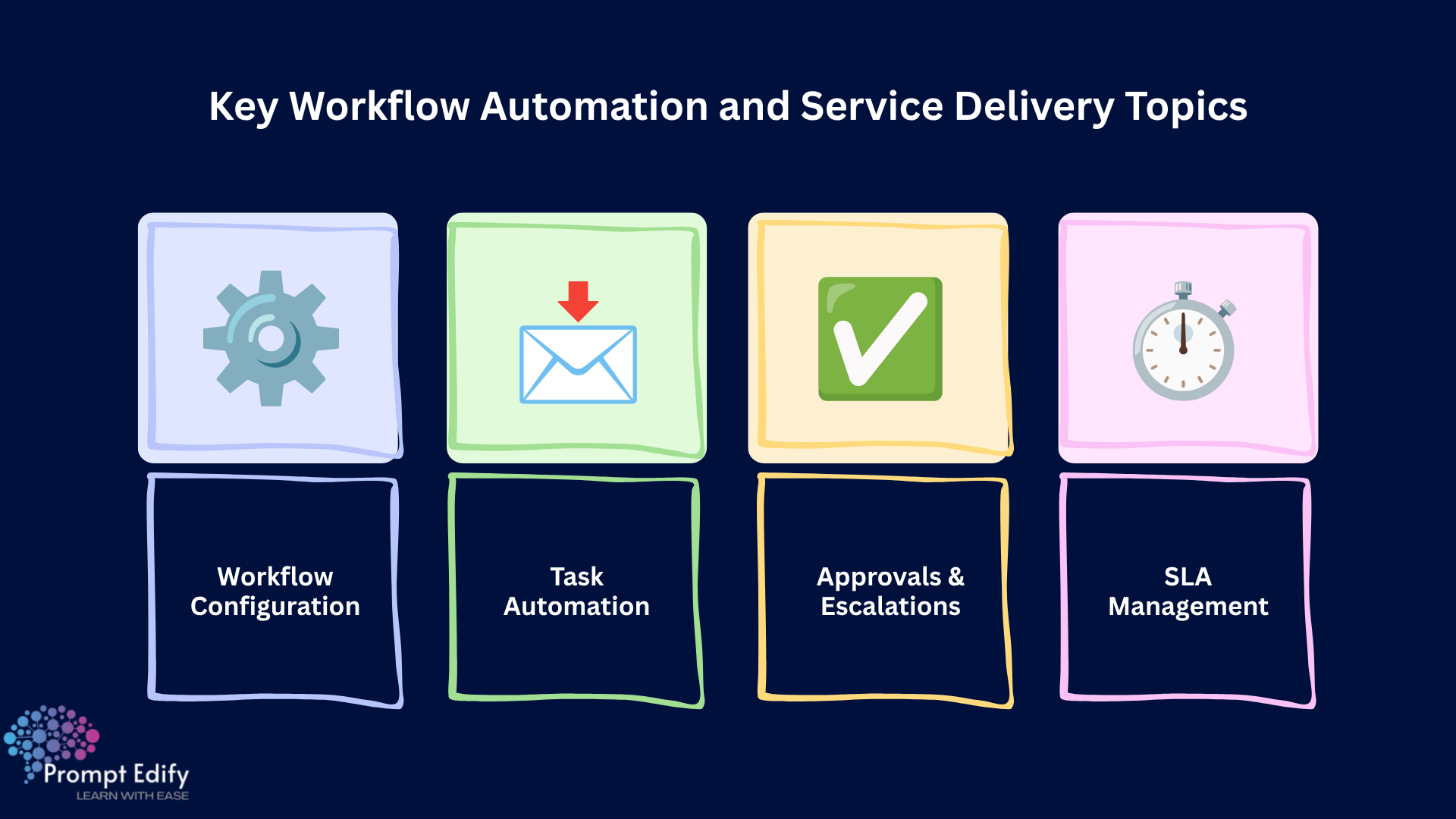
The next significant subject for training in SAP Service Management is Workflow Automation. It is essential that students get a proper understanding of the importance of workflow automation in ensuring that an organization reaches its objective of minimizing manual interventions.
Look for the following subjects for training on Enterprise Service Management:
For example, if a certain employee submits a request that is connected to purchasing, the automated workflow will pass it to the relevant manager to approve and notify the corresponding team about the follow-up action.
Service management platforms for modern enterprises are now making use of artificial intelligence to assist service operations. Consequently, an ESM course must expose learners to some basics of AI-enabled service management.
Some of the concepts learners need to understand are:
For instance, through AI, the intention of the employee’s inquiry could be determined and appropriate knowledge articles suggested.
Furthermore, learners need to understand that certain AI functionalities depend on the SAP solution in use.
Analytics and integration assist organizations in managing the performance of services and integrating other business processes.
An effective SAP ESM class needs to acquaint its learners with the elements of reporting, dashboards, and measuring service performance.
They are:
As an example, service managers may use reports in order to detect patterns among employee problems and pending requests, as well as areas for improving service delivery.
Knowledge is important but exposure to practical situations makes the learning easier for the learners on how the ESM concepts can be applied in real business scenarios.
When evaluating SAP ESM course modules, it would be helpful to assess if the course material contains any practical sessions or access to SAP learning platform.
Some practical activities that can be considered useful are:
It is essential that the learners get an idea about the SAP Enterprise Service Management Training before taking the course.
Here are some points to be considered:
After undergoing SAP service management training, learners must have gained adequate knowledge about essential concepts related to ESM, the processes of handling service requests, identifying areas for workflow automation and interpreting basic service performance reports.
They must also gain more insights into how SAP can help deliver services in a centralized manner.
The level of learning will be dependent on the course curriculum.
Selecting an appropriate training program will help you develop a solid understanding of enterprise service processes and the SAP based service management process. Before joining any training program, you need to check various aspects like course content, hands-on exercises, expertise of the trainers and the learning objectives before joining that particular course.
For more information on SAP Enterprise Service Management Training, contact us at Prompt Edify.
By Team Prompt Edify
Have any enquiry? Call us
+(27) 740294414
(+91) 99932-86938
wecare@promptedify.com


Prompt Edify Africa (PTY) Limited
2nd Floor, Rivonia VillageCnr Mutual Road and Rivonia Boulevard Rivonia Village, 2191
Johannesburg , South Africa
Contact : +27740294414
Prompt Edify East Africa Limited
KN 78 ST, Kagarama, Kigali, Kigali, Nyarugenge, Umujyi wa Kigali, Rwanda
Contact : +250 727 845 771
Prompt Edify Private Limited
4th Floor #15, City Vista Tower, Fountain Road,
Kharadi, Pune(MH), India.
PIN- 411014
Contact : (+91) 99932 86938



Contact Us Today!
+27740294414 | (+91) 99932 86938 | +250 727 845 771
contact@promptedify.com | wecare@promptedify.com
🌐 https://promptedify.co.za/