
Explore SAP EPPM training modules, portfolio planning, project execution, financial management, resource planning and risk management to build practical skills.

Having multiple projects in play, allocating resources and keeping track of business investment can get really difficult for organizations that are handling several projects at one time. The need of the hour for any organization is to have a systematic process for ensuring that their projects align with organizational objectives and budgetary constraints and produce the desired output. In such cases, SAP Enterprise Portfolio & Project Management comes into play.
In case you wish to gain experience in this field, then it would be wise to have knowledge of the SAP EPPM course syllabus. A good SAP EPPM course includes topics like portfolio planning, project execution, finance management, resource planning and risk assessment.
A good SAP EPPM course must provide understanding of the process through which companies handle their projects starting from selection until its completion. Instead of emphasizing transactional details, the SAP EPPM training course must provide an overview of how all these things – portfolio management, project activities, and financials – integrate together.
These are the subjects that students must look out for during SAP EPPM course evaluation:
The SAP Project Portfolio Management training course outline must provide a combination of functionality and systems knowledge for students. Students must be provided with not just the functionalities but also when and why companies use them.
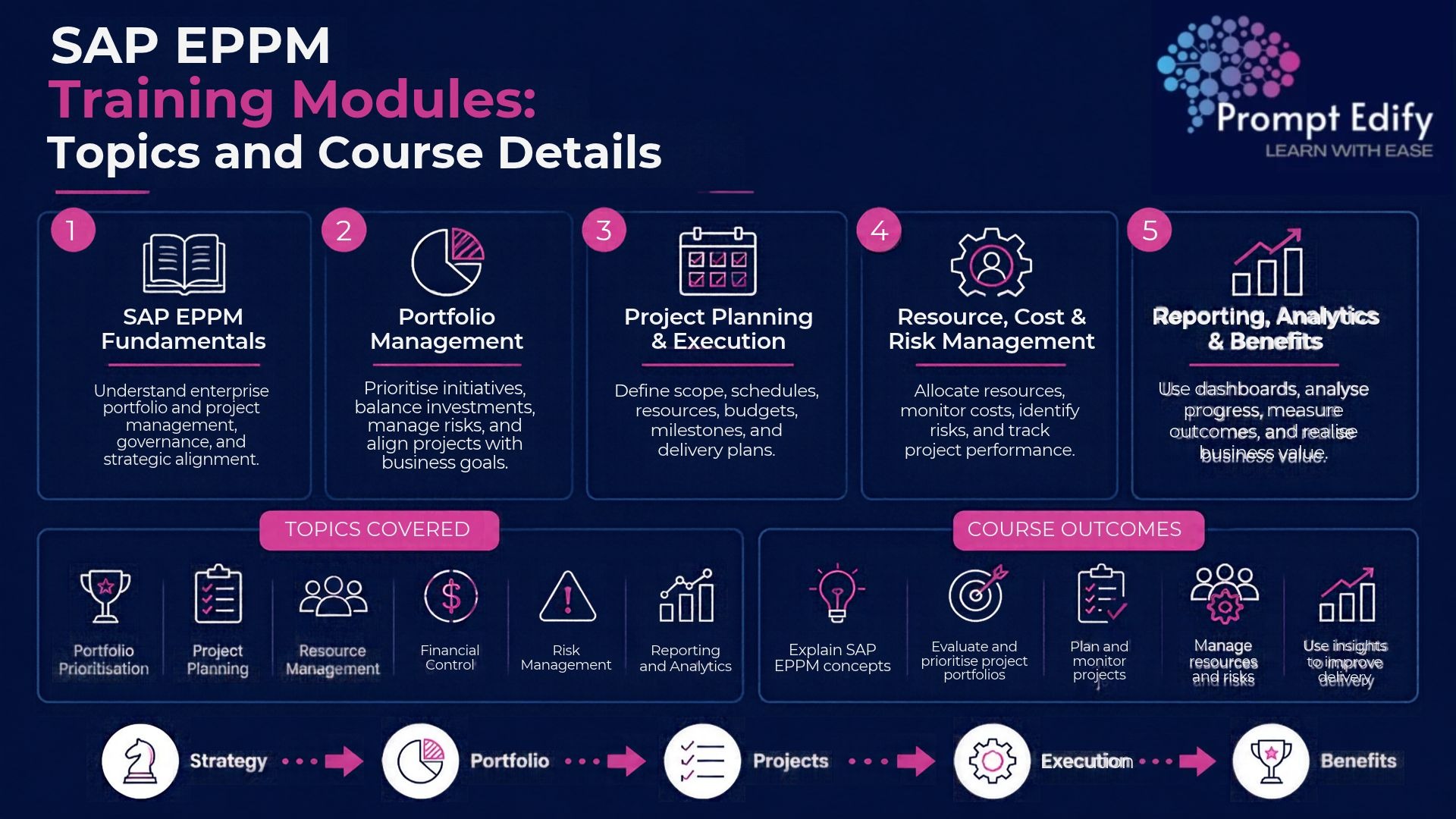
Portfolio management is an essential part of the SAP EPPM because most organisations have more project ideas than they can afford in terms of money or other resources. The module needs to cover the way companies analyze their initiatives and choose projects that support their strategic goals.
Key areas to explore:
By taking an SAP Portfolio Management course, one will learn how decision makers make decisions comparing various projects.
Planning and execution of the project are yet another critical components of the SAP EPPM modules. This segment should outline the process of transforming an approved project into an organized plan for its execution.
The SAP Project Management course material should cover such issues as project structure, WBS (work breakdown structure), project phases, milestones, scheduling, and dependency between tasks.
The participants should learn how the project managers allocate responsibilities, deliverables, and monitor the progress according to the predetermined schedule. It is also important to learn about the project status management, as the delay of one activity may impact the entire project schedule.
The curriculum should provide examples of project creation, activity scheduling, and monitoring of the progress.
Every business project has certain financial elements involved. Without financial planning and control processes, business projects may exceed their budgets and affect the bottom line of the organization.
The part of the SAP EPPM material on this topic should address aspects related to planning, controlling, and analysis of project costs and finance.
Some possible topics are:
The students have to understand how financial data can be used in project decision making. Some practical examples with comparison of planned and actual costs would make the module more applicable.
A project needs various kinds of resources such as people, equipment, material and others. Allocation of the resources ignoring their availability and capacity may lead to scheduling issues.
A comprehensive SAP Resource Management training program must include the following topics: resource identification, resource allocation, resource availability assessment, resource capacity management, and workload monitoring. Students must learn how project managers deal with the shortage of resources and allocate them properly in order to ensure project schedule.
Risk management topics must be a part of the curriculum as well. It includes project risk identification, assessment of its effect, risk monitoring and response planning.
Scenarios will provide practical understanding of the role of resource constraints, costs and project delays.
After undergoing the training, the learners shall find themselves in a position where they will understand the relationship between portfolio decision making and project execution. The learners will also acquire the functional skills that are needed in project planning, financial and resource management.
Before registering for the training, evaluate the same using the below checklist;
A combination of theoretical and practical learning will enable the learners to learn more valuable skills.
Selecting an appropriate syllabus can assist in gaining good insights into enterprise portfolio and project management. You must first assess the topic areas, practical learning sessions and desired learning outcomes before joining any training session.
Discover more about the SAP Enterprise Portfolio & Project Management syllabus at Prompt Edify to learn more about the scope of training and learning opportunities. Gain relevant SAP skills through Prompt Edify’s SAP training sessions and dedicated support.
Contact Prompt Edify now and get one step closer to mastering your SAP EPPM skills.
By Team Prompt Edify
Have any enquiry? Call us
+(27) 740294414
(+91) 99932-86938
wecare@promptedify.com


Prompt Edify Africa (PTY) Limited
2nd Floor, Rivonia VillageCnr Mutual Road and Rivonia Boulevard Rivonia Village, 2191
Johannesburg , South Africa
Contact : +27740294414
Prompt Edify East Africa Limited
KN 78 ST, Kagarama, Kigali, Kigali, Nyarugenge, Umujyi wa Kigali, Rwanda
Contact : +250 727 845 771
Prompt Edify Private Limited
4th Floor #15, City Vista Tower, Fountain Road,
Kharadi, Pune(MH), India.
PIN- 411014
Contact : (+91) 99932 86938



Contact Us Today!
+27740294414 | (+91) 99932 86938 | +250 727 845 771
contact@promptedify.com | wecare@promptedify.com
🌐 https://promptedify.co.za/