
Discover SAP FI and SAP CO differences, functions, integration and business uses. Explore their roles in financial accounting, cost management and SAP Finance.

Financial management is vital in every organization, and businesses require reliable systems for managing accounts, monitoring expenses, and analyzing financial performance. SAP provides various integrated financial management capabilities that allow businesses to carry out these processes by using suitable modules.
Two important modules of SAP financial management are SAP FI (Financial Accounting) and SAP CO (Controlling). While both of these modules serve the purpose of financial management, they have different functions in the organization.
To correctly use SAP and pursue a career in SAP Finance, it is important to know the distinctions between SAP FI and SAP CO.
SAP FI is a financial accounting system within SAP, which assists businesses in logging, supervising, and reporting their financial operations. It refers to the external financial reporting of the company, managed through accounting records.
Businesses can monitor their financial activity with the help of SAP FI by carrying out financial activities such as payments to suppliers, transactions with customers, ledger accounting, and managing fixed assets.
The main functions of SAP FI include:
General Ledger Accounting: logs transactions and allows for the preparation of balance sheets as well as profit & loss statements.
Accounts payable: facilitates the management of supplier invoices, payment processing and liabilities.
Accounts receivable: manages customer invoices, incoming payments and outstanding receivables.
Asset Accounting: conducts fixed asset administration, whether it comes to asset acquisition, amortization/depreciation or retirement.
Bank Accounting: administers banking accounts, bank statements, and reconciliation.
Financial reporting: provides reporting and assists in conducting economic analysis.
SAP FI provides businesses with the ability to keep stable accounting records and conform to the requirements of financial reporting.
SAP CO refers to the Controlling module of SAP, mainly used for internal controlling concerns. This module aids businesses in managing costs, analyzing expenditures, distributing resources, and assessing profitability. Unlike SAP FI, which deals with external financial reporting, SAP CO deals with internal financial performance and aids management in decision-making regarding various aspects of business.
SAP CO serves several functions such as:
Cost element accounting: involves the identification and management of costs incurred in business operations.
Cost center accounting: is mostly concerned with the monitoring of costs across various departments and divisions in a company.
Internal order accounting: involves the management of costs related to specific programs, projects and internal activities.
Profit center accounting: focuses on determining the financial results of various departments or divisions.
Product costing: allows a company to estimate or analyze the costs of manufacturing products.
Profitability analysis: contains several instruments that allow a company to evaluate its profitability on various products, clients, markets and other business segments.
SAP CO offers management the required information regarding cost structures, operating efficiency, and profitability of the company.
SAP FI and SAP CO are closely connected but have different responsibilities within financial management. Understanding their differences helps learners identify how each module contributes to business operations.
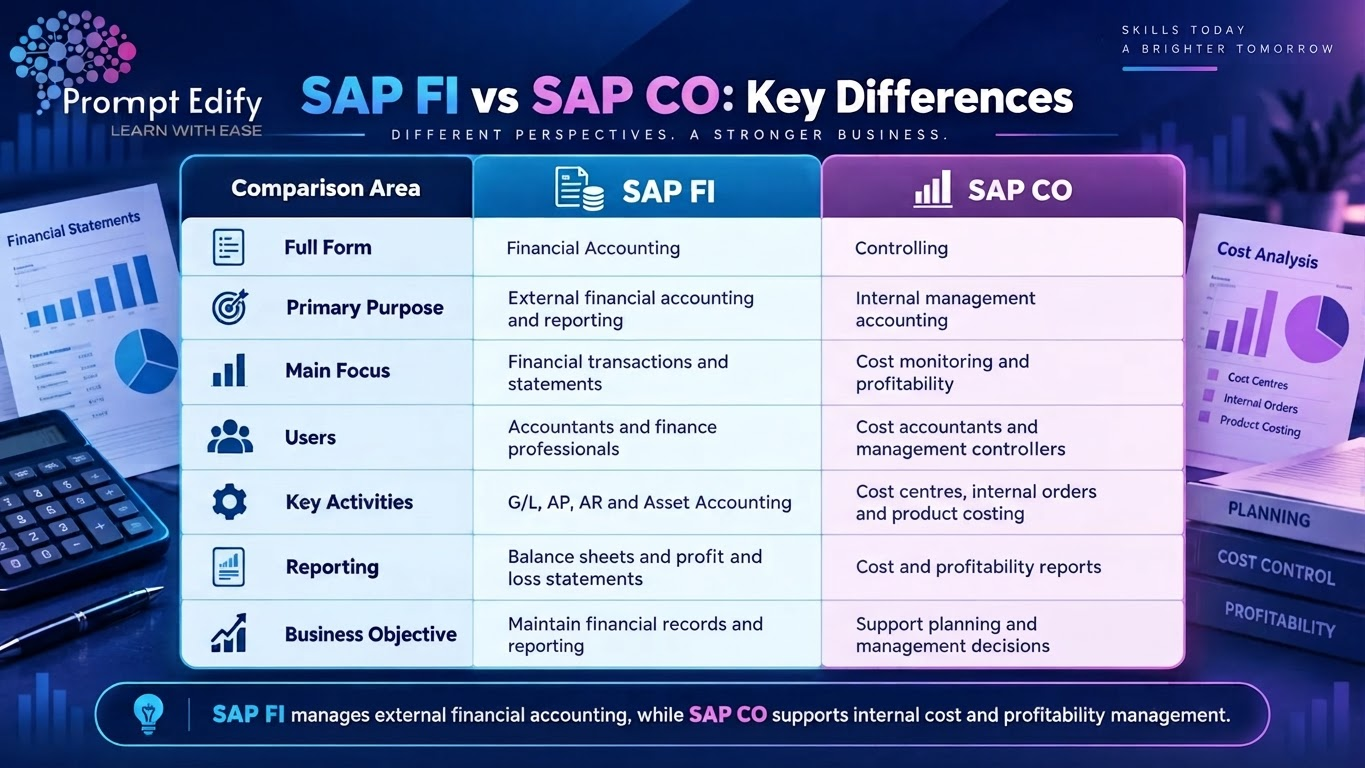
Both modules work together to provide organisations with a more comprehensive understanding of their financial performance.
SAP FI and SAP CO work together as part of SAP’s financial solution. This integration helps businesses to combine the financial information recorded in FI with internal cost and profitability accounting.
For instance, when a company incurs an expense through a vendor invoice in FI, it is likely that this expense will have a relevant costing, like a cost centre or internal order. This information allows management to track expenditures in CO.
Some of the main integration areas include:
SAP S/4HANA Finance introduces a Universal Journal concept that enables consolidation of the financial and control data into a single journal.
SAP FI and SAP CO are used by corporations to oversee several areas of their finances.
Choosing between SAP FI and SAP CO depends upon your area of expertise and choice of career.
SAP FI is suited to those people who are engaged in financial accounting, maintain ledger accounts, accounts payable, accounts receivable, and financial reporting.
For individuals who are interested in cost accounting, budgeting, cost centre accounting, product costing and profitability analysis, SAP CO might be more useful.
For those who would like to get a full picture of SAP financial management, learning both the modules through SAP FICO training would provide them with the necessary hints on Financial accounting and controlling principles and how it works in the SAP system.
The acquisition of knowledge in SAP Financial Management will enable professionals to comprehend how organizations regulate the processes of accounting, controlling, and business reporting.
Prompt Edify provides SAP consulting services and training with the purpose of developing one's understanding of solutions of SAP and business processes.
SAP Finance courses include several categories of knowledge in regard to SAP FI, SAP CO, and SAP S/4HANA Finance. With great experience, SAP trainers will introduce you to various topics of financial accounting, cost management, and so on.
Regardless of whether a learner has previously studied SAP or is starting his/her career, learning FI and CO lays a good foundation for the development of his/her knowledge of financial processes.
By Team Prompt Edify
Have any enquiry? Call us
+(27) 740294414
(+91) 99932-86938
wecare@promptedify.com


Prompt Edify Africa (PTY) Limited
2nd Floor, Rivonia VillageCnr Mutual Road and Rivonia Boulevard Rivonia Village, 2191
Johannesburg , South Africa
Contact : +27740294414
Prompt Edify East Africa Limited
KN 78 ST, Kagarama, Kigali, Kigali, Nyarugenge, Umujyi wa Kigali, Rwanda
Contact : +250 727 845 771
Prompt Edify Private Limited
4th Floor #15, City Vista Tower, Fountain Road,
Kharadi, Pune(MH), India.
PIN- 411014
Contact : (+91) 99932 86938



Contact Us Today!
+27740294414 | (+91) 99932 86938 | +250 727 845 771
contact@promptedify.com | wecare@promptedify.com
🌐 https://promptedify.co.za/