
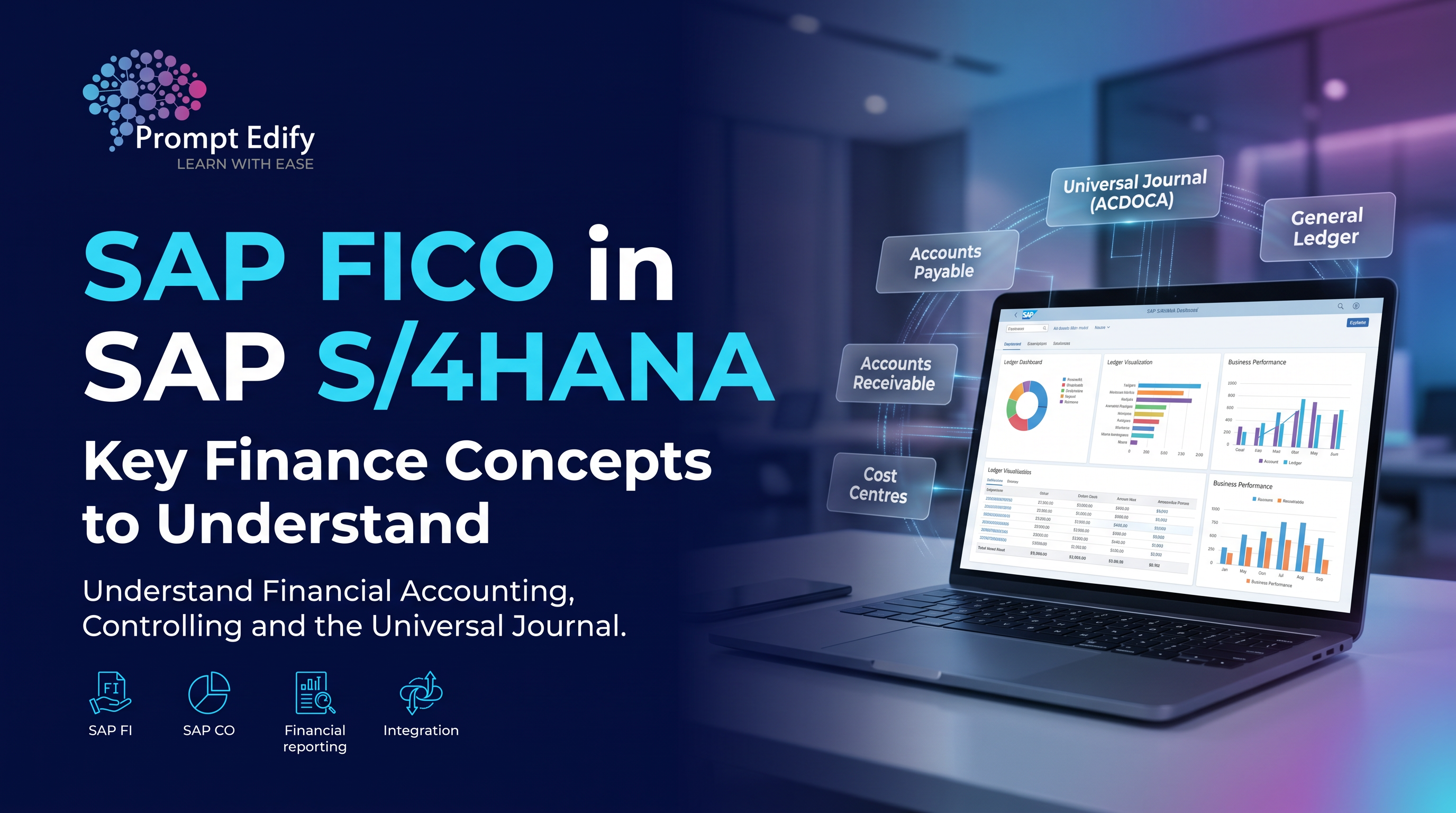
Master SAP FICO in SAP S/4HANA. Learn how the Universal Journal, the ACDOCA table, and the Business Partner model streamline financial accounting and management reporting.
Financial management is one of the key aspects of how organizations evaluate their business performance, organize transactions, and make the right choices. In the current times when many organizations switch to modern ERP systems, it has become increasingly crucial for finance practitioners and SAP students to know how finance functions.
Within the framework of SAP S/4HANA, SAP FICO combines the traditional notions of Financial Accounting (FI) and Controlling (CO) within the advanced ERP environment. Even though many common accounting and controlling processes are still the same for the already existing SAP users, the new system has some modifications related to the financial data model, reporting abilities, and system experience.
This guide provides information about the basics of SAP S/4HANA finance, the Universal Journal, finance integration, and the major distinctions between SAP ERP and SAP S/4HANA.
SAP FICO refers to two important fields in SAP financial management: Financial Accounting (FI) and Controlling (CO). These fields are used for external financial report management and internal cost processing.
In SAP S/4HANA, these functions are integrated into the finance environment. SAP S4/HANA Finance is not a renamed form of a typical SAP FICO module. The infrastructure of the product is based on an upgraded data model and better integration of financial and management accounting information.
SAP FI enables external accounting procedures, which means everything from general ledger management to accounts payable, accounts receivable, asset accounting, and financial reporting. It allows companies to keep records related to financial transactions and provide final reports as financial statements.
SAP CO runs on internal management accounting features. It helps organizations keep track of costs, manage expenditures, and assess profitability in particular cost centers, internal orders, and profit centers. The two functions provide an overall view of the financial activity of an organization.
A crucial concept in learning SAP FICO in SAP S/4HANA is the Universal Journal..
In the previous SAP ERP versions, financial and controlling data was typically spread among several tables and data sets. This called for reconciling accounting components and increased complexity in reporting.
SAP S/4HANA has introduced a Universal Journal, which combines several financial and controlling lines of business into a common data structure which gets the name ACDOCA.
The Universal Journal integrates such fields as:
This approach minimizes redundancy in data and enables uniform financial reporting. It provides opportunity for analysis of financial and controlling data on an even more integrated IT foundation.
In learning SAP FICO, it is necessary to learn about ACDOCA and the Universal Journal as parts of the SAP S/4HANA Finance structure as well.
There are many principles apart from the Universal Journal that explain financial processes in SAP S/4HANA.
General Ledger Accounting is the main area of financial transactions. It enables the preparation of financial statements such as balance sheets and profit and loss statements. Important elements to know include G/L accounts, document transactions, ledgers, and financial periods.
Accounts Payable takes care of the amounts payable to suppliers while Accounts Receivable takes care of the amounts receivable from customers. Accounts Payable and Accounts Receivable include processes such as invoice posting, payments, outstanding amounts, and reconciliation processes.
Asset Accounting ensures the management of the various organization’s fixed assets from their acquisition till retirement. Management of fixed assets includes acquisition depreciation, transfers, retirement of the assets, and asset reporting.
Management Accounting deals with the internal control of costs. It uses important elements such as cost centers, internal orders, and profit centers to help organizations understand the places of costs and how they perform.
SAP S/4HANA takes on the Business Partner Methodology approach as an entry point for keeping track of suppliers and clients master data. Traditional SAP ERP techniques required companies to manage their customers and vendors separately, but now organizations utilize business partner records with distinct roles according to their functions and effective client and supplier data integration.
Financial professionals working in payment processing and accounting can benefit from learning more about this system.
The transition from traditional SAP ERP to SAP S/4HANA involves changes in the underlying financial architecture. However, the fundamental accounting principles and many business processes remain relevant.
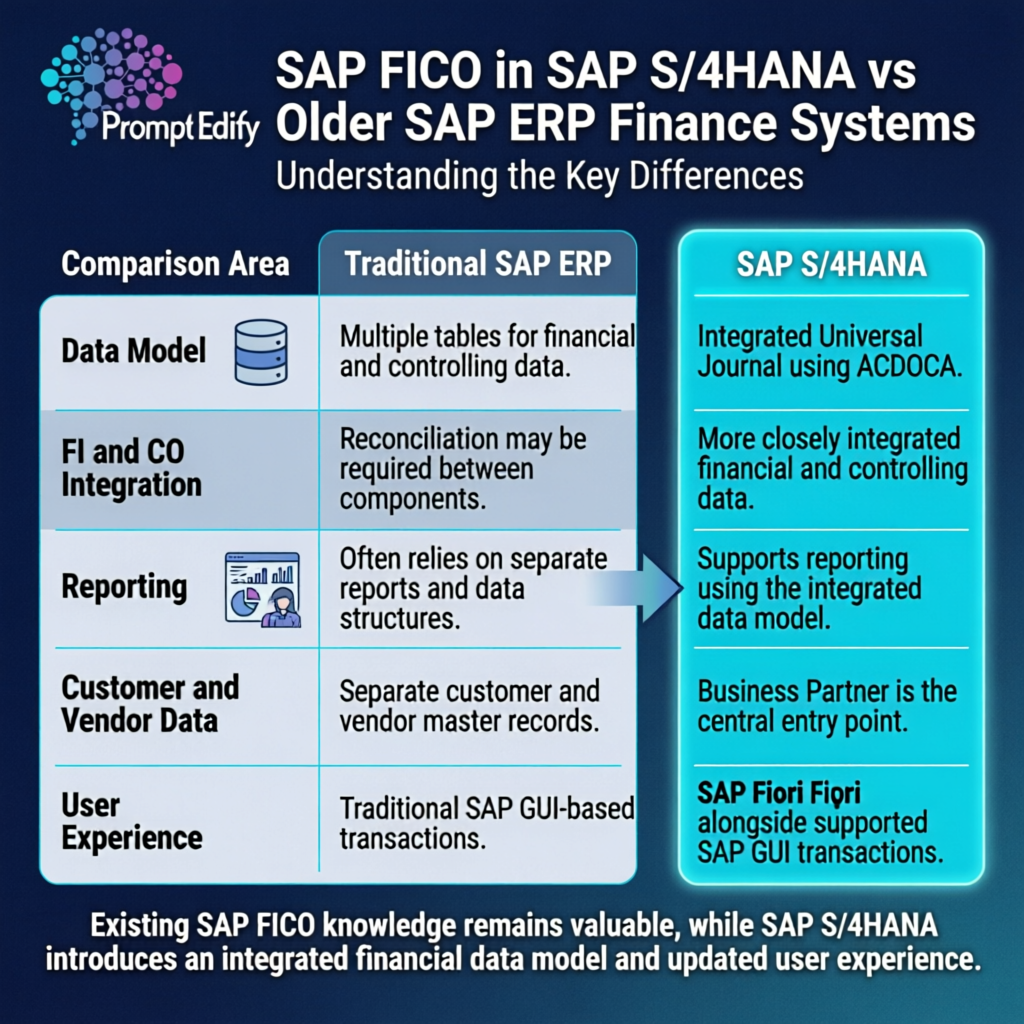
These differences show why existing SAP FICO knowledge remains useful but needs to be extended to cover the SAP S/4HANA environment.
The exact features and available applications can vary depending on the SAP S/4HANA release and deployment model.
SAP finance integration involves financial accounting linking up with other parts of a business so that the impact of operations on finances is documented.
For example, when goods are ordered, the whole procurement process leads to recording the respective financial transactions. Once the product gets delivered and bills from suppliers are processed, the corresponding accounting entries can be recorded in the financial software.
Sales operations can also impact the generation of receivables and revenues. In addition, capital investments enable updates of asset accounting, while the controlling information provides companies with insights on costs incurred during operations.
Overall, such integration allows understanding the financial consequences of various processes within a company.
SAP finance integration involves financial accounting linking up with other parts of a business so that the impact of operations on finances is documented.
For example, when goods are ordered, the whole procurement process leads to recording the respective financial transactions. Once the product is delivered and bills from suppliers are processed, the corresponding accounting entries can be recorded in the financial software.
Sales operations can also impact the generation of receivables and revenues. In addition, capital investments enable updates of asset accounting, while the controlling information provides companies with insights on costs incurred during operations.
Overall, such integration allows understanding the financial consequences of various processes within a company.
Prompt Edify offers SAP training and consulting services that have been developed to enable individuals and organizations to gain a comprehensive understanding of SAP solutions. Its programs enable learners to master the rules of finance in accounting, management accounting, and SAP S/4HANA Finance.
If you want to broaden your knowledge of SAP FICO or switch from older SAP ERP finance systems, understanding core concepts will help you understand the current SAP financial processes.
By Team Prompt Edify
Have any enquiry? Call us
+(27) 740294414
(+91) 99932-86938
wecare@promptedify.com


Prompt Edify Africa (PTY) Limited
2nd Floor, Rivonia VillageCnr Mutual Road and Rivonia Boulevard Rivonia Village, 2191
Johannesburg , South Africa
Contact : +27740294414
Prompt Edify East Africa Limited
KN 78 ST, Kagarama, Kigali, Kigali, Nyarugenge, Umujyi wa Kigali, Rwanda
Contact : +250 727 845 771
Prompt Edify Private Limited
4th Floor #15, City Vista Tower, Fountain Road,
Kharadi, Pune(MH), India.
PIN- 411014
Contact : (+91) 99932 86938



Contact Us Today!
+27740294414 | (+91) 99932 86938 | +250 727 845 771
contact@promptedify.com | wecare@promptedify.com
🌐 https://promptedify.co.za/