
Explore SAP Field Service and Asset Management, compare field service and maintenance, and learn about planning, mobile execution and ERP integration.
Companies that have equipment, machinery, and customer services require effective means for asset maintenance and field services provision. In this regard, SAP Field Service and Asset Management become highly valuable. They allow companies to take care of requests for services, scheduling technicians, monitoring equipment performance, and maintaining assets.
Field service and asset management have a number of similarities and connections but perform different functions in business. It is useful to understand their differences and characteristics.
Field Service Management deals with organizing and managing the services that are delivered at site by either the customer or distant locations. This involves management of service requests, technician scheduling, work assignment, dispatching, and mobile service delivery.
Asset Management deals with the management of the physical assets of an organization in the lifecycle from installation/acquisition to maintenance, and finally decommissioning. It helps organizations in maintaining awareness of asset conditions, maintenance plans, and protection of assets against failures.
In conclusion, the processes of field service management and asset management integrate service delivery and maintenance of equipment. Using SAP Asset Management software, organizations can monitor their asset details and maintenance efforts.
Field Service Management mainly deals with providing services to customers at their location. This process requires management of service requests, appointment scheduling, assignment of technicians, and completion of service tasks. It makes use of mobile technology to enable technicians to have access to the customer details and provide updates about service activities. The purpose of Field Service Management is to increase customer satisfaction through efficient service delivery.
On the other hand, Asset Maintenance entails equipment maintenance that ensures their reliable performance. In this case, maintenance planning, scheduling of maintenance tasks, maintenance record keeping, and allocation of maintenance resources become important. Using asset and maintenance data, companies are able to detect any problems before they occur in order to avoid unexpected breakdowns and increase equipment uptime.
In one instance, when a customer reports a problem in the machine, the field service department arranges for a technician visit and service task scheduling. At the same time, the asset maintenance department uses maintenance history and technical data of the equipment to diagnose the problem and carry out the repair.
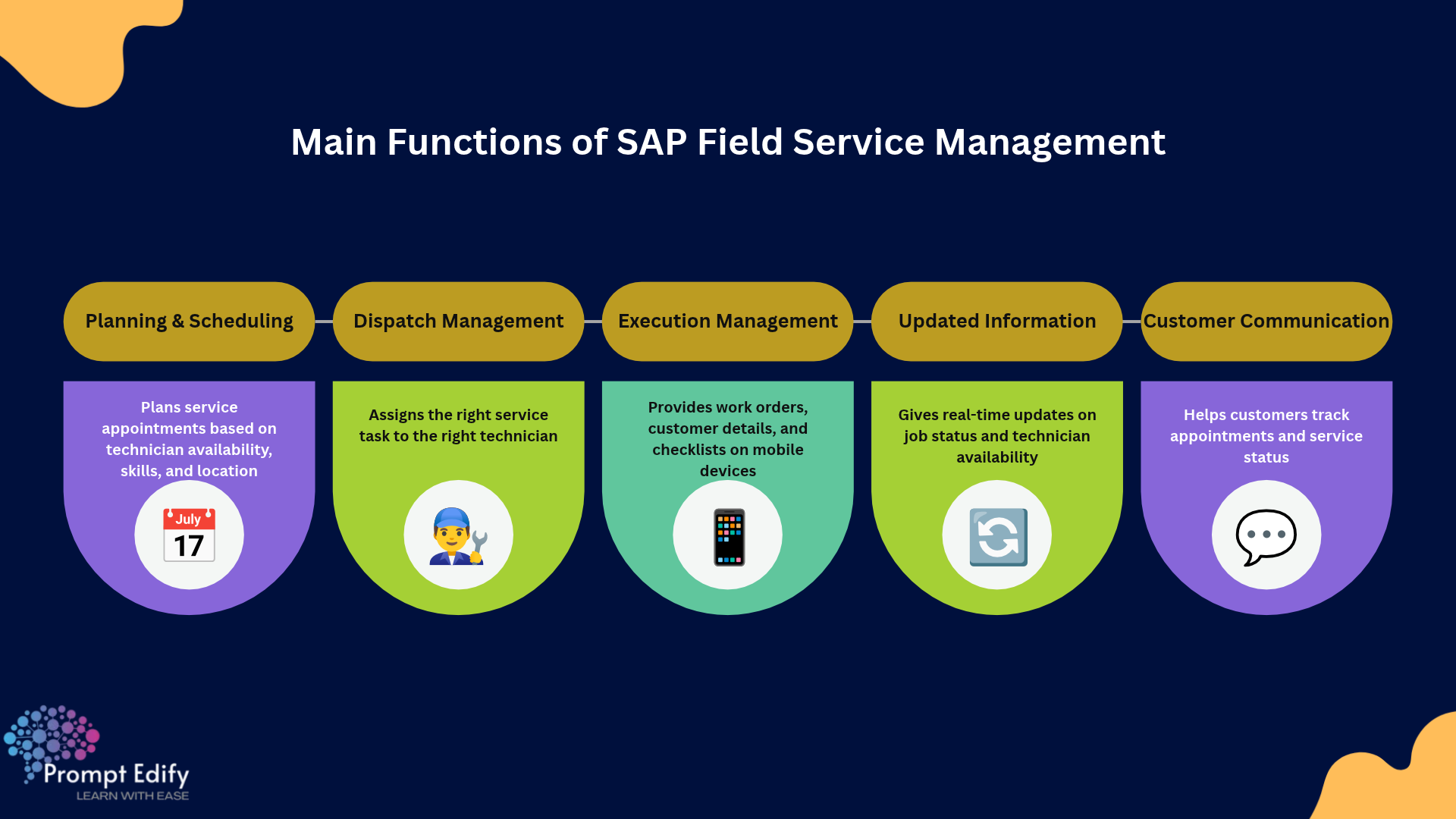
Some of the key benefits of SAP Field Service Management software are:
All the above activities help to complete the service in a timely manner.
Information about assets is crucial for the effective execution of services. Through the application of SAP solution, organizations will be able to store information regarding their assets such as the asset number, serial number, installation date, warranty information, maintenance history and other technical information.
In the case of generation of a service request, the technician will be able to use the stored information to know the status of the asset and past maintenance.
For instance, if some industrial equipment needs repair, the technician will be able to look at the past maintenance records and know the problem faced and spare parts needed without going to the location.
Effective planning and dispatching play a significant role in field service processes. The organization should make sure that the appropriate technician is dispatched to the correct location with the right set of tools.
The SAP Field Service Management can assist with this process with:
Mobile Execution is also helpful for field technicians in becoming more efficient in terms of accessing appropriate information while executing tasks.
SAP Field Service and SAP Asset Management work better through ERP integration.
Integration with ERP systems makes it possible for service operations to be integrated into important business processes such as finance, procurement, inventory, sales, and customer management.
For example, in case the technician must replace the parts, the service operations can be integrated into the inventory and procurement operations. Also, in case the service operation is completed, it helps integrate billing operation and finance management.
Integration allows for Asset Management and Service Operations to be integrated rather than remaining as separate business processes.
SAP service integration allows information exchange between the field service software, asset management solutions, and ERP solutions.
Information flow can be described as follows:
These solutions require attention to such factors as data accuracy, systems compatibility, integration interfaces, security, and synchronization.
For those who wish to understand SAP services and asset management, the following topics need to be considered:
Knowledge of all this will build a good foundation for practical SAP service & maintenance management.
SAP Field Service and Asset Management allow enterprises to integrate the service delivery process of customers with asset management operations. As field service is concerned with scheduling, dispatching, and delivery of services, asset management revolves around equipment reliability, maintenance scheduling, and lifecycle management.
Through the combination of such abilities with ERP and other enterprise processes, companies will be able to increase transparency and improve their performance.
If you are a student, a working professional, or an SAP consultant-in-training, studying these topics will give you an insight into the service and asset operations of modern enterprises.
Would you like to develop your SAP knowledge and learn about business processes in practice? Get in touch with us at Prompt Edify for more information on SAP training.
By Team Prompt Edify
Have any enquiry? Call us
+(27) 740294414
(+91) 99932-86938
wecare@promptedify.com


Prompt Edify Africa (PTY) Limited
2nd Floor, Rivonia VillageCnr Mutual Road and Rivonia Boulevard Rivonia Village, 2191
Johannesburg , South Africa
Contact : +27740294414
Prompt Edify East Africa Limited
KN 78 ST, Kagarama, Kigali, Kigali, Nyarugenge, Umujyi wa Kigali, Rwanda
Contact : +250 727 845 771
Prompt Edify Private Limited
4th Floor #15, City Vista Tower, Fountain Road,
Kharadi, Pune(MH), India.
PIN- 411014
Contact : (+91) 99932 86938



Contact Us Today!
+27740294414 | (+91) 99932 86938 | +250 727 845 771
contact@promptedify.com | wecare@promptedify.com
🌐 https://promptedify.co.za/