
Master SAP General Ledger Accounting. Discover how G/L management, multi-ledger accounting, and the S/4HANA Universal Journal unify your financial records.

In every company, it is necessary to have a suitable method of controlling and recording financial transactions. All financial actions, such as payments to suppliers and receipts from clients or purchases of goods and use of assets, should be properly processed for the financial records to be trustworthy. It is in this regard that the General Ledger Accounting function in accounting is important.
SAP General Ledger Accounting is one of the processes in SAP Financial Accounting (SAP FI). The technology allows companies to register financial transactions and maintain G/L accounts.
In this guide, information about SAP G/L accounting, its main features, as well as the process of posting financial information will be provided. Every organization must have an appropriate process of accounting for financial transactions.
SAP General Ledger Accounting, also known as G/A accounting, is one of the prominent components of SAP Financial Accounting. It enables organizations to manage their financial operations by allowing them to track and register the accounting transactions in respective general ledger accounts.
Each financial transaction has an impact on different accounts. For instance, a customer payment results in updated accounts for the customer and the bank. Similarly, the payment made to the supplier will also be recorded in the accounting records.
SAP General Ledger Accounting collects all these financial transactions and manages these postings for the preparation of accounting statements.
In other words, the general ledger is responsible for the systematic record of the financial data of the organization.
SAP General Ledger Accounting offers several advantages that assist finance teams in maintaining accurate financial records and managing accounting functions.
G/L account management refers to the process wherein the companies can manage the various accounts that can record several financial transactions. Assets, liabilities, income, expenditure, and equity are some important financial categories.
The chart of accounts is important for companies to categorise various financial transactions accordingly.
Financial posting refers to the process of documenting the transactions of the company into the respective G/L account. All the accounting transactions will be registered in the accounting record of the business (document) through the G/L account.
For example, when the company spends money on office expenses, the respective expense and bank account will undergo the accounting postings.
In the SAP system, a ledger is responsible for retaining financial data based on the requirements of reporting of an organization. SAP has both leading and non-leading ledgers, and it provides businesses with capabilities to track their financial data under different accounting regulations.
This is helpful for organizations that are required to prepare financial statements based on various accounting standards.
Financial period management is responsible for the management and control of periods when accounting transactions are recorded. Finance teams manage the posting periods and help with month-end closing and year-end closing.
SAP General Ledger Accounting provides financial information for the purpose of reporting and analysis. Organizations can prepare balance sheets, income statements, and other accounts-based reports based on their accounting records.
These reports help management understand business performance and financial position.
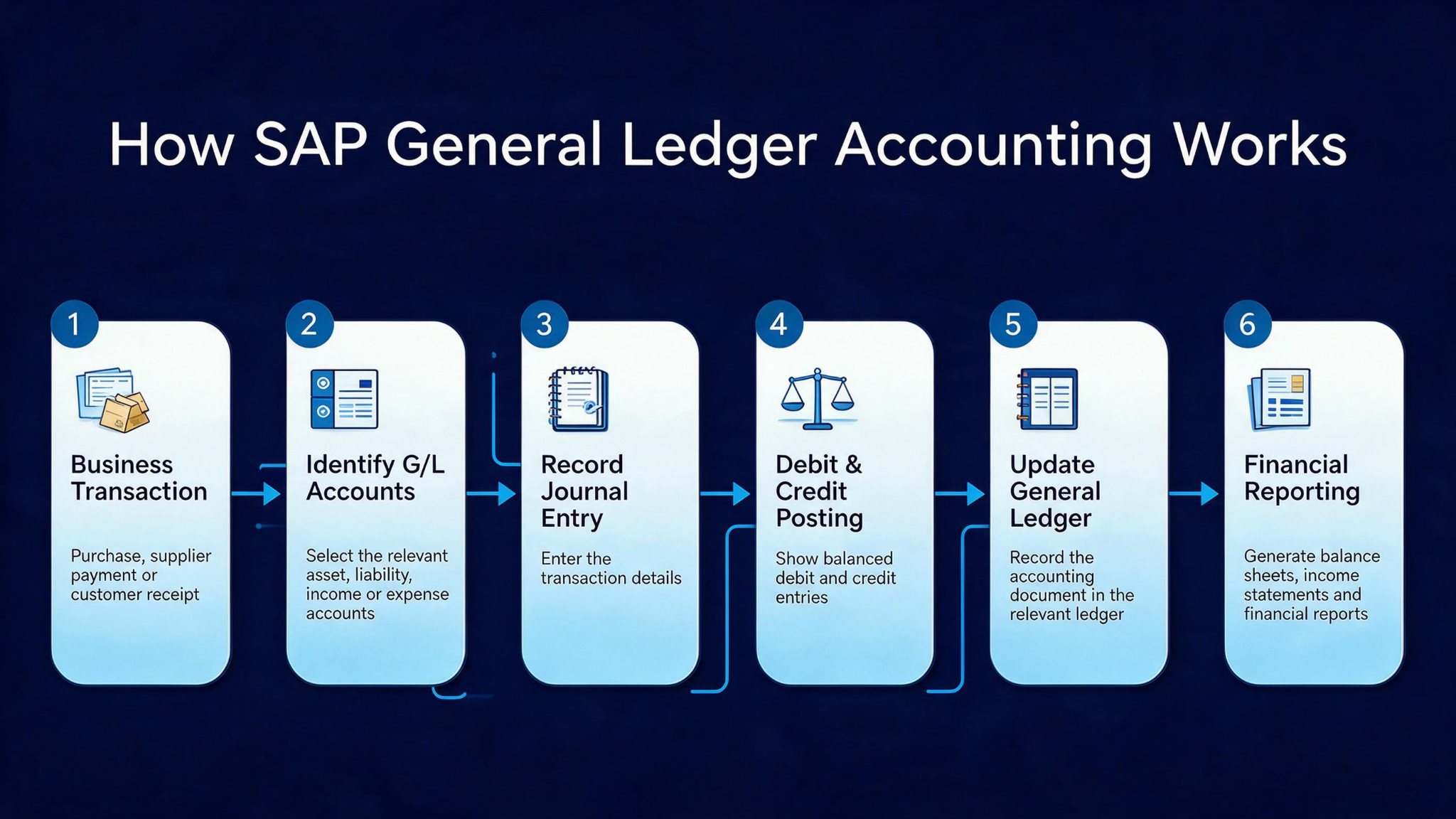
The SAP G/L accounting process begins with the occurrence of a financial transaction that requires recording.
An example is a company that buys office equipment and pays for it using its bank account.
The transaction is recorded using the appropriate accounting technique in which the asset-related account receives the update regarding the purchase and the bank account shows the payment made. SAP generates an accounting document with the respective debit and credit records.
A standard financial posting involves:
These procedures help organizations keep accounting documents and track transactions.
SAP ledger is a vital element in financial accounting since it facilitates recording and reporting of financial data.
SAP general ledger accounting has several types of ledgers that can be applied according to organization and reporting requirements.
The leading ledger is the main ledger that represents the accounting principles of an organization and fulfills its financial reporting needs.
A non-leading ledger is used by businesses for record-keeping according to different accounting standards.
This means that if a company operates in several countries, it may have to prepare financial reports under both the local standards and international reporting standards.
Different ledgers may thus help fulfill reporting requirements in the SAP system.
The SAP General Ledger Accounting plays a crucial role in SAP S/4HANA Finance, with the significant change being the introduction of the Universal Journal. Universal Journal merges different financial and controlling records into one unified data structure, ACDOCA.
With the introduction of the Universal Journal, all information is pulled together from such areas of accounting as general ledger, asset accounting, and controlling. Usage of a unified data model contributes to more consistent financial reporting and reduces the necessity to perform reconciliation among various accounting elements.
SAP S/4HANA offers a lot of reporting functionalities based on the integrated financial model.
The SAP General Ledger Accounting system provides many benefits for companies managing their financial transactions and reporting.
This way, companies are able to manage their accounting properly and realize their financial standing in a better way.
Individuals interested in financial accounting and using ERP-based business processes can benefit from understanding SAP General Ledger Accounting.
Learning SAP General Ledger Accounting may be advantageous to the following groups of individuals:
Basic knowledge of accounting principles, debit and credit entries, and financial statements will allow students learning SAP General Ledger Accounting to become more efficient in absorbing the subject.
Prompt Edify provides SAP training and consultation services to assist individuals and businesses in gaining knowledge about how best to use SAP solutions. Its SAP finance study programme covers various significant domains in financial accounting, general ledger accounting, controlling, and SAP S/4HANA finance.
Whether you have just started learning about SAP or are trying to improve your knowledge of financial procedures, learning SAP General Ledger Accounting will help you form a solid basis in corporate financial management.
By Team Prompt Edify
Have any enquiry? Call us
+(27) 740294414
(+91) 99932-86938
wecare@promptedify.com


Prompt Edify Africa (PTY) Limited
2nd Floor, Rivonia VillageCnr Mutual Road and Rivonia Boulevard Rivonia Village, 2191
Johannesburg , South Africa
Contact : +27740294414
Prompt Edify East Africa Limited
KN 78 ST, Kagarama, Kigali, Kigali, Nyarugenge, Umujyi wa Kigali, Rwanda
Contact : +250 727 845 771
Prompt Edify Private Limited
4th Floor #15, City Vista Tower, Fountain Road,
Kharadi, Pune(MH), India.
PIN- 411014
Contact : (+91) 99932 86938



Contact Us Today!
+27740294414 | (+91) 99932 86938 | +250 727 845 771
contact@promptedify.com | wecare@promptedify.com
🌐 https://promptedify.co.za/