
Explore the SAP IBP training curriculum, key modules, practical topics and learning outcomes to understand how to build skills in integrated business planning.
SAP Integrated Business Planning (SAP IBP) is one of the vital solutions for organizations that intend to enhance their skills in supply chain planning, demand forecasting, and inventory management. With the increasing adoption of advanced planning solutions by firms, the need for people who have knowledge of SAP IBP is becoming high.
SAP IBP Training enables the learner to get a grip of the integrated planning solution provided by SAP, which is useful in handling diverse supply chain processes. Training in SAP IBP involves the teaching of the necessary concepts, practical aspects, configuration and business case studies.
Prior to choosing a course, learners need to be aware of what they will learn. This article highlights some of the vital concepts taught in the curriculum of SAP IBP training programs.
Well-organized content for SAP IBP courses must comprise not only theoretical elements but also practical knowledge. In addition, the SAP IBP course content must provide an insight into the interaction of various planning functions within the organization.
The training curriculum for SAP IBP normally comprises such themes as:
A good course must necessarily have practical exercises and business cases that demonstrate the work of SAP IBP in practice.
The most important module of SAP IBP is the demand planning. The demand planning module helps firms plan for future customer demands from previous sales data and forecasts.
In this module, students get to know how to make demand plans and forecast analysis.
Some of the topics that are taught in this module are as follows:
Learning outcome: Students would be able to understand how to prepare demand forecasts and analyze customer demands.
Suppliers can aid organizations in managing their product availability, production capabilities, and cost of maintaining inventories.
The subject matter deals with meeting supply to meet expected demands. Students learn about ways in which organizations plan their supplies, production, and requirements.
Some of the important subjects in this course are:
Inventory optimization plays an important role in maintaining optimum inventory without incurring too many inventory costs for companies.
Some of the issues to be covered in the class include:
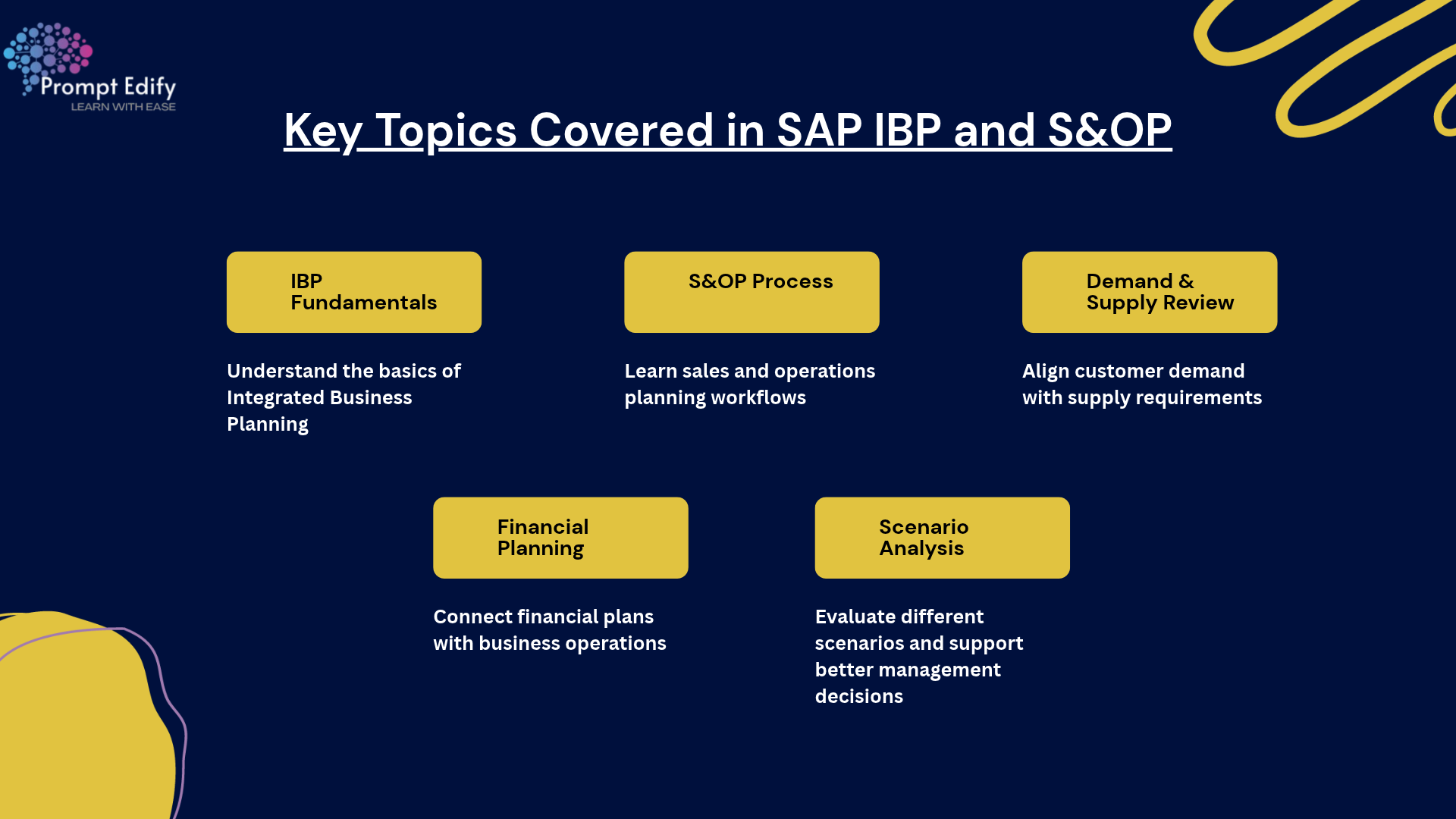
Sales & Operations Planning (S&OP) integrates sales, finance, and operations in developing one plan for the organization.
In the SAP IBP course, the topic on Sales & Operations Planning discusses how an organization integrates its strategic objectives with its operational objectives.
Topics to be covered include:
Learning outcome: The learners understand how different departments integrate to achieve the organizational objectives.
Planning Area, Master Data, and Key Figures are some of the basic concepts that one has to know when dealing with SAP IBP. They are vital in establishing the planning data structure, storage, and analyses.
The students should be conversant with:
Learning Outcome: The students will be able to gain knowledge about the planning data structure and how the key figures make the supply chain planning process easy.
Furthermore, it is also crucial that through this course, the learners gain insights into SAP IBP configuration and implementation.
This knowledge will enable the learners to gain insights about the configuration of SAP IBP according to the requirements of the organization.
Some of the major topics that need to be covered are as follows:
Learning Outcome: Insights into SAP IBP Configuration & Implementation
It is essential to choose an appropriate SAP IBP course as per the requirement. Before joining any SAP IBP course, candidates must review the course keeping in view the following parameters.
Following parameters need to be considered carefully:
SAP IBP is one of the effective solutions that help in handling the planning processes of the current supply chain. An organized SAP IBP Training program assists in acquiring knowledge about Demand Forecasting, Supply Planning, Inventory Optimization, S&OP, Configuration & Integration.
Choosing an SAP IBP training program with complete modules and good learning options will help in creating a solid base in SAP IBP.
Planning to enhance SAP IBP skills? Connect with Prompt Edify and know more about SAP IBP Training programs.
By Team Prompt Edify
Have any enquiry? Call us
+(27) 740294414
(+91) 99932-86938
wecare@promptedify.com


Prompt Edify Africa (PTY) Limited
2nd Floor, Rivonia VillageCnr Mutual Road and Rivonia Boulevard Rivonia Village, 2191
Johannesburg , South Africa
Contact : +27740294414
Prompt Edify East Africa Limited
KN 78 ST, Kagarama, Kigali, Kigali, Nyarugenge, Umujyi wa Kigali, Rwanda
Contact : +250 727 845 771
Prompt Edify Private Limited
4th Floor #15, City Vista Tower, Fountain Road,
Kharadi, Pune(MH), India.
PIN- 411014
Contact : (+91) 99932 86938



Contact Us Today!
+27740294414 | (+91) 99932 86938 | +250 727 845 771
contact@promptedify.com | wecare@promptedify.com
🌐 https://promptedify.co.za/