
Discover SAP maintenance planning and scheduling, including planning stages, resource availability, work centre capacity, maintenance orders and key challenges.

Good maintenance management is an important factor in ensuring equipment dependability, decreasing unplanned stoppages, and running a steady business. Maintenance teams in manufacturing and other industries where there are a lot of assets should know in advance what will be done, which resources will be used, and when to do it. Lack of organisation and proper planning would cause production disruptions and an increase of operating expenses.
SAP PM facilitates these processes through systematized maintenance processes. Being aware of SAP maintenance planning and scheduling allows companies to facilitate maintenance processes.
This article covers the main planning phases and availability of resources, scheduling processes, maintenance order preparation and challenges faced during operation.
SAP maintenance planning and scheduling involves the methods used to find out maintenance requirements, make arrangements for anticipated work, and find out when and how scheduled maintenance needs to be completed.
Despite their closeness in nature, planning and scheduling differ in terms of functions.
In SAP PM, maintenance planners may use maintenance orders, notifications, task lists, and work centers. All these features help maintenance services to help carry out work that is planned and make the appropriate arrangement.
A well-defined maintenance planning procedure allows maintenance actions to be planned properly before they are executed. The important steps in this process are as follows.
The first phase is to determine the equipment in need of inspection, rectification or preventive maintenance. The need for repair activities can originate from breakdowns of equipment, alerts from operators, findings from inspections or preventive maintenance schedules.
In the process of diagnosing problems maintenance notifications can be generated which will inform about the issue and the technical apparatus involved. Thus, this stage provides the planner with the first understanding of the work needed to be performed.
After the maintenance necessity is determined, the planners analyze the data at hand and eventually define the actions to be taken. Here, they investigate the state of the equipment, detect the issue and define the work scope.
For instance, it might be the case when a pump needs to be inspected, or a component should be replaced or lubricated.
The next step is to determine what resources will be needed for the work. This includes spare parts, tools, services from third parties and qualified maintenance personnel.
Planners check whether the necessary materials have been acquired and identify any shortages that may hinder the completion of the job. They take into account the abilities and the availability of specialists who will perform the work.
After the work assessment is finished, the maintenance order can be created in SAP PM. The order sets the framework for keeping and processing the information regarding the conducted maintenance activities.
The order can include operations, assignments of a work center, materials needed, expected labor inputs, scheduling information and cost estimation. It gives the maintenance workers a good idea of what has to be done and what resources will be needed to do it.
Work centre capacity is crucial in the process of maintenance scheduling and planning in SAP. A work centre can be described as the place or unit where maintenance work is done. It can mean either a group of technicians, a workshop, or a maintenance crew.
Capacity planning allows maintenance managers to figure out how much work a work centre can perform in a given time.
For instance, if there is an electrical maintenance crew with several technicians working the same shift, the maintenance planners need to consider the working hours of these technicians, their earlier assignments, and the duration of the work to be carried out before assigning more tasks.
Resource availability may be present:
All this information helps minimize possible conflicts in scheduling and provides smooth planning of maintenance work.
Scheduling maintenance defines when the planned tasks will be accomplished. Coordination of various parties is needed for this process, which includes the maintenance department, manufacturing departments, and other operational parties.
There are many factors that have an effect on the scheduling process.
Maintenance work usually requires switching off the equipment. Therefore, planners have to cooperate with manufacturing specialists to find an appropriate time to carry out the maintenance and thus minimize interruption of work.
Not all maintenance work is of the same urgency. While it may be vital, for instance, to repair any serious breakdowns or safety violations, it is possible to plan routine inspections for the future.
The estimate of the time necessary for work to be performed assists planners in allocating a proper time slot for the tasks. In case of complex maintenance processes, additional time, personnel, or time for shutting down the equipment for maintenance have to be allocated.
Scheduling should take the availability of technicians, work centres, materials, and tools into account. Over-scheduling by assigning too much work to resources that are available will incur delays, thereby negatively impacting maintenance performance.
Certain maintenance tasks must be performed prior to other tasks commencing. For instance, isolation of equipment might be required before inspection or repair work can take place. In addition, understanding these dependencies is crucial for providing a realistic series of activities.
Maintenance orders play a vital role in organizing maintenance activities. They provide all necessary information for the preparation and execution of maintenance operations.
A maintenance order contains:
After the order is created and released according to the organization's procedure, the technicians can execute operations and indicate required confirmations. This means that maintenance teams receive information about the progress of work and resources used.
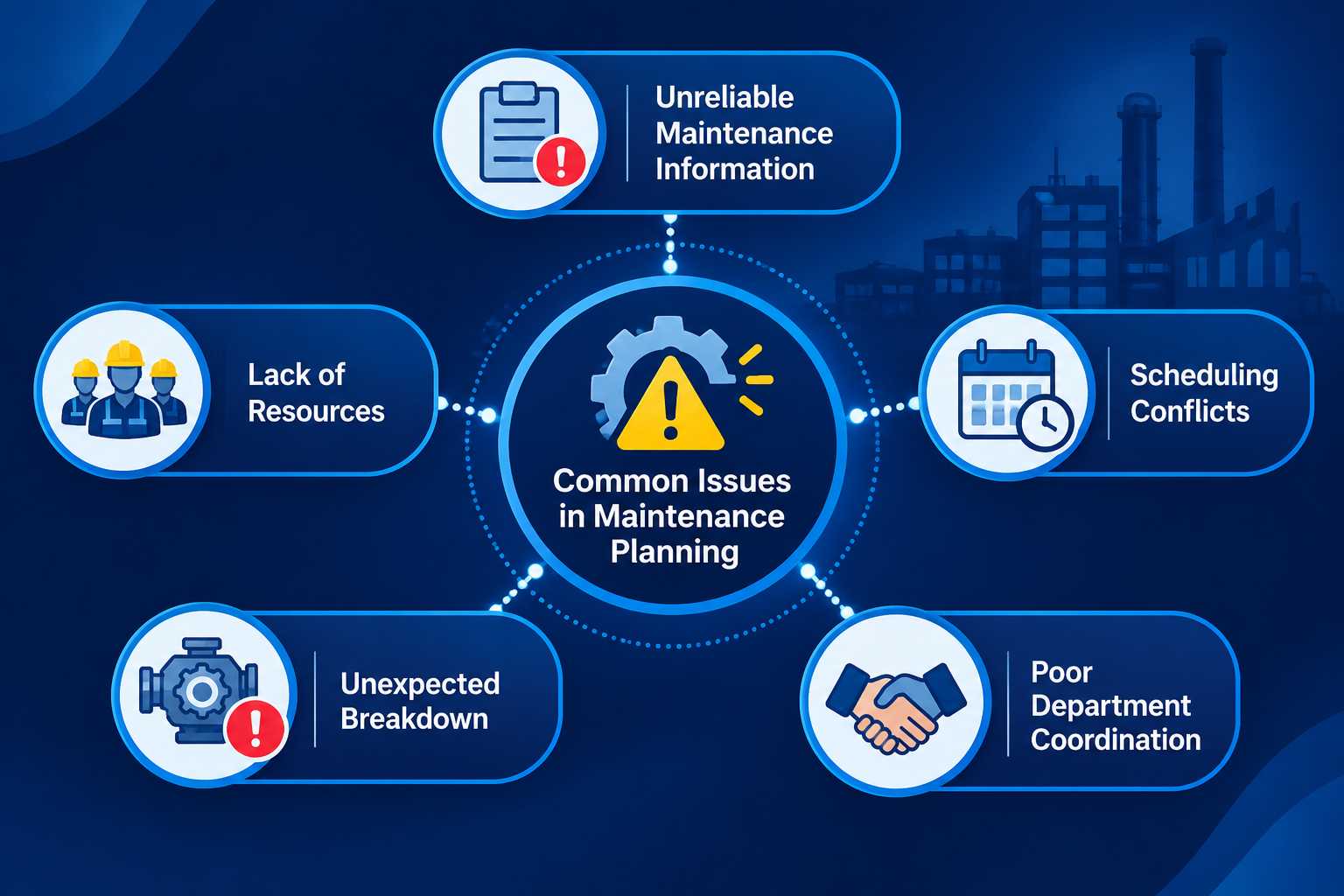
Despite the fact that the processes employed might be organized, there might still be events causing issues with the execution of maintenance plans.
1.Maintenance information is unreliable: There may not be enough records concerning the equipment or descriptions of the problems.
2.The company lacks resources: Due to the shortage of skilled technicians, required spare parts or necessary specialized equipment, the scheduled work might get stopped.
3.The maintenance schedule is not compatible with the production schedule: There might be no time slots for shutdowns, with maintenance work competing for time slots with production.
4.Unexpected breakdown of the equipment: An emergency repair might have an impact on already scheduled maintenance.
5.Bad cooperation between departments: Poor coordination of actions between maintenance, production and procurement teams might lead to failure to implement plans in a timely manner and effectively.
SAP maintenance planning and scheduling involves identifying maintenance requirements, preparing the necessary work and determining when maintenance activities should be performed using SAP maintenance processes.
Maintenance planning defines the work, materials, labour, and resources required. Maintenance scheduling determines when the work will take place based on priorities, equipment availability, and resource capacity.
Work centre capacity represents the available working capacity of a maintenance team or work centre. It helps planners assess whether sufficient resources are available for assigned maintenance activities.
Maintenance orders contain operations, work centre assignments, material requirements, estimated durations and scheduling information. These details help maintenance teams organise and coordinate maintenance work.
Resource availability helps ensure that technicians, materials, tools and work centres are available when maintenance activities are planned. This reduces scheduling conflicts and unnecessary delays.
The planning and scheduling of maintenance using SAP enables companies to effectively meet their requirements for maintenance, provide resources and plan maintenance activities in line with operational needs. With the proper implementation of the structured planning stages and the examination of work centers, as well as resource availability, maintenance teams can enhance their readiness and performance in terms of maintenance work execution.
SAP PM helps to enhance maintenance visibility and to manage the work related to the equipment through the application of the functions of SAP PM such as maintenance notifications, maintenance orders, and work centers.
By Team Prompt Edify
Have any enquiry? Call us
+(27) 740294414
(+91) 99932-86938
wecare@promptedify.com


Prompt Edify Africa (PTY) Limited
2nd Floor, Rivonia VillageCnr Mutual Road and Rivonia Boulevard Rivonia Village, 2191
Johannesburg , South Africa
Contact : +27740294414
Prompt Edify East Africa Limited
KN 78 ST, Kagarama, Kigali, Kigali, Nyarugenge, Umujyi wa Kigali, Rwanda
Contact : +250 727 845 771
Prompt Edify Private Limited
4th Floor #15, City Vista Tower, Fountain Road,
Kharadi, Pune(MH), India.
PIN- 411014
Contact : (+91) 99932 86938



Contact Us Today!
+27740294414 | (+91) 99932 86938 | +250 727 845 771
contact@promptedify.com | wecare@promptedify.com
🌐 https://promptedify.co.za/