
Learn about SAP Manufacturing Execution Training, key MES modules, shop-floor workflows, production monitoring, traceability, quality and ERP integration skills.
The manufacturing firms have used advanced technology to control production activities and improve product quality. There should be an efficient system of monitoring, managing, tracking and controlling production operations. SAP Manufacturing Execution (SAP ME) is helpful in this regard to organize these production activities.
In case of individuals interested in making a career in manufacturing technology, the SAP Manufacturing Execution Training is one such learning opportunity. It assists them to learn about how manufacturing operations are performed and how software assists in daily production operations.
Before taking a training course, it is very important to know the curriculum of the course. It is supposed to include MES basics, production process flows, data acquisition, quality management, product traceability, and integration with ERP systems.
Let us analyze the important modules and skills that should be included in an SAP ME training course.
Module one will be an introduction to Manufacturing Execution Systems (MES). MES involves software used by organizations in controlling and monitoring manufacturing operations in the shop floor.
The students will gain insight into the relationship that exists between business planning and manufacturing using MES. Reasons why manufacturing organizations use MES will also be explained.
Topics to be covered will include:
This particular module will be beneficial to those who have no background in manufacturing execution systems.
After understanding the concepts related to MES, it is essential for the learners to be aware of the basic architecture of SAP ME. This module will help the learners to know how the system works and how the different components of the system help in manufacturing processes.
The SAP ME course curriculum should cover the topics such as:
It is necessary for the learners to have knowledge about how production data can be stored in SAP ME.
Shop floor processes are an essential part of the SAP Manufacturing Execution course contents. This module covers how the products go through the manufacturing process stages.
The students need to have knowledge of how the production orders are managed, as well as the operators' actions on the shop floor.
Key SAP ME training includes:
Practical examples will help the learner comprehend how the product goes through one manufacturing process to another.
Correct production information is necessary for manufacturing firms to conduct their operations on a day-to-day basis. Monitoring production enables managers to know what is going on in the factory floor.
In this module, students will learn how production information is gathered and used in monitoring production performance.
Some of the issues that the discussion should cover include:
The quality of the product is a very crucial aspect in manufacturing. The manufacturers need to ensure that their products meet the required quality standards and that their production activities are traceable when necessary.
An effective curriculum for MES training should address the aspects of product traceability and quality management.
Some of the topics covered include:
SAP ME is not a stand-alone application; it has the capability to communicate with enterprise applications such as SAP ERP, linking production activities with the business process.
This topic covers the ways in which information flows between shop floor and business applications.
Students should cover the following areas:
The topic of integration will help students appreciate the link between production and other business processes.
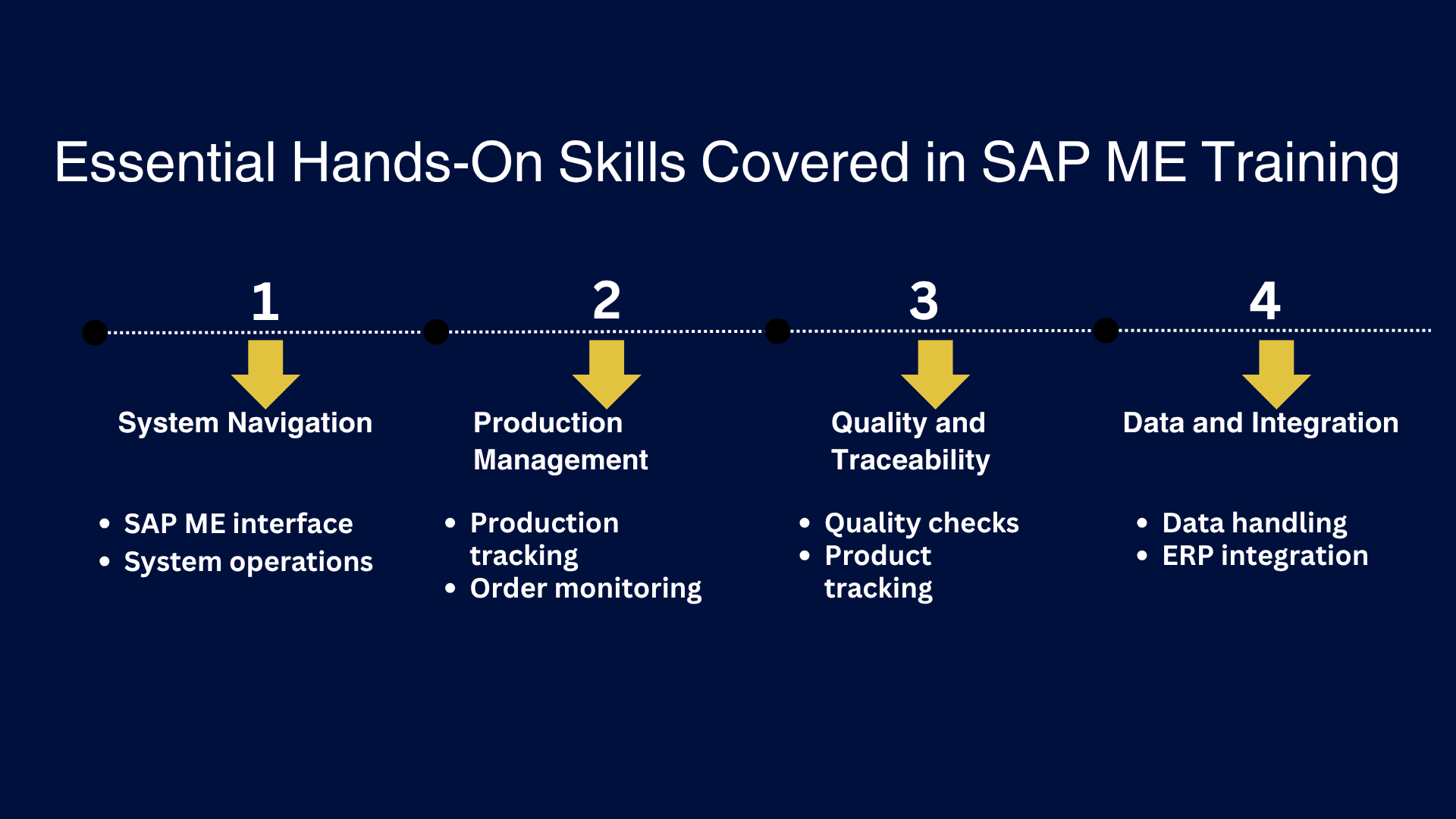
A proper SAP Manufacturing Execution Training course would be one which provides learners with both practical learning and theoretical learning.
The learner must be able to gain an understanding of the functions of the system by means of demonstration, exercise and manufacturing examples.
Some of the critical skills that the training program can impart would include:
Selection of the right course is a crucial step for any learner who wishes to learn about manufacturing execution technology.
Prior to taking the course, the learner should ensure that the course addresses all the required modules. The syllabus should elaborate on both basics and advanced concepts in layman terms.
It would be useful to select those trainers who are able to describe manufacturing processes using practical examples.
Regarding manufacturing execution training for beginners, it would be useful to consider courses that cover MES fundamentals first.
SAP Manufacturing Execution aids organizations in managing their production processes, tracking their shop floor operations, collecting data from their manufacturing process, and making their products traceable. Understanding these concepts will aid professionals in understanding the functioning of current manufacturing systems.
A comprehensive syllabus for an SAP ME training course must include topics such as MES basics, SAP ME architecture, shop floor processes, production process monitoring, data collection, quality management, traceability, and ERP integration.
For professionals who are planning to gain knowledge on this subject, choose an SAP ME training course which provides comprehensive syllabus coverage.
Wish to know more about SAP Manufacturing Execution training course?
Get in touch with Prompt Edify to know more about the syllabus, training, learning methodology, and options available.
By Team Prompt Edify
Have any enquiry? Call us
+(27) 740294414
(+91) 99932-86938
wecare@promptedify.com


Prompt Edify Africa (PTY) Limited
2nd Floor, Rivonia VillageCnr Mutual Road and Rivonia Boulevard Rivonia Village, 2191
Johannesburg , South Africa
Contact : +27740294414
Prompt Edify East Africa Limited
KN 78 ST, Kagarama, Kigali, Kigali, Nyarugenge, Umujyi wa Kigali, Rwanda
Contact : +250 727 845 771
Prompt Edify Private Limited
4th Floor #15, City Vista Tower, Fountain Road,
Kharadi, Pune(MH), India.
PIN- 411014
Contact : (+91) 99932 86938



Contact Us Today!
+27740294414 | (+91) 99932 86938 | +250 727 845 771
contact@promptedify.com | wecare@promptedify.com
🌐 https://promptedify.co.za/