
Explore SAP Manufacturing Integration Training, key modules, ERP connectivity, shop-floor workflows, data exchange, monitoring, troubleshooting, and practical skills.
Manufacturing companies employ different software programs to control production, materials, inventories, and their operations. For the proper coordination of these activities, these programs must interact among themselves. SAP Manufacturing Integration facilitates interaction between enterprise application programs and shop floor systems for exchanging important information about production.
SAP Manufacturing Integration Training will be beneficial for learners who are keen to learn about manufacturing technologies. This training will expose learners to integration concepts as well as exchange of business information between enterprise systems and manufacturing applications.
Before enrolling in a training program, one must be aware of the syllabus, important modules, practical training, and learning objectives. Let us discuss some of the topics that must be covered by a good training program.
The first module should focus on basic principles of manufacturing integration. It is necessary that learners comprehend reasons why organizations need to integrate their business applications and manufacturing processes.
Manufacturing integration allows different organizational units to exchange information and better organize production activities.
Some issues to cover:
Learning Objective: Learners are aware of basic principles of manufacturing integration and its importance for contemporary manufacturing companies.
SAP manufacturing integration solutions are covered in this module to provide learners knowledge on SAP solutions that are used for integration between business and production processes.
SAP manufacturing integration course content should address how SAP systems communicate with manufacturing systems.
Some of the key subjects that need to be covered are:
Learning outcome: Learners know how SAP integration solutions facilitate communication between enterprise and manufacturing systems.
ERP connectivity is one of the significant lessons taught in any manufacturing integration course. The Enterprise system handles production planning, material, inventory, and information management.
The learners must be aware of the way manufacturing systems integrate with SAP ERP and SAP S/4HANA.
Topics to cover include:
Learning Outcome: The learner learns the process of sharing production and material information from enterprise systems into the manufacturing systems.
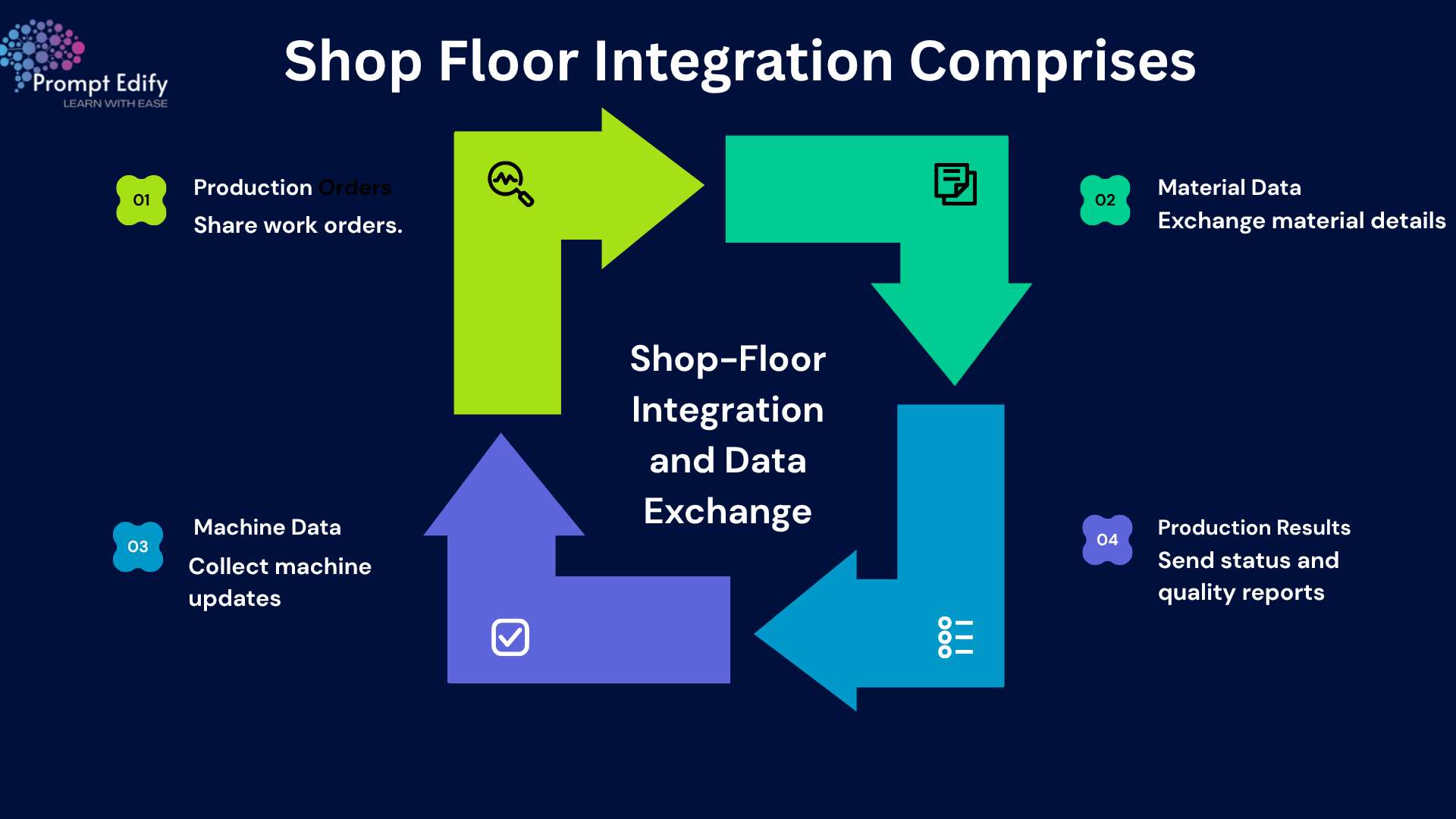
Shop floor integration comprises production process integration and enterprise application processes integration. The production process is made capable of communicating with machines, operators, and production processes.
This is an important part of SAP manufacturing integration training.
Important shop floor integration comprises:
Outcome of learning: Learners will be aware of shop floor information integration with enterprise systems.
A good learning program should stress on how the manufacturing process works and why integration plays an important role in this production process.
The learners will have to learn about the information flow process from production planning to manufacturing.
Topics to be covered are:
Learning outcome: The learners learn about systems integration in the production process.
The software SAP Manufacturing Integration and Intelligence (SAP MII) is used for connecting manufacturing systems to enterprise systems.
Learners need to be familiar with its basic functionality and how it helps to exchange manufacturing data.
Some of the most typical SAP MII training areas are:
Learning Outcome: Learners get an overview of SAP MII concepts and manufacturing integration scenarios.
There may be instances where integration issues will hinder production activities as well as data communication. Hence, troubleshooting should also be included in the course curriculum.
It is necessary for learners to know how to detect common communication and data transmission problems.
The following are some topics that learners need to learn about:
Learning outcome: Learners learn about common integration problems and how to troubleshoot them.
Digitalization is currently being utilized by existing manufacturing organizations in order to attain production transparency and efficiency.
SAP Digital Manufacturing Training will expose the trainees to various applications of manufacturing in the current manufacturing environment.
This will include:
The trainees will also be offered an opportunity to get insights on the integration process through demonstrations.
Learning Outcome: The trainees will understand the basics of digital manufacturing and the significance of application integration in current manufacturing environments.
Before taking up the training, one should verify if the course includes major topics on integration. Some of the topics that should be present in the curriculum include ERP connectivity, communication between the shop floor, manufacturing processes, production process monitoring, and problem-solving.
Trainees should look for instructors who are able to simplify complex technical aspects through illustration.
Those who are new to manufacturing and integration should go for courses that start with basic manufacturing processes.
The purpose of SAP Manufacturing Integration Training is to make the learners familiar with the communication process between enterprise systems and shop floor systems. Some topics that must be covered in a comprehensive training program include:
SAP ERP Connectivity, SAP S/4HANA Integration, Shop Floor Data Exchange, Manufacturing Process, SAP MII, Monitoring, and Troubleshooting.
These topics form the basics of understanding the concept of connected manufacturing systems.
Interested in learning about SAP Manufacturing Integration Training?
Get in touch with Prompt Edify for the details of the course curriculum, training modules, hands-on learning experience, and training programs available.
By Team Prompt Edify
Have any enquiry? Call us
+(27) 740294414
(+91) 99932-86938
wecare@promptedify.com


Prompt Edify Africa (PTY) Limited
2nd Floor, Rivonia VillageCnr Mutual Road and Rivonia Boulevard Rivonia Village, 2191
Johannesburg , South Africa
Contact : +27740294414
Prompt Edify East Africa Limited
KN 78 ST, Kagarama, Kigali, Kigali, Nyarugenge, Umujyi wa Kigali, Rwanda
Contact : +250 727 845 771
Prompt Edify Private Limited
4th Floor #15, City Vista Tower, Fountain Road,
Kharadi, Pune(MH), India.
PIN- 411014
Contact : (+91) 99932 86938



Contact Us Today!
+27740294414 | (+91) 99932 86938 | +250 727 845 771
contact@promptedify.com | wecare@promptedify.com
🌐 https://promptedify.co.za/