
Explore SAP MM to understand procurement, inventory management, material master data, supplier processes, and integration across SAP ERP and SAP S/4HANA.

This is where SAP MM (materials management) comes in. SAP MM assists in managing the process of procurement and stocking as well as connecting the processes of material to other business functions. As a core component of SAP ERP and SAP S/4HANA, SAP MM provides good control over purchasing, inventory, and material management.
SAP MM (Materials Management) is a module of SAP that is intended for management of procurement and inventory management in an organization. It includes the entire process of material management, which begins from recognizing the material requirements and purchasing materials to receiving and storing materials.
This module enables organizations to manage material data, supplier data, create purchase orders, manage material movement, and keep record of the inventory. It ensures that purchasing and warehousing staff have access to correct and up-to-date information.
Let us consider an example of a manufacturing company where raw material is required to manufacture finished goods. SAP MM enables the purchasing department to recognize material requirements, choose the suppliers, make purchase orders, and record the incoming materials while the warehousing department gets to know the available stock and issue materials for manufacturing.
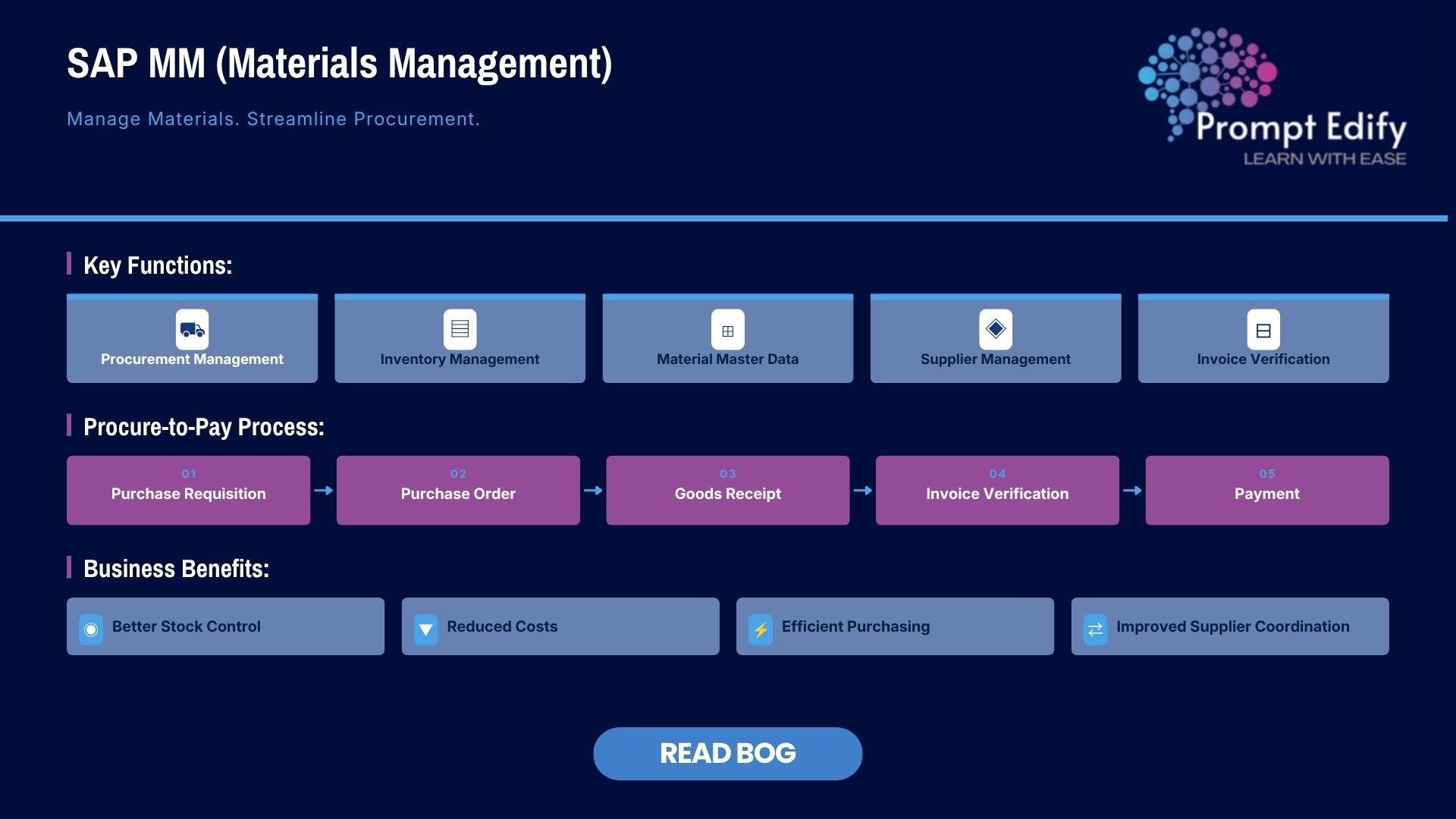
SAP Material Management Core Functions
Some of the key functions of SAP MM are as follows:
The procurement function is one of the core functions of SAP MM. The procurement function of SAP MM assists in managing the whole procurement process, starting from determining requirements till placing orders with the suppliers.
Some of the major activities performed by the procurement module of SAP MM are:
The inventory management enables organizations to track the number and flow of material within various storage locations. The SAP MM provides up-to-date details about stocks that enable the organization to know what is available, what is received, and what is issued.
Key processes involved are:
Material master data is the repository of all the data necessary in regard to the materials in the organization. This will be the main source of all data relating to materials required in various processes within the organization.
The data relating to material master includes description of the material, unit of measure, purchase data, stock data, valuation data, and planning data.
The proper maintenance of the material master data will help the purchasing department, inventory control department, production department, and finance department work on the same data.
Invoice verification involves the integration of procurement and finance functions. When an invoice is received from the supplier, the SAP MM software will help verify the invoice in terms of purchase orders and goods received data.
The SAP MM system allows for the management of purchasing information related to suppliers, which includes pricing of the materials, purchasing conditions, and other supplier related information.
SAP MM contains various business processes that are interconnected. P2P process can be regarded as one of the significant business processes where the procurement process from need recognition to payment of invoices is included.
Below are the following steps followed in the procurement process:
Inventory Replenishment process is one of the significant processes for tracking of inventories and planning procurement.
This module is required since there is a great connection between the MM functions inside the SAP program and many business processes.
In SAP ERP, the MM module interacts with other modules, providing integrated business processes opportunities.
Materials management in SAP S/4HANA is the integration of material management into the digital ERP system when using the SAP HANA in-memory database technology.
Some changes were introduced in SAP S/4HANA regarding the data model and user experience. For instance, procurement and inventory management can be performed through SAP Fiori applications.
It is worth mentioning, however, that despite the importance of procurement and inventory management basics, SAP ECC users planning SAP S/4HANA migration should know about new processes and applications.
SAP MM helps the business organizations perform material-related activities more effectively and accurately. It is not only procurement and warehouse management where SAP MM becomes important for the business.
Main benefits that SAP MM brings to the business are listed below:
SAP MM module is very important in SAP ERP and SAP S/4HANA because it is the bridge connecting procurement, inventory management, and material related business processes. The module helps organizations have more control in material management by helping them process purchase orders, receipt of materials and vendor invoices validation.
Understanding SAP Material Management helps one understand the connection of purchasing and inventory with manufacturing, sales, quality and financial processes.
At Prompt Edify, people are given the chance to understand SAP concepts and SAP modules through SAP MM training and SAP Training Hub.
Understand SAP through SAP Training by Prompt Edify.
By Team Prompt Edify
Have any enquiry? Call us
+(27) 740294414
(+91) 99932-86938
wecare@promptedify.com


Prompt Edify Africa (PTY) Limited
2nd Floor, Rivonia VillageCnr Mutual Road and Rivonia Boulevard Rivonia Village, 2191
Johannesburg , South Africa
Contact : +27740294414
Prompt Edify East Africa Limited
KN 78 ST, Kagarama, Kigali, Kigali, Nyarugenge, Umujyi wa Kigali, Rwanda
Contact : +250 727 845 771
Prompt Edify Private Limited
4th Floor #15, City Vista Tower, Fountain Road,
Kharadi, Pune(MH), India.
PIN- 411014
Contact : (+91) 99932 86938



Contact Us Today!
+27740294414 | (+91) 99932 86938 | +250 727 845 771
contact@promptedify.com | wecare@promptedify.com
🌐 https://promptedify.co.za/