
Learn about SAP PLM modules, product structures, document management, engineering changes, and product development concepts to choose the right training.
Product development entails various processes such as planning, design, engineering, documentation, and product lifecycle management. Companies require proper mechanisms to help them in handling product information and coordinating the processes among various departments. This is where SAP Product Lifecycle Management (SAP PLM) comes in handy.
Those who wish to learn how to develop products and enterprise technology will find it useful to learn about SAP PLM modules. Prior to joining any training course, trainees must be aware of the various modules involved in the course.
SAP PLM (Product Lifecycle Management) is a suite of functionalities which help organizations manage their product-related information and processes from the beginning till the end of the product lifecycle.
This covers activities like planning, design, manufacturing and making changes in the products. The system facilitates collaboration among engineering, manufacturing and other business functions. It ensures that the product information is connected.
This knowledge about SAP PLM will help learners understand how the enterprise systems manage product information.
A structured learning module must acquaint learners with the key functional areas of SAP PLM.
Some of the key modules of SAP Product Lifecycle Management are:
Such key functional areas will assist learners in comprehending the process of creation, maintenance, updating, and exchange of product information.
Product Data Management is among the basic topics that the learner needs to know when studying SAP PLM.
This topic emphasizes the management of product information that entails material information, product specifications, engineering information, and other product information.
SAP PLM product data management ensures that product information is consistent and available to the respective business units.
For instance, when a team of engineers creates a new product, there is a need for the product information to reach the manufacturing unit and procurement unit, among others.
Learners need to understand the process of product data management.
Product structure gives an account of how various components and materials combine to make the finished product.
Bill of Materials (BOM) includes information regarding the various components and materials used to make the product.
For instance, an automobile has a variety of components such as the engine, transmission system, electrical systems, and body components. The component itself could be made up of several sub-components.
An effective SAP PLM training session would include an explanation of the organization of product structures, the management of BOM information, and the impact of changes in products on the components.
Modification of products may take place due to advancements in designs, quality problems, customer feedback, or even manufacture-related problems.
The SAP engineering change management process can be useful to firms in effectively managing their product modifications.
It is important that students understand the basic terminologies, including:
An example of where there is a need to modify a product is when the firm decides to replace its parts with a better one.
Document management is another aspect that falls within SAP PLM.
The company will be facing a range of document issues concerning its products like engineering drawings, technical data, design, and manufacturing documents.
The learner needs to know how these documents are categorized and associated with product data.
Product development issues are equally critical. They help the learner grasp the concept of how ideas flow from designing through engineering, validating, and making the product ready for manufacture.
The proper structure for learning will be how people work together to exchange product information during development activities.
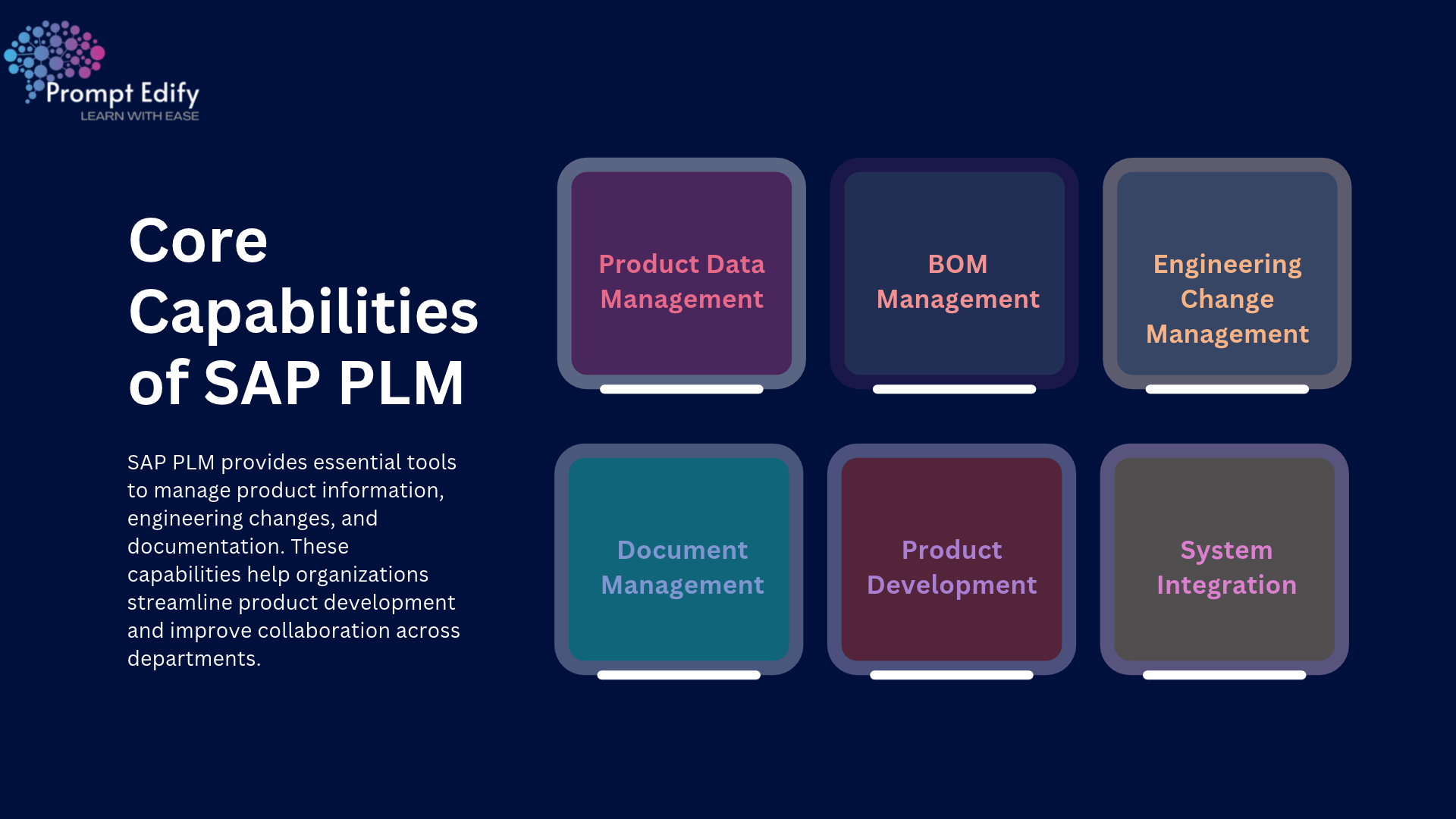
It is necessary for one to be aware of the key SAP PLM functionalities for them to understand how the system enables product life cycle activities.
Some of the key SAP PLM functionalities are:
It should be noted that SAP PLM is not a standalone system. Information related to products may have to be integrated with other enterprise systems and processes.
This could mean, for instance, that integration with SAP ERP would allow the connection of product data with such processes as purchasing, planning, logistics, and production.
In this way, learners are expected to get familiarized with the ways product data contributes to business processes and the significance of integration in managing the entire product lifecycle.
Before enrolling in a class, one must have reviewed the SAP PLM course outline and see whether it entails concepts that meet one’s learning objectives.
An appropriate SAP PLM training syllabus would entail the following key concepts: product data management, product structures, engineering change management, document management, and product development.
In addition, one needs to seek practical illustrations, business scenarios, and examples explaining how various SAP PLM functions are applied in organizations.
Key SAP PLM learning areas need to incorporate concepts that not only encompass basic knowledge but also the relationship between various product lifecycle activities.
Instead of opting for courses with more topics, one can consider the learning objectives, practical aspects, instructor advice, and SAP PLM concepts contained in the courses.
SAP PLM modules will help the learners to learn how products' information is managed, engineering change management, documentation, and product development processes are carried out. Product Data Management (PDM), Bill Of Material (BOM) structures and system integration are among the capabilities provided by SAP PLM which make for better coordination of product lifecycle management.
The choice of training program is one of the ways that can help the learner gain solid knowledge of SAP PLM.
Want to learn more about SAP PLM? Get in touch with Prompt Edify for SAP PLM training programs.
By Team Prompt Edify
Have any enquiry? Call us
+(27) 740294414
(+91) 99932-86938
wecare@promptedify.com


Prompt Edify Africa (PTY) Limited
2nd Floor, Rivonia VillageCnr Mutual Road and Rivonia Boulevard Rivonia Village, 2191
Johannesburg , South Africa
Contact : +27740294414
Prompt Edify East Africa Limited
KN 78 ST, Kagarama, Kigali, Kigali, Nyarugenge, Umujyi wa Kigali, Rwanda
Contact : +250 727 845 771
Prompt Edify Private Limited
4th Floor #15, City Vista Tower, Fountain Road,
Kharadi, Pune(MH), India.
PIN- 411014
Contact : (+91) 99932 86938



Contact Us Today!
+27740294414 | (+91) 99932 86938 | +250 727 845 771
contact@promptedify.com | wecare@promptedify.com
🌐 https://promptedify.co.za/